Biomedical Engineering Scope in Pakistan
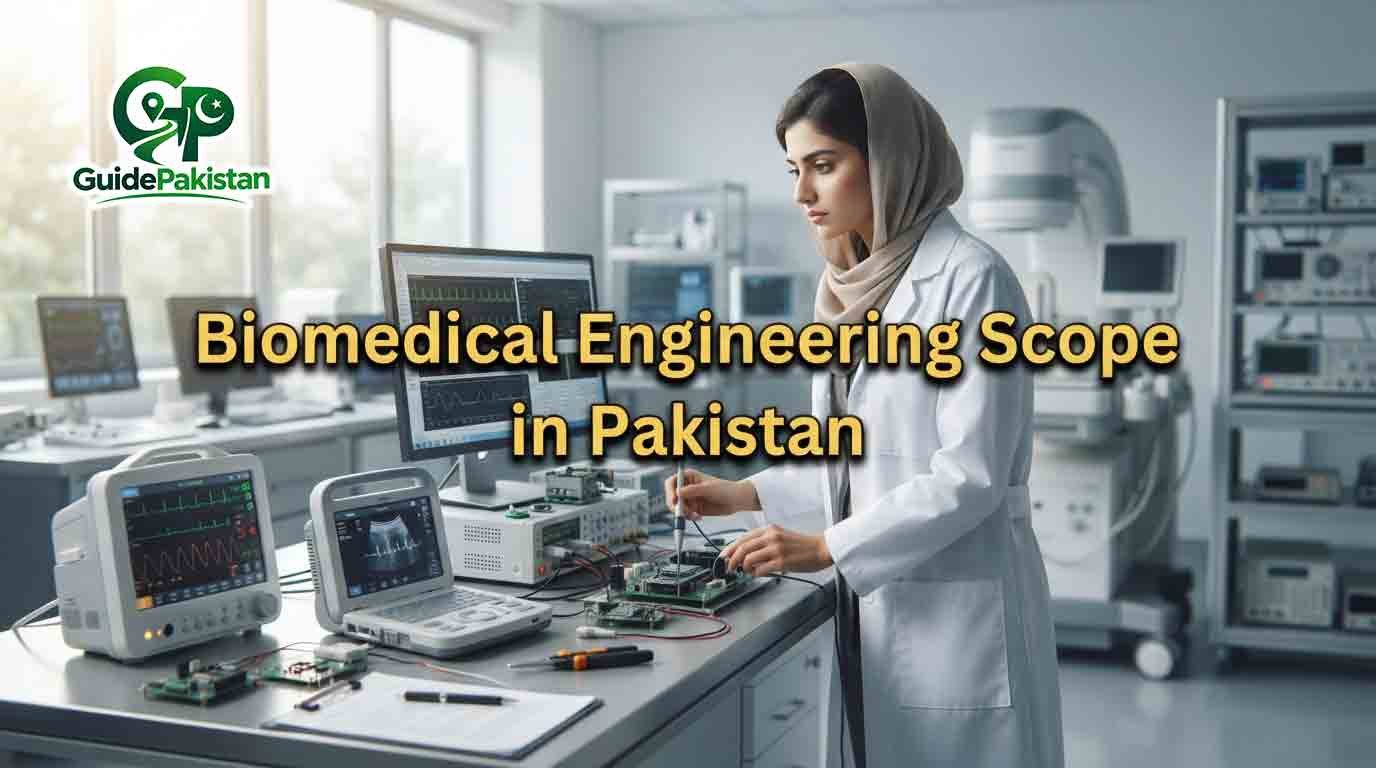
Biomedical Engineering Scope in Pakistan
Biomedical Engineering is an interdisciplinary engineering field that combines engineering, medicine, biology, electronics, computing, materials science and other related disciplines to develop technologies that improve healthcare. In Pakistan, the field is becoming increasingly important as hospitals, diagnostic centers, medical-device companies, research institutions and healthcare organizations depend on sophisticated equipment and digital technologies.
A biomedical engineer can work with medical equipment, diagnostic systems, patient-monitoring technologies, rehabilitation devices, medical imaging, biomedical electronics, biomaterials, prosthetics, healthcare software, research and technical support. The field is particularly suitable for students who are interested in both engineering and healthcare but do not necessarily want to become doctors.
In Pakistan, universities offer undergraduate Biomedical Engineering programs with different curricula and admission requirements. For example, UET Lahore's Biomedical Engineering curriculum is a four-year, eight-semester program with 138 credit hours, while NED University of Engineering and Technology offers a four-year Bachelor of Engineering in Biomedical Engineering requiring 136 credit hours.
What Is Biomedical Engineering?
Biomedical Engineering applies engineering principles to medical and biological problems. A biomedical engineer may help design, install, test, maintain, improve or research technologies used in healthcare.
The discipline brings together areas such as:
-
Electrical and electronic engineering
-
Mechanical engineering
-
Computer programming
-
Medical sciences
-
Human anatomy
-
Human physiology
-
Biology
-
Biochemistry
-
Materials science
-
Signal processing
-
Medical imaging
-
Artificial intelligence
-
Data analysis
-
Rehabilitation technology
NED University describes Biomedical Engineering as a combination of engineering problem-solving with medical, physical, chemical, biological and computational sciences. Its department identifies areas including rehabilitation engineering, biomaterials and tissue engineering among the field's applications.
Biomedical Engineering Scope in Pakistan
The scope of Biomedical Engineering in Pakistan can be considered promising, but it is important to understand the nature of the Pakistani job market.
Biomedical Engineering is a specialized field. It does not have the same number of vacancies as broad engineering or computing disciplines. However, graduates can compete for positions related to medical equipment, healthcare technology, technical services, hospital engineering departments, medical-device companies, research and development, quality assurance, sales engineering and technical support.
The growth of modern healthcare technology creates a need for professionals who understand both medical equipment and engineering systems.
Biomedical engineers can potentially work in:
-
Hospitals
-
Diagnostic laboratories
-
Medical-device companies
-
Medical equipment suppliers
-
Pharmaceutical and healthcare companies
-
Research organizations
-
Universities
-
Government healthcare institutions
-
Healthcare technology companies
-
Rehabilitation centers
-
Medical imaging organizations
-
Technical service companies
-
Biomedical equipment maintenance departments
-
Regulatory and quality-related roles
-
Entrepreneurship and medical-device businesses
Pakistan Engineering Council material also describes biomedical engineers as professionals who may work in hospitals, pharmaceutical companies, medical-device and testing companies, government agencies, universities and medical schools.
Why Biomedical Engineering Is Important in Pakistan
Modern hospitals use a large variety of sophisticated equipment. Examples include patient monitors, ventilators, infusion systems, ECG machines, ultrasound systems, imaging equipment, laboratory equipment and other electronic and computerized medical technologies.
These technologies require people who understand how engineering systems work and how they are used in healthcare environments.
A biomedical engineer can contribute by helping organizations:
-
Select appropriate equipment
-
Evaluate technical specifications
-
Install equipment
-
Test equipment
-
Maintain equipment
-
Troubleshoot technical problems
-
Coordinate with vendors
-
Train users
-
Monitor equipment performance
-
Participate in technology management
-
Develop new healthcare technologies
-
Conduct research
-
Improve rehabilitation technologies
The exact responsibilities depend on the employer and the individual's specialization.
Major Areas of Biomedical Engineering
Biomedical Engineering is not limited to hospital equipment maintenance. It contains several specialized areas.
1. Biomedical Electronics
Biomedical electronics focuses on electronic systems used in healthcare.
Students may study circuits, sensors, instrumentation and electronic systems that can be applied to medical devices.
This area can be useful for students interested in electronics and medical technology.
2. Medical Instrumentation
Medical instrumentation involves systems used to measure physiological signals and other patient-related information.
Examples include technologies associated with:
-
ECG
-
Blood pressure monitoring
-
Patient monitoring
-
Temperature measurement
-
Oxygen monitoring
-
Other physiological measurements
A biomedical engineer needs to understand both the technical system and the medical application.
3. Medical Imaging
Medical imaging is an important area of modern healthcare technology.
Depending on education and specialization, biomedical engineers may work around technologies associated with:
-
Ultrasound
-
X-ray systems
-
CT
-
MRI
-
Nuclear medicine
-
Digital imaging
-
Image processing
Biomedical engineering education can include biomedical signals and imaging. UET Lahore's current postgraduate admission information, for example, lists biomedical signals and imaging among core Biomedical Engineering subject areas.
4. Rehabilitation Engineering
Rehabilitation engineering develops or applies technologies that help people with disabilities or physical limitations.
Potential applications include:
-
Prosthetic devices
-
Orthotic devices
-
Assistive technologies
-
Rehabilitation equipment
-
Mobility-related technologies
NED University identifies rehabilitation engineering as one of the major areas within Biomedical Engineering.
5. Biomaterials
Biomaterials are materials designed or selected for use in medical applications.
Students interested in materials and medical applications can explore this specialization through higher education and research.
6. Tissue Engineering
Tissue engineering combines engineering and biological sciences to investigate ways of repairing or regenerating damaged tissues.
This is generally more research-oriented and may require postgraduate education for advanced professional work.
7. Biomedical Signals and Signal Processing
Medical devices can generate large amounts of physiological information.
Biomedical engineers may study techniques for processing and interpreting signals obtained from the human body.
This area connects Biomedical Engineering with electronics, mathematics, programming and data analysis.
8. Healthcare Artificial Intelligence
Artificial intelligence is becoming increasingly relevant to healthcare technology.
Biomedical engineers with additional skills in:
-
Python
-
Machine learning
-
Data analysis
-
Computer vision
-
Signal processing
-
Medical imaging
can explore research and technology-development opportunities at the intersection of AI and healthcare.
This is an emerging specialization rather than a guarantee of employment.
9. Healthcare Software and Digital Health
Biomedical Engineering increasingly overlaps with digital health.
NED University, for example, offers postgraduate study in Digital Health alongside its Biomedical Engineering programs.
Students interested in this area can develop skills in programming, databases, data analysis, health information systems and digital healthcare technologies.
10. Medical Equipment Management
Hospitals need systematic management of medical equipment.
Biomedical engineers may become involved in:
-
Equipment inventories
-
Maintenance planning
-
Technical evaluation
-
Vendor coordination
-
Equipment installation
-
Performance checks
-
Troubleshooting
-
Replacement planning
This can be one of the more practical career directions for graduates entering healthcare organizations.
Biomedical Engineering Subjects in Pakistan
The exact curriculum depends on the university, but students generally study a mixture of engineering, computing, mathematics, biology and medical sciences.
UET Lahore's current curriculum includes subjects such as Applied Physics, Computing Fundamentals, Electric Circuits, Human Physiology and Anatomy, Programming, Biomedical Electronics, Digital Logic Design, Biochemistry, Cellular and Molecular Biology, Biomaterials and Design.
Typical subject areas can include:
-
Engineering mathematics
-
Physics
-
Chemistry
-
Biology
-
Human anatomy
-
Human physiology
-
Electrical circuits
-
Electronics
-
Digital logic
-
Programming
-
Biomedical electronics
-
Biomedical instrumentation
-
Biomaterials
-
Biochemistry
-
Biomechanics
-
Biomedical signals
-
Medical imaging
-
Control systems
-
Medical device design
-
Engineering design
-
Research methods
-
Final-year design project
Students should check the curriculum of the specific university because course names and credit hours can change.
Duration of Biomedical Engineering Degree
A Bachelor of Biomedical Engineering or Biomedical Engineering-related engineering degree normally takes about four years in Pakistan.
For example, NED University states that its Bachelor of Engineering in Biomedical Engineering is a four-year program with 136 credit hours.
UET Lahore's current Biomedical Engineering curriculum is also structured over four years and eight semesters, with 138 credit hours.
Some universities may use B.E., B.Sc. or BS terminology depending on their program and institutional structure.
Eligibility for Biomedical Engineering in Pakistan
Eligibility depends on the university.
For example, NED University's current undergraduate information states that applicants need HSC Part I and II or an equivalent qualification with at least 60% aggregate marks. It lists Pre-Engineering, Pre-Medical and Computer Science combinations among acceptable subject backgrounds.
Riphah International University's current B.Sc. Biomedical Engineering information lists F.Sc. Pre-Medical, Pre-Engineering, ICS, relevant DAE and A Levels among eligible backgrounds, with a minimum of 60% for Pakistani applicants.
Therefore, students should not assume that one university's eligibility rules apply everywhere.
Before applying, check:
-
Required Intermediate group
-
Minimum percentage
-
Entry-test requirement
-
University admission test
-
Subject requirements
-
Equivalence requirements for A Levels
-
DAE eligibility
-
Current admission advertisement
Can Pre-Medical Students Study Biomedical Engineering?
In some Pakistani universities, Pre-Medical students can apply to Biomedical Engineering.
NED University's current eligibility information specifically lists Pre-Medical with Biology, Physics and Chemistry among the acceptable subject combinations for its Biomedical Engineering program.
However, students from Pre-Medical backgrounds should understand that Biomedical Engineering remains an engineering degree.
They may have to deal with mathematics, electronics, programming, circuits and other engineering subjects.
Therefore, a Pre-Medical student who is interested in Biomedical Engineering should be comfortable learning mathematics, physics, computing and engineering concepts.
Best Universities for Biomedical Engineering in Pakistan
Students should evaluate universities based on the current status of the particular program, faculty, laboratories, curriculum, practical training, research opportunities, location and accreditation.
Some institutions with Biomedical Engineering-related programs or documented academic activity include:
UET Lahore
The University of Engineering and Technology Lahore has a Department of Biomedical Engineering and offers a four-year undergraduate program. Its department describes the program as preparing graduates for healthcare research and industry.
NED University of Engineering and Technology
NED University in Karachi offers a four-year Bachelor of Engineering in Biomedical Engineering. Its current undergraduate page provides eligibility and program structure information.
Riphah International University
Riphah offers a B.Sc. Biomedical Engineering program at campuses in Islamabad and Lahore. Its current program page lists an eight-semester, 138-credit-hour degree and provides current admission information.
Other Institutions
Other Pakistani universities and institutions have offered Biomedical Engineering programs at different times. However, program availability and accreditation can change.
Students should always verify the current intake and accreditation status directly with the university and the Pakistan Engineering Council before paying admission fees.
The Pakistan Engineering Council's accreditation database shows historical accreditation information for Biomedical Engineering programs and specific batches, demonstrating why checking the exact university and intake year is important.
Accreditation Matters
Accreditation is extremely important when choosing an engineering degree.
A student should not select a Biomedical Engineering program simply because the university advertises the degree.
Before admission, verify:
-
Whether the program is currently offered.
-
Whether the specific intake/batch is accredited where applicable.
-
The relevant accreditation status.
-
The university's current admission information.
-
The degree-awarding status.
-
Any requirements for professional registration.
The Pakistan Engineering Council publishes information about accredited engineering programs and batches. Students should use the official PEC information rather than relying only on advertisements or social media posts.
Career Options After Biomedical Engineering
After completing a Biomedical Engineering degree, graduates can consider several career paths.
Biomedical Engineer
A biomedical engineer may work on healthcare technology, medical equipment or engineering projects related to medicine.
Clinical or Hospital Engineer
Depending on the organization's structure and job requirements, graduates may work with hospital equipment, maintenance, procurement and technical management.
Biomedical Equipment Engineer
This role can involve installation, maintenance, troubleshooting and servicing of medical equipment.
Medical Equipment Application Specialist
Some companies need technical professionals who can explain equipment functionality and support healthcare users.
Field Service Engineer
Medical equipment suppliers may employ engineers to install, diagnose and service equipment at customer locations.
Sales Engineer
Biomedical engineers can enter technical sales where knowledge of medical technology is required.
Research Assistant
Graduates interested in research can work with universities, laboratories and research groups.
Product Development Engineer
This career direction focuses on developing or improving medical technologies.
Quality Assurance Professional
Graduates with appropriate additional training can explore quality-related roles in medical-device organizations.
Regulatory Affairs
Medical devices operate in regulated environments. Engineers with relevant knowledge can explore regulatory and compliance roles.
Rehabilitation Technology Specialist
Those interested in prosthetics, orthotics and assistive technology can build careers in rehabilitation engineering.
Healthcare Technology Entrepreneur
A biomedical engineer can also develop a business around medical equipment, healthcare technology, technical services or specialized products, subject to applicable laws and regulatory requirements.
Biomedical Engineering Jobs in Pakistan
Job opportunities can be found in different sectors, including:
-
Public-sector hospitals
-
Private hospitals
-
Diagnostic centers
-
Medical equipment companies
-
Medical device distributors
-
Healthcare technology firms
-
Research institutions
-
Universities
-
Rehabilitation organizations
-
Pharmaceutical and healthcare companies
-
Technical service providers
However, students should understand that job availability varies considerably by city, employer and specialization.
The number of Biomedical Engineering vacancies may be smaller than the number of general engineering or IT vacancies. As a result, students should develop practical skills instead of depending entirely on the degree title.
Skills That Increase Job Opportunities
A Biomedical Engineering degree provides the foundation, but additional technical and professional skills can make a major difference.
Technical Skills
Useful areas include:
-
Electronics
-
Circuit analysis
-
Sensors
-
Medical instrumentation
-
Biomedical equipment
-
Troubleshooting
-
Computer programming
-
Data analysis
-
MATLAB or similar engineering tools
-
Python
-
CAD
-
Signal processing
-
Medical imaging
-
Embedded systems
-
Basic networking
-
Technical documentation
Soft Skills
Employers may also value:
-
Communication
-
Problem-solving
-
Teamwork
-
Time management
-
Report writing
-
Presentation skills
-
Customer handling
-
Technical explanation
-
Project management
A biomedical engineer frequently works between doctors, nurses, technicians, vendors, engineers and management. Communication skills are therefore particularly useful.
Biomedical Engineering and Artificial Intelligence
AI can create additional opportunities for biomedical engineers.
Students who combine Biomedical Engineering with programming and AI can explore:
-
Medical image analysis
-
ECG signal analysis
-
Patient monitoring
-
Predictive healthcare models
-
Computer vision
-
Health data analytics
-
Medical decision-support research
-
Digital health applications
This does not mean every Biomedical Engineering graduate automatically becomes an AI professional. Students need additional training and practical projects.
The interdisciplinary nature of Biomedical Engineering makes it suitable for combining healthcare knowledge with modern computational technologies.
Biomedical Engineering and Medical Equipment Business
Pakistan imports and uses a wide variety of medical technologies.
A biomedical engineer with technical and business knowledge may eventually explore medical equipment supply, installation, maintenance, calibration-related services where legally and technically appropriate, or technical consultancy.
Entrepreneurship can be particularly attractive for graduates who understand both equipment and the needs of healthcare organizations.
However, medical equipment is a specialized and regulated area. Anyone starting a business should verify applicable registration, licensing, procurement and regulatory requirements before operating.
Salary of Biomedical Engineers in Pakistan
There is no single fixed salary for Biomedical Engineers in Pakistan.
Income depends on:
-
Employer
-
City
-
Qualification
-
Experience
-
Technical specialization
-
Job responsibilities
-
Industry
-
Organization size
-
Sales or field-service responsibilities
-
Additional certifications
-
Communication skills
Fresh graduates generally start at different salary levels depending on the organization, while experienced engineers with specialized skills may have significantly better opportunities.
Because salary advertisements change frequently, students should check current job postings rather than relying on old salary figures published online.
GuidePakistan.com recommends treating any fixed salary figure as an estimate unless it comes from a current employer's official vacancy or reliable employment data.
Is Biomedical Engineering Better Than Electrical Engineering?
There is no universal answer.
Electrical Engineering is broader and can lead to careers in power, electronics, telecommunications, control systems, embedded systems and other industries.
Biomedical Engineering is more specialized and connects engineering with healthcare.
A student should consider Biomedical Engineering if they genuinely enjoy:
-
Biology
-
Medical technology
-
Electronics
-
Engineering
-
Healthcare
-
Research
-
Medical devices
A student who wants maximum flexibility across many engineering industries may prefer a broader engineering discipline.
Is Biomedical Engineering Better Than MBBS?
Biomedical Engineering and MBBS are completely different careers.
MBBS prepares students for the medical profession and clinical practice.
Biomedical Engineering prepares students to work with engineering, technology, medical devices, healthcare systems and research.
A student who wants to diagnose and treat patients as a doctor should pursue the appropriate medical education.
A student who is interested in designing, developing, managing or researching healthcare technology may prefer Biomedical Engineering.
Is Biomedical Engineering a Good Career in Pakistan?
Biomedical Engineering can be a good career choice for the right student.
It is particularly suitable for someone who enjoys both engineering and healthcare.
However, students should enter the field with realistic expectations. It is a specialized market, and the degree alone may not guarantee a job.
Students who build strong skills in medical equipment, electronics, programming, AI, imaging, data analysis, research or technical services can improve their career options.
Future of Biomedical Engineering in Pakistan
Pakistan's healthcare sector continues to adopt technology. Hospitals and healthcare organizations increasingly depend on sophisticated equipment and computerized systems.
Potential areas of future development include:
-
Digital health
-
Telemedicine
-
Medical imaging
-
Artificial intelligence
-
Wearable healthcare devices
-
Remote patient monitoring
-
Rehabilitation technology
-
Medical robotics
-
Biomedical research
-
Health data analytics
-
3D printing
-
Biomaterials
-
Tissue engineering
-
Personalized healthcare
The future will likely favor professionals who can combine biomedical knowledge with modern engineering and computing skills.
Higher Education After Biomedical Engineering
Graduates can pursue postgraduate education depending on their academic background and university requirements.
Possible areas include:
-
MS Biomedical Engineering
-
MEng Biomedical Engineering
-
Digital Health
-
Biomedical Sciences
-
Medical Imaging
-
Bioinformatics
-
Biomaterials
-
Biomechanics
-
Artificial Intelligence
-
Signal Processing
-
Rehabilitation Engineering
-
Electronics
-
Control Systems
-
Healthcare Technology
NED University lists postgraduate opportunities including M.Engg. Biomedical Engineering, MS Digital Health and PhD Biomedical Engineering.
Riphah also offers an MS Biomedical Engineering program and states that applicants require relevant 16-year engineering education with the specified academic requirements.
Biomedical Engineering for Students Interested in Research
Biomedical Engineering can be an excellent research field.
Research can involve:
-
Medical devices
-
Biomaterials
-
Biomedical signals
-
Medical imaging
-
Tissue engineering
-
Rehabilitation
-
Artificial intelligence
-
Digital health
-
Computational biology
-
Healthcare robotics
Students interested in research should focus on mathematics, programming, scientific writing, laboratory work and research methodology during their undergraduate degree.
Advantages of Biomedical Engineering
Major advantages include:
-
Interdisciplinary education
-
Connection between engineering and healthcare
-
Multiple specialization options
-
Research opportunities
-
Medical technology exposure
-
Potential for entrepreneurship
-
International study opportunities
-
Compatibility with AI and computing
-
Contribution to healthcare improvement
Challenges of Biomedical Engineering in Pakistan
Students should also understand the challenges.
Specialized Job Market
The number of Biomedical Engineering jobs may be smaller than jobs in broader fields.
Need for Practical Skills
Employers may prefer graduates who can actually work with equipment rather than those who only have theoretical knowledge.
Competition
Graduates may compete for limited specialized positions.
Equipment and Training
Good practical exposure depends heavily on the university's laboratories, internships and industry connections.
Need for Continuous Learning
Medical technology changes rapidly. Engineers must continue learning after graduation.
How to Build a Strong Biomedical Engineering Career
Students can improve their career prospects by following a practical approach.
During university, try to:
-
Understand electronics properly.
-
Learn programming.
-
Develop MATLAB or Python skills.
-
Work on final-year projects seriously.
-
Participate in laboratory work.
-
Complete internships.
-
Learn technical documentation.
-
Understand medical equipment.
-
Develop communication skills.
-
Attend seminars and workshops.
-
Build a professional CV.
-
Create a portfolio of technical projects.
-
Follow developments in medical technology.
-
Explore AI and data analysis.
-
Consider postgraduate education if appropriate.
Final Verdict
Biomedical Engineering has a meaningful and developing scope in Pakistan, but it should be viewed as a specialized engineering career rather than a guaranteed high-paying profession.
The strongest opportunities are likely to be available to graduates who combine their Biomedical Engineering degree with practical technical skills, medical equipment knowledge, programming, data analysis, AI, research or specialized healthcare technology expertise.
For students who genuinely enjoy the combination of engineering and medicine, Biomedical Engineering can be a rewarding choice.
Before admission, however, always verify the university's current program availability, eligibility requirements, fees, admission schedule and relevant accreditation status. Current official university pages and Pakistan Engineering Council information should be treated as the primary sources for these decisions.
Guide Information
Eligibility
Eligibility varies by university. Current examples show that applicants may be accepted from Pre-Engineering, Pre-Medical, ICS, A Levels or relevant DAE backgrounds depending on the institution. NED University currently lists a minimum of 60% aggregate for its Biomedical Engineering program and accepts Pre-Engineering, Pre-Medical and Computer Science combinations. Riphah International University currently lists a minimum of 60% and accepts F.Sc. Pre-Medical, Pre-Engineering, ICS, relevant DAE and A Levels. Students must verify the latest requirements directly with the university before applying.
Required Documents
CNIC or B-Form where applicable
Recent passport-size photographs
Matriculation certificate or result card
Intermediate/HSSC certificate or result card
A Levels certificate and equivalence certificate where applicable
DAE certificate and relevant documents where applicable
IBCC equivalence certificate for foreign qualifications where required
Domicile where required by the university
University admission application form
Admission or entry-test result where applicable
Any additional documents specifically requested by the university
Fees
Biomedical Engineering fees vary significantly by university, campus, credit hours and admission year. Students should check the latest official fee schedule before admission. For example, Riphah's current published first-semester fee information differs between its Islamabad and Lahore Biomedical Engineering offerings, and the university states that fees may be revised. Do not rely on old fee figures when planning admission.
Processing Time
There is no universal processing time for a Biomedical Engineering degree admission. University applications are processed according to the institution's admission schedule, test dates, document verification procedures and merit-list schedule. Students should follow the latest admission calendar of the selected university.WHEN TO APPLY:Biomedical Engineering admissions are generally linked to university admission cycles. Students should monitor the official admission pages of their preferred universities and apply before the published deadline. Admission dates can change each year.
Application Method
The application method depends on the university.
Validity Period
A completed Biomedical Engineering degree does not have a short-term validity period. The qualificat
Step-by-Step Process
- Decide whether Biomedical Engineering matches your interests.
- Understand that Biomedical Engineering combines engineering with medicine and biology.
- Review the major areas of Biomedical Engineering.
- Check your Intermediate or equivalent academic background.
- Identify universities that currently offer Biomedical Engineering.
- Visit the official website of each university.
- Open the latest undergraduate admission information.
- Check the current eligibility criteria.
- Check whether your subject combination is accepted.
- Check the minimum required percentage.
- Check whether an entry test is required.
- Check whether an interview is required.
- Check the current admission deadline.
- Check the number of available seats if published.
- Review the Biomedical Engineering curriculum.
- Compare the number of semesters and credit hours.
- Review the university's laboratory facilities.
- Investigate internship and practical-training opportunities.
- Check the current accreditation status of the specific program and intake where applicable.
- Use the Pakistan Engineering Council's official information for accreditation verification.
- Prepare your academic documents.
- Prepare your CNIC or B-Form as required.
- Prepare photographs according to the university's requirements.
- Obtain an equivalence certificate if your qualification requires one.
- Complete the university's admission application.
- Upload the required documents.
- Pay the application fee if required.
- Submit the application before the deadline.
- Download or save your application confirmation.
- Prepare for the university entry test if applicable.
- Attend the entry test according to the official schedule.
- Attend an interview if the university requires one.
- Monitor the official merit list or admission result.
- Follow the university's instructions if selected.
- Pay the required admission and semester dues before the deadline.
- Complete enrollment and document verification.
- Attend orientation if provided by the university.
- Begin the Biomedical Engineering program.
- Build strong foundations in mathematics, physics, electronics and biology.
- Learn programming and computational tools during the degree.
- Take laboratory work seriously.
- Learn about biomedical equipment and instrumentation.
- Participate in projects and technical activities.
- Seek relevant internships before graduation.
- Develop a professional CV and technical portfolio.
- Explore medical imaging, rehabilitation, biomaterials, digital health or other specializations.
- Learn additional tools such as Python, MATLAB or relevant engineering software.
- Develop communication and technical-reporting skills.
- Complete a practical and relevant final-year project.
- Research employment, postgraduate study and professional-development options before graduation.
Official Information
Contact: For engineering accreditation and professional information:Pakistan Engineering Council (PEC) — use the official PEC website and current contact directory.For admission information:Contact the admissions office of the selected university through its official website.For program-specific academic information:Contact the Biomedical Engineering department of the selected university through its official university website.
Frequently Asked Questions
Biomedical Engineering is an interdisciplinary engineering field that applies engineering principles to medicine, biology and healthcare technology.
It has scope in hospitals, medical-device companies, healthcare technology, technical services, research, universities, rehabilitation and related fields.
It can be a good choice for students who genuinely enjoy engineering, healthcare and technology, but it is a specialized job market.
Biomedical Engineering is an engineering discipline, although the exact degree title and professional recognition depend on the university and program.
Undergraduate Biomedical Engineering programs commonly take four years.
A typical undergraduate program has eight semesters, although students should verify the structure of their selected university.
Some universities accept Pre-Medical students. NED University, for example, currently lists Pre-Medical among accepted subject backgrounds for its Biomedical Engineering program.
Yes, Pre-Engineering is accepted by several universities offering Biomedical Engineering, subject to their current admission requirements.
Some universities accept ICS applicants. Riphah currently lists ICS among eligible backgrounds for its B.Sc. Biomedical Engineering.
Some universities accept relevant DAE qualifications, subject to their current eligibility rules.
Subjects may include mathematics, physics, electronics, programming, anatomy, physiology, biomedical electronics, biomaterials, biomechanics, imaging and biomedical signals.
Yes. Mathematics is an important part of engineering education and is useful for understanding signals, electronics, modeling and other technical areas.
Yes. Biomedical Engineering connects engineering with biology and medicine, so students study areas such as anatomy, physiology and biochemistry.
Programming is included in many Biomedical Engineering curricula, and additional programming skills can be valuable for healthcare technology and research.
Responsibilities vary but can include medical equipment support, technical evaluation, maintenance coordination, research, product development and healthcare technology projects.
Yes. Hospitals can employ biomedical engineers or related technical professionals for medical equipment and healthcare technology management.
Yes. Medical equipment companies can employ biomedical engineers for technical support, field service, applications, sales engineering and related roles.
Yes. Biomedical Engineering has research opportunities in medical devices, imaging, biomaterials, rehabilitation, signals, digital health and other areas.
Graduates can pursue academic and research careers, particularly after obtaining relevant postgraduate qualifications.
Biomedical instrumentation involves technologies used to measure, monitor or acquire information related to the human body and healthcare.
Rehabilitation engineering focuses on technologies such as prosthetics, orthotics and assistive devices that support rehabilitation and functional independence.
It involves engineering and computational technologies used with medical imaging systems and image-processing applications.
Yes. Graduates who learn programming, machine learning, data analysis and medical imaging can explore AI-related healthcare applications.
Yes. Medical equipment is an important practical area of Biomedical Engineering.
They can explore entrepreneurship in healthcare technology, equipment services and related areas, subject to applicable legal and regulatory requirements.
Neither is universally better. Electrical Engineering is broader, while Biomedical Engineering is more specialized toward healthcare and medical technology.
They lead to different careers. MBBS prepares students for the medical profession, while Biomedical Engineering focuses on engineering and healthcare technology.
Useful skills include electronics, medical instrumentation, programming, data analysis, technical troubleshooting, communication and project management.
It can be challenging because it combines engineering, mathematics, computing and biological sciences.
There is no single fixed salary. Pay varies by employer, city, experience, specialization, skills and job responsibilities.
Jobs exist across hospitals, medical equipment companies, healthcare organizations, research institutions and related sectors, but the market is specialized.
The field has potential as healthcare organizations adopt more advanced medical equipment, digital health, imaging and technology-based solutions.
Options can include MS or MEng Biomedical Engineering, Digital Health, biomedical sciences, imaging, biomaterials, biomechanics, AI and related engineering fields.
Yes. Students should verify the current accreditation status of the specific university program and intake where applicable before admission.
There is no universal best university. Students should compare current accreditation, curriculum, faculty, laboratories, practical training, research opportunities, location and fees.
The degree can support international study and employment opportunities, but foreign professional recognition and employment requirements must be checked in the destination country.
It can be suitable if you are interested in engineering and healthcare and are willing to study mathematics, electronics and computing in addition to biology.
Yes. Programming can strengthen opportunities in digital health, biomedical signals, medical imaging, AI and research.
Not always. Some entry-level jobs can be pursued after a bachelor's degree, while postgraduate education can be useful for research, specialization and academic careers.
Check the current eligibility, admission deadline, fee schedule, curriculum, laboratory facilities, internship opportunities and relevant accreditation status.
The Pakistan Engineering Council is the appropriate official source for checking engineering program accreditation information.