BSCS Scope in Pakistan
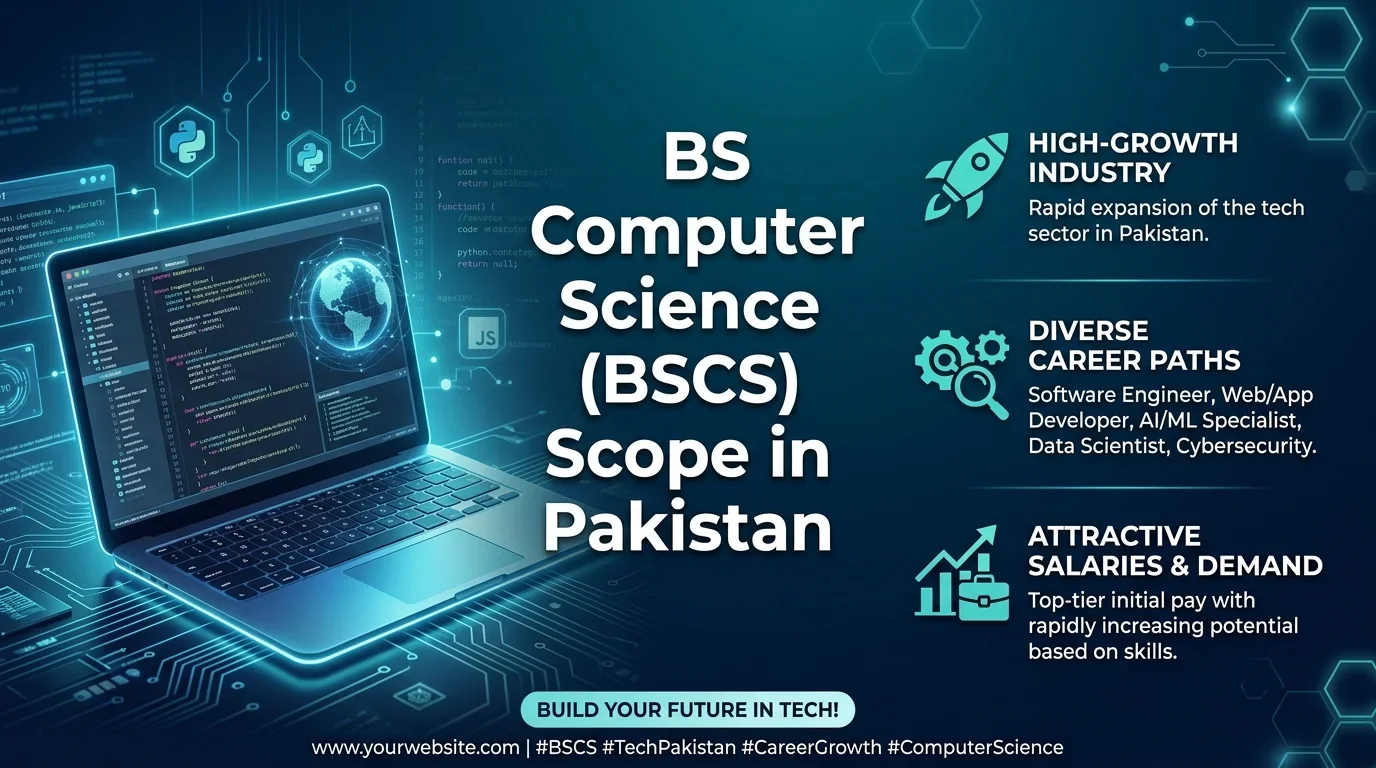
What is BSCS?
BSCS stands for Bachelor of Science in Computer Science. It is an undergraduate degree that focuses on computer systems, programming, algorithms, software development, databases, operating systems, computer networks, artificial intelligence, information security, and other areas of computing.
BSCS normally provides students with a combination of theoretical knowledge and practical skills. Students learn how software and computer systems work and how to design, develop, test, maintain, and improve technology-based solutions.
The degree is not limited to programming. Computer Science graduates can enter many different technology careers depending on their interests and skills.
The HEC Computer Science curriculum has been updated to provide greater flexibility through core subjects, electives, specialization areas, professional certifications, field experience, and final-year projects.
Is BSCS a Good Degree in Pakistan?
Yes, BSCS can be an excellent degree choice in Pakistan, particularly for students who are interested in technology, programming, problem-solving, mathematics, software, artificial intelligence, or digital businesses.
However, the value of a BSCS degree depends heavily on practical skills.
A student who completes BSCS without developing programming, communication, problem-solving, project-building, and industry-related skills may find it difficult to compete for good jobs.
On the other hand, a BSCS graduate who develops strong practical skills can apply for local jobs, remote jobs, freelance projects, international opportunities, and technology-based businesses.
Therefore, BSCS should be considered a combination of:
- University education
- Technical skills
- Practical projects
- Internships
- Professional certifications
- Communication skills
- Continuous learning
Scope of BSCS in Pakistan
The scope of BSCS in Pakistan is broad because almost every major industry now uses information technology.
BSCS graduates can find opportunities in:
- Software houses
- Banks
- Telecommunications companies
- E-commerce companies
- Educational institutions
- Hospitals and healthcare organizations
- Government departments
- Technology startups
- Digital marketing companies
- Manufacturing companies
- Oil and gas companies
- Financial technology companies
- Cybersecurity companies
- Cloud service providers
- IT consulting firms
- Freelancing platforms
- International technology companies
Pakistan's technology sector also provides opportunities for remote employment and export-oriented IT services.
Major Career Fields After BSCS
A BSCS graduate can choose a career according to their interests and technical strengths.
Software Developer
Software development is one of the most common career paths after BSCS.
Software developers design, develop, test, and maintain applications and software systems.
A graduate may specialize in:
- Java
- Python
- C++
- C#
- JavaScript
- PHP
- Go
- Kotlin
- Swift
Software developers can work on desktop applications, enterprise software, web applications, mobile applications, and cloud-based systems.
Web Developer
Web development is another major field for BSCS graduates.
Web developers create websites and web applications using technologies such as:
- HTML
- CSS
- JavaScript
- PHP
- Python
- React
- Node.js
- Laravel
- WordPress
- MySQL
Web developers can work for companies or provide services independently through freelancing.
Mobile App Developer
Mobile application development is also a growing field.
BSCS graduates can develop applications for Android and iOS platforms.
Common technologies include:
- Kotlin
- Java
- Swift
- Flutter
- React Native
Mobile developers can work for software companies, startups, banks, e-commerce businesses, and independent clients.
Artificial Intelligence Engineer
Artificial Intelligence has become one of the most important areas of modern computing.
AI professionals work on systems that can analyze information, recognize patterns, generate content, make predictions, or automate tasks.
Relevant areas include:
- Machine learning
- Deep learning
- Natural language processing
- Computer vision
- Generative AI
- AI automation
- Recommendation systems
The HEC 2025 Computer Science curriculum specifically recognizes Artificial Intelligence as one of the major specialization areas.
Data Scientist
Data science combines programming, statistics, mathematics, and analytical techniques to extract useful information from data.
Data professionals may work with:
- Python
- SQL
- Statistics
- Machine learning
- Data visualization
- Data analytics
- Big data technologies
Organizations use data professionals to understand customers, improve operations, identify trends, and support business decisions.
Cybersecurity Professional
Cybersecurity is another important career path.
Cybersecurity professionals help organizations protect systems, networks, applications, and information from unauthorized access and cyber threats.
Possible careers include:
- Security Analyst
- Security Engineer
- SOC Analyst
- Penetration Tester
- Security Consultant
- Incident Response Analyst
- Digital Forensics Analyst
Cybersecurity is also recognized within Pakistan's modern computing education framework.
Cloud Computing Professional
Cloud computing allows businesses to run applications and infrastructure using cloud platforms instead of relying exclusively on traditional physical infrastructure.
BSCS graduates can develop careers in:
- Cloud administration
- Cloud engineering
- Cloud architecture
- Cloud security
- Infrastructure automation
- DevOps
Important cloud platforms include AWS, Microsoft Azure, and Google Cloud.
DevOps Engineer
DevOps combines software development and IT operations.
DevOps professionals help organizations automate software development, testing, deployment, monitoring, and infrastructure management.
Important skills include:
- Linux
- Git
- Docker
- Kubernetes
- CI/CD
- Cloud platforms
- Infrastructure as Code
- Monitoring
This field can provide strong opportunities for experienced professionals and remote workers.
Database Administrator
Database professionals manage and maintain databases used by businesses and organizations.
Common database technologies include:
- MySQL
- PostgreSQL
- Microsoft SQL Server
- Oracle Database
- MongoDB
Database professionals may be responsible for performance, security, backups, availability, and data management.
Quality Assurance Engineer
Quality Assurance (QA) professionals test software applications before and after release.
They identify bugs, test features, verify functionality, and help development teams deliver reliable software.
Career paths include:
- Manual QA Tester
- Automation Tester
- QA Engineer
- Software Test Engineer
- Test Automation Engineer
UI/UX Professional
BSCS graduates interested in design can also enter UI and UX-related careers.
UI/UX professionals focus on making software applications easier and more attractive to use.
Useful skills include:
- User research
- Wireframing
- Prototyping
- Interface design
- Usability testing
- Figma
- Design systems
Network Engineer
Networking is another possible career path.
Network engineers design, configure, maintain, and troubleshoot computer networks.
They may work with:
- Routers
- Switches
- Firewalls
- Wireless networks
- VPNs
- Network monitoring
- Enterprise infrastructure
Networking combined with cloud and cybersecurity skills can create additional career opportunities.
BSCS Specializations in Pakistan
The updated HEC Computer Science framework provides a wide range of specialization possibilities. These include Software Engineering, Artificial Intelligence, Data Science, Cybersecurity, Information Technology, Computer Engineering, Computer Games Development, Multimedia and Animation, Robotics, Human-Computer Interaction, Internet of Things, Network Infrastructure and Cloud Computing, Quantum Computing, and Health Informatics.
Some of the most promising areas for students include:
Artificial Intelligence
AI is suitable for students interested in machine learning, automation, intelligent applications, generative AI, and advanced computing.
Data Science
Data Science is suitable for students who enjoy mathematics, statistics, programming, data analysis, and machine learning.
Cybersecurity
Cybersecurity is suitable for students interested in protecting networks, applications, systems, and digital information.
Software Engineering
Software Engineering is suitable for students who want to build professional software applications and work in software development teams.
Cloud Computing
Cloud Computing is suitable for students interested in infrastructure, servers, networking, automation, and large-scale applications.
Internet of Things
IoT combines software, hardware, sensors, networking, and data.
It can be applied in smart homes, industrial systems, agriculture, healthcare, manufacturing, and other sectors.
Robotics
Robotics combines programming, electronics, automation, artificial intelligence, and mechanical systems.
Health Informatics
Health Informatics combines technology and healthcare data and systems. It can provide opportunities in healthcare technology and information management.
BSCS Jobs in Pakistan
BSCS graduates can apply for positions such as:
- Software Engineer
- Software Developer
- Web Developer
- Front-End Developer
- Back-End Developer
- Full-Stack Developer
- Mobile App Developer
- AI Engineer
- Machine Learning Engineer
- Data Analyst
- Data Scientist
- Cybersecurity Analyst
- Security Engineer
- SOC Analyst
- Cloud Engineer
- DevOps Engineer
- Network Engineer
- Database Administrator
- QA Engineer
- Automation Tester
- UI/UX Designer
- System Administrator
- IT Support Engineer
- Technical Support Engineer
- Business Intelligence Analyst
- Research Assistant
- Computer Science Teacher
- Lecturer
- IT Consultant
Actual job titles and requirements vary between employers.
BSCS Salary in Pakistan
BSCS salaries vary considerably depending on skills, experience, location, employer, specialization, and ability to work on real-world projects.
A fresh graduate may start with a relatively modest salary while building professional experience. Developers with several years of experience and strong technical skills can earn considerably more.
Professionals working in specialized areas such as:
- Artificial Intelligence
- Cybersecurity
- Cloud Computing
- DevOps
- Data Engineering
- Software Engineering
may have stronger earning potential, particularly when they work for international companies or remote employers.
It is better to evaluate a BSCS career based on skills and long-term earning potential rather than expecting a fixed salary immediately after graduation.
BSCS and Freelancing in Pakistan
BSCS is particularly useful for students who want to pursue freelancing.
A graduate can provide services to clients in Pakistan and other countries.
Popular freelance services include:
- Website development
- WordPress development
- PHP development
- Python programming
- Mobile app development
- Software development
- Database development
- API development
- Automation
- AI integration
- Data analysis
- Cybersecurity consulting
- Technical support
Freelancing income is not guaranteed and depends on skills, portfolio quality, client acquisition, communication, reviews, and the ability to deliver projects professionally.
Remote Jobs After BSCS
Remote employment is another important opportunity.
A Pakistani BSCS graduate may work remotely for an international company without relocating immediately.
Remote roles can include:
- Software Engineer
- Full-Stack Developer
- Backend Developer
- Frontend Developer
- Mobile Developer
- DevOps Engineer
- Cloud Engineer
- Data Analyst
- AI Engineer
- QA Engineer
- Cybersecurity Analyst
Strong English communication, professional behavior, time management, and reliable technical skills are particularly important for remote work.
Government Jobs After BSCS
BSCS graduates can also apply for technology-related positions in the public sector.
Depending on the recruitment rules and job advertisement, graduates may find opportunities in:
- Government IT departments
- Universities
- Public-sector organizations
- Banks
- Research organizations
- Defense-related technology organizations
- Government digital services
- E-governance projects
Eligibility requirements vary by organization and position, so candidates should always check the official recruitment advertisement.
Private Sector Opportunities
The private sector provides a large range of technology careers.
BSCS graduates can work in:
- Software houses
- Banks
- Telecom companies
- E-commerce companies
- Technology startups
- IT service providers
- Consulting companies
- Digital agencies
- Healthcare technology companies
- Educational technology companies
- Fintech companies
The private sector generally places strong emphasis on practical skills and experience.
Skills Students Should Learn During BSCS
A degree alone is not enough to become a competitive Computer Science professional.
Students should try to develop practical skills throughout their university education.
Important skills include:
Programming
Students should become comfortable with at least one major programming language and understand programming fundamentals properly.
Data Structures and Algorithms
Data structures and algorithms are important for technical interviews and efficient software development.
Databases
Students should understand SQL, database design, queries, relationships, indexing, and basic database administration.
Git and Version Control
Git is widely used by development teams to manage source code and collaborate on projects.
Linux
Linux knowledge is useful for software development, servers, cloud computing, cybersecurity, and DevOps.
Communication
English communication is important for interviews, documentation, remote jobs, freelancing, and international clients.
Problem Solving
Employers often evaluate how candidates approach technical problems rather than simply asking whether they have completed a degree.
Portfolio Development
Students should build real projects and maintain a professional portfolio.
Examples include:
- E-commerce website
- School management system
- Hospital management system
- Mobile application
- AI chatbot
- Inventory system
- Banking application prototype
- Data analysis project
- Cybersecurity project
Importance of Internship
An internship can help a BSCS student understand how professional technology teams operate.
Students should ideally complete internships before graduation.
During an internship, students can learn:
- Professional development workflows
- Team collaboration
- Git
- Project management
- Software testing
- Client communication
- Code reviews
- Documentation
- Production systems
The HEC's revised framework places greater emphasis on practical integration, including field experience and final-year projects.
Final Year Project
The Final Year Project (FYP) is an important part of BSCS education.
Students should avoid selecting a project simply because it is easy.
A good FYP can demonstrate practical skills to future employers.
Potential project areas include:
- Artificial Intelligence
- E-commerce
- Healthcare technology
- Cybersecurity
- Cloud computing
- Mobile applications
- Data analytics
- Education technology
- Fintech
- IoT
- Automation
A properly documented project can become an important part of a student's portfolio.
Higher Education After BSCS
BSCS graduates can continue their education after completing the undergraduate degree.
Possible options include:
- MS Computer Science
- MS Artificial Intelligence
- MS Data Science
- MS Cybersecurity
- MS Software Engineering
- MS Information Technology
- MS Computer Engineering
- MS Information Systems
Students interested in research can also pursue advanced academic qualifications and eventually move toward teaching and research careers.
Professional Certifications After BSCS
Professional certifications can complement a university degree.
Depending on the selected career path, students may consider certifications in:
- Cloud computing
- Networking
- Cybersecurity
- Database technologies
- Project management
- Data analytics
- AI and machine learning
- DevOps
The updated HEC Computer Science framework also incorporates a professional certification component intended to strengthen industry relevance.
Future of BSCS in Pakistan
The future of BSCS in Pakistan is closely connected to the country's growing digital economy.
Technology is increasingly being used in:
- Banking
- Healthcare
- Education
- Government services
- E-commerce
- Manufacturing
- Agriculture
- Telecommunications
- Transportation
- Financial services
- Energy
- Media
Artificial intelligence, cloud computing, cybersecurity, data analytics, automation, and software development are expected to remain important areas of technology employment.
HEC has also introduced initiatives focused on improving computing graduates' industry readiness. In 2026, HEC announced a National Skill Competency Test for advanced computing students in collaboration with organizations including PSEB and P@SHA.
This indicates increasing emphasis on practical competency rather than degree credentials alone.
BSCS vs Other Computing Degrees
BSCS is one of several computing degrees available in Pakistan.
Other programs include:
- BS Software Engineering
- BS Artificial Intelligence
- BS Data Science
- BS Cybersecurity
- BS Information Technology
- BS Information Systems
- BS Computer Engineering
HEC's computing curriculum framework recognizes these as separate undergraduate computing disciplines.
BSCS is often considered a broad option because it provides students with a foundation that can lead into many different technology specializations.
Students who are unsure about a specific technology career may therefore prefer a broad Computer Science program and specialize through electives, projects, certifications, internships, and professional experience.
Who Should Choose BSCS?
BSCS may be suitable for students who:
- Enjoy computers and technology
- Like solving problems
- Are interested in programming
- Want to build software
- Are comfortable learning continuously
- Are interested in mathematics and logic
- Want opportunities in remote work
- Are interested in freelancing
- Want to work in the technology industry
- May want to build a technology startup
Students should understand that Computer Science requires continuous learning. Technologies change quickly, so graduates need to keep updating their skills throughout their careers.
Who May Find BSCS Difficult?
BSCS may be challenging for students who strongly dislike:
- Programming
- Mathematics
- Logical problem-solving
- Technical learning
- Computer-based work
- Continuous learning
It is possible to improve these skills through practice, but students should understand the nature of the field before selecting the degree.
The general BSCS admission process is:
- Select an HEC-recognized university.
- Check the university's BSCS eligibility requirements.
- Review the admission schedule.
- Complete the online or physical application form.
- Upload or submit the required documents.
- Pay the application or admission processing fee.
- Appear in the entry test if required.
- Check the merit list or admission result.
- Complete the admission formalities.
- Pay the required university fees.
- Attend orientation and begin the BSCS program.
Students should always follow the admission instructions published by their selected university.
Conclusion
The scope of BSCS in Pakistan is broad and continues to expand with the growth of software development, artificial intelligence, cloud computing, cybersecurity, data science, e-commerce, freelancing, and digital services.
The updated HEC Computer Science curriculum reflects this changing environment by supporting a wide range of specialization areas and placing greater emphasis on practical skills, field experience, final-year projects, and professional certifications.
However, students should not choose BSCS only because they believe it guarantees a high salary. The degree provides a foundation, but career success depends on practical skills, projects, internships, communication, problem-solving ability, and continuous learning.
For students who genuinely enjoy technology and are willing to develop practical skills, BSCS can provide opportunities in Pakistan as well as the international and remote technology markets.
Guide Information
Eligibility
Eligibility requirements depend on the university and admission policy.
Generally, students who have completed Intermediate or an equivalent qualification may apply for BSCS programs if they meet the university's requirements.
Common backgrounds may include:
FSc Pre-Engineering
FSc with Mathematics
ICS
Equivalent qualifications
Some universities may have specific mathematics or subject requirements.
Students should check the latest admission requirements of their selected university before applying.
Required Documents
Documents commonly requested during BSCS admission include:
Matric certificate or result card
Intermediate certificate or result card
CNIC or B-Form
Passport-size photographs
Domicile, where required
Character certificate, where required
Migration certificate, where required
Admission application form
University entry test result, where applicable
Requirements vary between universities
Fees
SCS fees vary significantly between universities. Public-sector universities generally have different fee structures from private universities. Students should check: Admission fee Tuition fee Examination fee Laboratory charges Registration charges Hostel charges, if applicable Other university-specific charges Always confirm the current fee structure directly from the university before admission.
Processing Time
A BSCS degree normally requires approximately four years of full-time study when completed according to the university's standard undergraduate schedule. The exact duration can vary depending on the university, academic progress, admission route, and applicable curriculum.
Application Method
For information about Pakistan's higher education
Validity Period
A BSCS degree is an academic qualification and does not normally have an expiry date. However, the
Step-by-Step Process
-
Choose a Recognized University
-
Select an institution that offers a recognized computing program and provides adequate academic and practical resources.
-
Learn Programming Early
-
Do not wait until the final year to learn programming.
-
Start with one language and develop strong fundamentals.
-
Build Real Projects
-
Create projects outside regular university assignments.
-
Projects demonstrate practical ability to employers.
-
Select a Specialization
-
By the middle of the degree, students should start exploring areas such as:
-
Software Engineering
-
AI
-
Data Science
-
Cybersecurity
-
Cloud Computing
-
DevOps
-
Mobile Development
-
Web Development
-
Complete an Internship
-
Gain professional experience before graduation.
-
Build a Portfolio
-
Maintain a portfolio containing your best projects and technical achievements.
-
Improve Communication Skills
-
Technical knowledge combined with good communication can significantly improve career opportunities.
-
Apply for Jobs and Freelance Work
-
After developing sufficient skills, apply for internships, junior positions, remote jobs, and freelance projects.
-
Continue Learning
-
Technology changes continuously. A successful BSCS professional should continue learning throughout their career.
Official Information
Contact: For curriculum-related information, students can contact the Higher Education Commission of Pakistan through its official channels. For admissions, fee information, and program-specific requirements, applicants should contact the admissions office of their selected university.
Frequently Asked Questions
BSCS has a broad scope in Pakistan. Graduates can work in software development, web development, mobile applications, AI, data science, cybersecurity, cloud computing, networking, databases, QA, DevOps, IT support, research, education, freelancing, and other technology-related fields.
Yes. BSCS can be a strong degree choice for students interested in technology, programming, software, artificial intelligence, data, cybersecurity, and digital careers. Practical skills are very important for achieving good career opportunities.
Common career options include Software Engineer, Software Developer, Web Developer, Mobile App Developer, AI Engineer, Data Analyst, Data Scientist, Cybersecurity Analyst, Cloud Engineer, DevOps Engineer, QA Engineer, Database Administrator, Network Engineer, and IT Support Engineer.
Yes. BSCS graduates may apply for relevant technology and computing positions in government departments and public-sector organizations, subject to the eligibility requirements mentioned in individual job advertisements.
Yes. BSCS graduates can work remotely for Pakistani or international companies if they have suitable technical, communication, and collaboration skills.
Yes. Web development, software development, mobile applications, AI integration, data analysis, automation, WordPress development, and other technology services can be offered through freelance platforms and direct clients.
There is no single specialization that is best for everyone. Artificial Intelligence, Data Science, Cybersecurity, Software Engineering, Cloud Computing, and DevOps can all provide strong career opportunities. Students should select an area according to their interests and abilities.
Yes. Artificial Intelligence is included as a major specialization area in the updated HEC Computer Science framework.
Yes. Cybersecurity is an important technology field, and BSCS graduates can move into roles such as Security Analyst, SOC Analyst, Security Engineer, Penetration Tester, and Cybersecurity Consultant after developing the required skills.
Yes. A BSCS graduate can pursue AI through university electives, professional certifications, projects, specialized training, or postgraduate education.
Yes. BSCS provides a useful foundation for Data Science because students normally study programming, databases, algorithms, mathematics, and other computing concepts.
Yes. BSCS graduates can apply for international jobs if they meet the employer's educational, technical, experience, language, and visa requirements.
Yes. Remote international employment is possible, particularly in software development, cloud computing, AI, data, cybersecurity, QA, and other technology fields.
Mathematics and logical reasoning are important parts of Computer Science. The amount and type of mathematics required can vary depending on the university and specialization.
Programming is a fundamental part of Computer Science. Students normally study programming fundamentals, object-oriented programming, data structures, and other programming-related subjects.
Students should develop practical programming skills, Git, databases, Linux, communication skills, problem-solving ability, project experience, and specialization-specific skills.
Neither degree is universally better. BSCS is generally broad and provides exposure to many areas of computing, while Software Engineering focuses more specifically on software development and engineering practices. Students should choose according to their career goals.
BSCS and IT have different academic focuses. BSCS generally provides stronger foundations in programming, algorithms, computation, and computer science concepts, while IT can focus more on applying and managing technology systems. The best choice depends on the student's career objectives.
Yes. Pakistan's increasing use of software, digital services, AI, cloud computing, cybersecurity, e-commerce, and technology-based businesses creates continuing demand for computing skills.