Chemical Engineering Scope in Pakistan
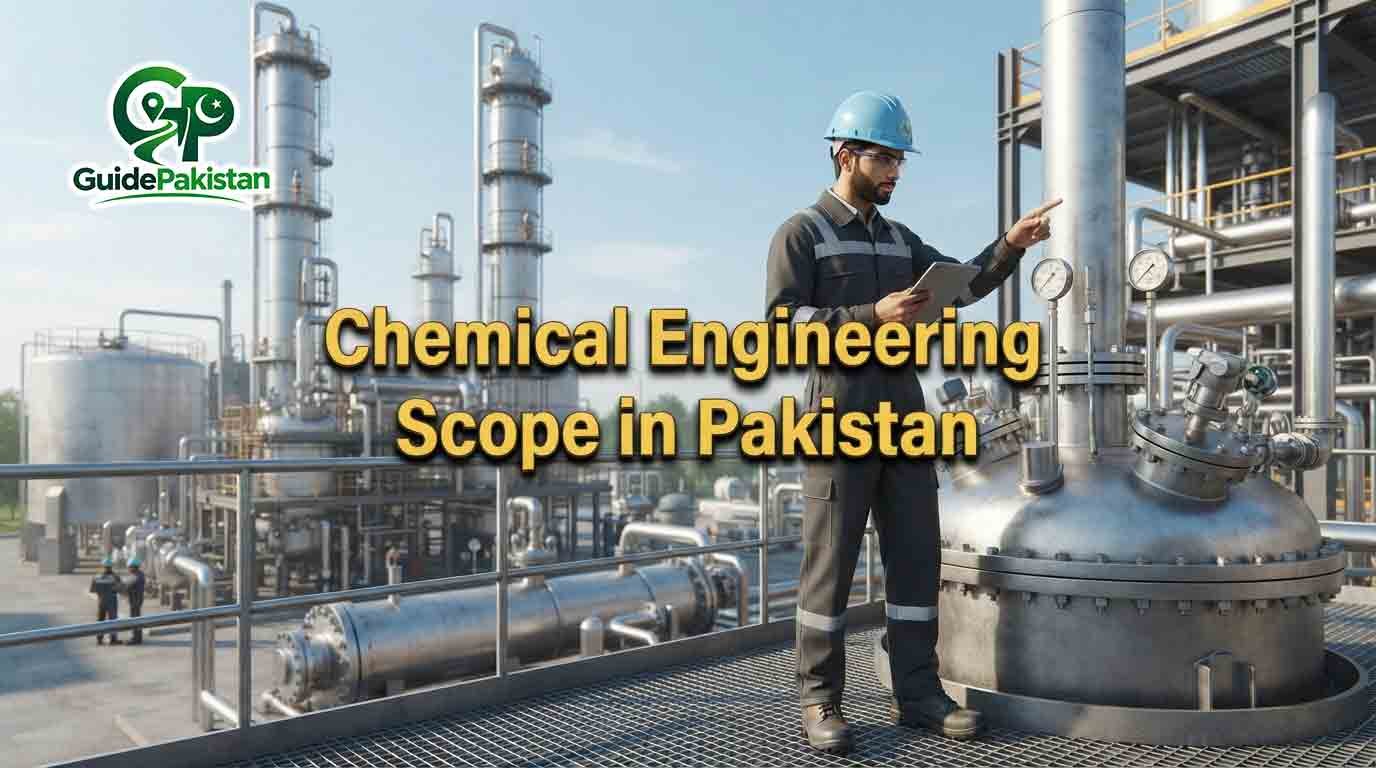
Chemical Engineering Scope in Pakistan
Chemical Engineering is one of the most important engineering disciplines for industries that convert raw materials into useful products. In Pakistan, Chemical Engineers can work in process industries, fertilizer plants, petroleum and petrochemical companies, refineries, pharmaceuticals, food processing, cement, chemicals, polymers, textiles, paints, power-related industries, water treatment, environmental management, manufacturing and research.
Unlike the common perception that Chemical Engineering is mainly about studying chemistry, it is actually a combination of chemistry, mathematics, physics, engineering, process design, thermodynamics, fluid mechanics, heat transfer, mass transfer, reaction engineering, process control and industrial management.
For students in Pakistan who enjoy chemistry but also have an interest in mathematics, physics, industrial processes and problem-solving, Chemical Engineering can be a strong engineering career option.
What Is Chemical Engineering?
Chemical Engineering is the branch of engineering concerned with designing, operating, controlling and improving industrial processes that transform raw materials into useful products.
A Chemical Engineer may be involved in converting natural gas into useful chemicals, crude oil into petroleum products, raw chemicals into medicines, agricultural materials into food products, minerals into industrial materials or chemical ingredients into fertilizers, polymers, paints and other products.
The HEC Chemical Engineering curriculum describes the field around the processing of raw materials into finished products economically while reducing environmental pollution. Its core areas include material and energy balances, heat, mass and momentum transfer, chemical thermodynamics, chemical reaction engineering, separation processes, process dynamics and control.
This means a Chemical Engineer is not simply a chemist working in a laboratory. A Chemical Engineer is trained to understand how chemical processes work at industrial scale.
Chemical Engineering Scope in Pakistan
The scope of Chemical Engineering in Pakistan is closely connected with the country's process and manufacturing industries.
Pakistan has industries involving fertilizers, petroleum products, pharmaceuticals, food processing, chemicals, textiles, cement, polymers, paints, paper, water treatment and other manufacturing activities. These industries require professionals who understand industrial processes, production systems, safety, quality and process optimization.
Chemical Engineering can therefore provide career opportunities in several different sectors rather than only one industry.
Major Fields for Chemical Engineers in Pakistan
Fertilizer Industry
The fertilizer sector is one of the important areas for Chemical Engineers.
Chemical Engineers may work in production plants, process operations, plant optimization, quality control, utilities, safety, maintenance coordination and process improvement.
Fertilizer manufacturing involves complex chemical and physical processes, making process engineering knowledge particularly important.
Oil and Gas Industry
Chemical Engineers can also work in oil and gas processing.
Possible areas include:
-
Gas processing
-
Refinery operations
-
Process design
-
Separation systems
-
Petroleum product processing
-
Process optimization
-
Safety management
-
Quality control
-
Plant operations
-
Utilities
-
Environmental management
Students interested in the petroleum sector may find Chemical Engineering useful because many oil and gas facilities involve large-scale chemical processing.
Petrochemical Industry
Petrochemical plants convert petroleum and natural-gas-based feedstocks into chemicals and materials.
Chemical Engineers can participate in production, process design, process control, plant optimization, quality assurance and safety.
The petrochemical sector can also provide opportunities for professionals interested in polymers, plastics and industrial chemicals.
Pharmaceutical Industry
Pharmaceutical manufacturing is another important area.
Chemical Engineers can contribute to:
-
Manufacturing processes
-
Process validation
-
Production planning
-
Quality systems
-
Process optimization
-
Equipment selection
-
Utilities
-
Safety
-
Scale-up operations
Chemical Engineering graduates may work alongside pharmacists, chemists, microbiologists, mechanical engineers, electrical engineers and quality professionals.
Food Processing Industry
Food manufacturing also involves many engineering processes such as heating, cooling, drying, evaporation, filtration, mixing, separation and packaging.
Chemical Engineers can work in food-processing plants in areas such as production, process optimization, quality management, plant operations and energy efficiency.
Cement Industry
Cement manufacturing involves high-temperature processing, material handling, grinding, chemical reactions and process control.
Chemical Engineers may work in production, process optimization, quality control, environmental systems and plant operations.
Chemical Manufacturing
Chemical manufacturing companies produce materials used by other industries.
Examples include:
-
Industrial chemicals
-
Solvents
-
Acids
-
Alkalis
-
Paint-related chemicals
-
Adhesives
-
Cleaning chemicals
-
Industrial additives
-
Specialty chemicals
Chemical Engineers can be involved in production planning, plant operations, process development and quality control.
Polymer and Plastics Industry
Chemical Engineering also has strong connections with polymers and plastics.
Career areas may include:
-
Polymer processing
-
Plastic manufacturing
-
Material development
-
Production
-
Quality control
-
Process optimization
-
Recycling
-
Product development
Pakistan's manufacturing sector uses polymer and plastic materials in packaging, construction, automotive components, consumer products and industrial applications.
Textile Industry
Pakistan has a large textile and apparel manufacturing sector. Chemical Engineers can find roles related to chemical processing, dyes, finishing processes, water treatment, effluent treatment, production and process optimization.
Paint and Coatings Industry
Paint and coatings manufacturing involves formulation, mixing, dispersion, quality testing and process control.
Chemical Engineers can contribute to manufacturing processes, formulation support, quality assurance, production management and plant operations.
Water Treatment and Environmental Engineering
Chemical Engineers can also develop careers in water and wastewater treatment.
Industrial plants need systems for:
-
Water purification
-
Wastewater treatment
-
Chemical treatment
-
Effluent management
-
Recycling
-
Pollution control
-
Environmental compliance
This area can become increasingly important as industries face greater pressure to use resources efficiently and reduce environmental impact.
Process Engineering
Process Engineering is one of the most important career directions for Chemical Engineers.
A Process Engineer studies how materials move through an industrial plant and how the process can be made safer, more efficient and more economical.
Typical responsibilities may include:
-
Monitoring production processes
-
Identifying process problems
-
Improving production efficiency
-
Reducing energy consumption
-
Improving product quality
-
Analyzing process data
-
Supporting plant modifications
-
Preparing technical reports
-
Coordinating with maintenance teams
-
Supporting safety improvements
Production Engineering
Chemical Engineers can work in production departments where they monitor manufacturing processes and help ensure that production targets are achieved.
They may be responsible for process parameters, production efficiency, raw material consumption, product quality and safe plant operation.
Process Design
Process design is another advanced career area.
Chemical Engineers may help design industrial processes before a plant is built or modified.
Process design can involve:
-
Process flow diagrams
-
Material balances
-
Energy balances
-
Equipment selection
-
Heat exchangers
-
Pumps
-
Reactors
-
Distillation systems
-
Separators
-
Storage systems
-
Process control
-
Safety considerations
Process Control and Automation
Modern industrial plants depend heavily on automation.
Chemical Engineers who understand process control can work with systems used to monitor and control temperature, pressure, flow, level and other process variables.
Knowledge of instrumentation, control systems, data analysis and industrial automation can make a graduate more competitive.
Research and Development
Chemical Engineers can also move into research and development.
Possible areas include:
-
New materials
-
Energy systems
-
Sustainable processes
-
Polymers
-
Nanomaterials
-
Environmental technologies
-
Process optimization
-
Alternative fuels
-
Industrial biotechnology
Students who want research careers can continue into MS, MPhil and PhD-level education.
HEC lists Chemical Engineering among disciplines at BS, MS/MPhil and PhD levels within its curriculum framework.
Chemical Engineering and Energy
Energy efficiency is an important concern for process industries.
Chemical Engineers can work on reducing energy consumption through improved process design, heat recovery, process optimization and efficient plant operation.
This creates links between Chemical Engineering and emerging areas such as renewable energy, hydrogen-related technologies, carbon management and sustainable manufacturing.
However, students should distinguish between a traditional Chemical Engineering degree and specialized degrees such as Energy Engineering. The exact curriculum and career pathway depends on the university and program.
Chemical Engineering and Artificial Intelligence
Artificial Intelligence is increasingly becoming relevant to engineering.
A Chemical Engineer with additional knowledge of:
-
Python
-
Data analysis
-
Machine learning
-
Process simulation
-
Optimization
-
Industrial data
-
Automation
can develop a modern skill set.
AI can support areas such as predictive maintenance, process optimization, quality prediction, energy management and production forecasting.
Students should therefore avoid thinking that Chemical Engineering is completely separate from computing.
Chemical Engineering and Software Skills
Software knowledge can improve a Chemical Engineer's career prospects.
Useful areas include:
-
Microsoft Excel
-
Advanced Excel
-
Python
-
MATLAB
-
Process simulation software
-
Data visualization
-
Statistical analysis
-
Engineering calculations
-
Technical documentation
Depending on the career path, students may encounter process simulation and engineering software used for plant design and analysis.
Important Subjects in Chemical Engineering
A Chemical Engineering student normally encounters a combination of mathematics, chemistry, physics and engineering subjects.
Important areas include:
-
Engineering Mathematics
-
Engineering Physics
-
Chemistry
-
Material and Energy Balances
-
Chemical Thermodynamics
-
Fluid Mechanics
-
Heat Transfer
-
Mass Transfer
-
Chemical Reaction Engineering
-
Separation Processes
-
Process Dynamics
-
Process Control
-
Process Design
-
Process Safety
-
Engineering Economics
-
Plant Design
-
Environmental Engineering
-
Technical Communication
HEC's Chemical Engineering curriculum specifically identifies material and energy balances, heat/mass/momentum transfer, thermodynamics, reaction engineering, separation processes and process dynamics/control as core areas.
Is Chemical Engineering Difficult?
Chemical Engineering can be challenging.
The degree requires students to understand mathematics, chemistry, physics and engineering concepts simultaneously.
Some subjects can be particularly demanding because students must apply mathematical models to real industrial processes.
The difficulty should not discourage students who genuinely enjoy engineering and problem-solving.
Good performance usually requires consistent study rather than relying only on memorization.
Who Should Study Chemical Engineering?
Chemical Engineering may suit students who:
-
Like chemistry
-
Are comfortable with mathematics
-
Enjoy physics
-
Like industrial processes
-
Want to work in manufacturing
-
Enjoy solving technical problems
-
Are interested in factories and plants
-
Like process optimization
-
Want an engineering career
-
Are interested in energy and environmental systems
Students who strongly dislike chemistry, mathematics or industrial environments should carefully compare Chemical Engineering with other engineering disciplines before choosing it.
Admission and Degree Path
Students normally enter an undergraduate engineering program after completing the required intermediate or equivalent qualification and meeting the university's admission requirements.
Exact eligibility, entry-test requirements, merit and subject combinations vary by university and admission year.
Students should check the latest admission advertisement of the university before applying.
The professional status of an engineering degree is also important. PEC currently places Chemical Engineering under its PEC Curricula-2023 accreditation category.
Importance of PEC Accreditation
Students should not select an engineering program only because the university is well known.
They should also check whether the specific Chemical Engineering program and relevant intake batch have the required PEC accreditation.
PEC's accreditation records are organized by institution, program and intake batch, meaning students should verify the exact program and batch rather than assuming that every program or every intake is automatically covered. Current PEC records include Chemical Engineering programs at institutions such as NUST, UET Lahore, UET Peshawar, University of the Punjab's Institute of Chemical Engineering and Technology, and other institutions, with accreditation records varying by intake.
Jobs for Chemical Engineers in Pakistan
Possible job titles include:
-
Chemical Engineer
-
Process Engineer
-
Production Engineer
-
Process Design Engineer
-
Plant Engineer
-
Operations Engineer
-
Process Control Engineer
-
Quality Engineer
-
Safety Engineer
-
Environmental Engineer
-
Utilities Engineer
-
Research Engineer
-
Project Engineer
-
Manufacturing Engineer
-
Process Improvement Engineer
The actual job title depends on the employer, industry and experience.
Government Sector Opportunities
Chemical Engineers may find opportunities in government organizations, public-sector companies, research organizations, regulatory bodies, universities and public industrial enterprises.
Government recruitment is usually dependent on vacancies, qualification requirements, age limits, testing procedures and the relevant organization's rules.
Students should always check the official recruitment advertisement rather than relying on old social-media posts.
Private Sector Opportunities
The private sector can offer opportunities in:
-
Manufacturing companies
-
Fertilizer companies
-
Pharmaceutical companies
-
Chemical manufacturers
-
Oil and gas companies
-
Refineries
-
Food companies
-
Cement plants
-
Textile companies
-
Paint manufacturers
-
Polymer companies
-
Water-treatment companies
-
Engineering consultancies
-
Industrial services companies
Chemical Engineering Salary in Pakistan
There is no single fixed salary for Chemical Engineers in Pakistan.
Salary can vary considerably depending on:
-
Qualification
-
University
-
PEC status where applicable
-
Experience
-
Industry
-
Job location
-
Company size
-
Technical skills
-
Shift responsibilities
-
Management responsibilities
-
International exposure
Fresh graduates may begin at different salary levels depending on the employer and role, while experienced engineers with strong process, management or specialized technical skills can progress into better-paying positions.
Therefore, students should not choose Chemical Engineering only on the basis of a promised salary figure.
Career Growth
A Chemical Engineer can progress from an entry-level technical position toward positions such as:
Junior Engineer → Process Engineer → Senior Engineer → Lead Engineer → Plant/Operations Manager → Technical Manager → Engineering Manager
The exact career structure differs from company to company.
Professional growth is strongly influenced by practical experience, technical competence, communication skills, safety awareness and leadership ability.
Higher Education After Chemical Engineering
After a bachelor's degree, graduates can consider postgraduate study in areas such as:
-
Chemical Engineering
-
Process Engineering
-
Environmental Engineering
-
Energy Engineering
-
Polymer Engineering
-
Materials Engineering
-
Industrial Engineering
-
Petroleum-related fields
-
Environmental Management
-
Biotechnology
-
Engineering Management
The appropriate postgraduate option depends on the university's admission requirements and the student's career goals.
Chemical Engineering vs Chemistry
Chemical Engineering and Chemistry are related but different.
Chemistry focuses primarily on substances, reactions, molecular structures and chemical behavior.
Chemical Engineering focuses on converting chemical and physical principles into industrial processes.
A chemist may investigate how a reaction works in a laboratory.
A Chemical Engineer may be concerned with how that reaction can be safely and economically operated at industrial scale.
Chemical Engineering vs Mechanical Engineering
Mechanical Engineering focuses broadly on machines, mechanical systems, thermal systems, manufacturing and mechanical design.
Chemical Engineering focuses more on chemical and physical processes, process plants, reactions, separation systems, thermodynamics, heat and mass transfer and process control.
There can still be considerable cooperation between the two disciplines in industrial plants.
Chemical Engineering vs Petroleum Engineering
Petroleum Engineering is specifically focused on exploration and production aspects of petroleum resources.
Chemical Engineering has a broader process-industry focus and can work in refineries, gas processing, petrochemicals, fertilizers, pharmaceuticals, food processing and many other industries.
A student interested specifically in drilling, reservoirs and upstream oil and gas should also examine Petroleum Engineering.
Advantages of Chemical Engineering
Major advantages include:
-
Broad industrial applications
-
Strong connection with manufacturing
-
Opportunities in process industries
-
Multiple specialization options
-
International relevance
-
Potential for research
-
Opportunities in production and process design
-
Combination of science and engineering
-
Scope for management progression
-
Potential to combine engineering with data and automation
Challenges of Chemical Engineering
The field also has challenges.
Industrial jobs can involve:
-
Plant environments
-
Shift work
-
Operational pressure
-
Safety responsibilities
-
Remote industrial locations
-
Strict production targets
-
Complex technical problems
Competition for desirable positions can also be significant.
A degree alone may not be enough. Practical skills, internships, software knowledge, communication and professional development can make a major difference.
Future of Chemical Engineering in Pakistan
The future of Chemical Engineering will increasingly involve efficiency, automation, sustainability and advanced manufacturing.
Important emerging areas include:
-
Process automation
-
Energy efficiency
-
Waste reduction
-
Water treatment
-
Recycling
-
Sustainable manufacturing
-
Advanced materials
-
Polymer technology
-
Renewable-energy processes
-
Industrial data analytics
-
Artificial Intelligence
-
Process optimization
-
Environmental protection
Chemical Engineers who combine traditional engineering knowledge with modern digital skills may be better prepared for changing industrial requirements.
How Students Can Build a Strong Chemical Engineering Career
Students should not wait until graduation to develop professional skills.
They can begin by learning Excel, technical writing, engineering calculations and basic programming.
They should also understand process flow diagrams, industrial safety and basic plant operations.
Internships are particularly valuable because they allow students to connect classroom concepts with real industrial systems.
Students should also develop communication skills because Chemical Engineers frequently work with production, maintenance, electrical, mechanical, laboratory, safety and management teams.
Final Verdict
Chemical Engineering has a meaningful and diverse scope in Pakistan, particularly for students interested in industrial production, process plants, manufacturing, fertilizers, chemicals, pharmaceuticals, petroleum processing, food processing, polymers, environmental systems and process optimization.
It is not simply a chemistry degree. It is an engineering discipline that combines chemistry, mathematics, physics and engineering to design and improve industrial processes.
The strongest career path is usually built by combining a recognized engineering degree with practical experience, technical software skills, process knowledge, safety awareness, communication skills and continuous learning.
Students should verify the current university admission requirements and the PEC accreditation status of the exact Chemical Engineering program and intake before making their final admission decision. PEC currently categorizes Chemical Engineering under its Curricula-2023 accreditation framework.
Guide Information
Eligibility
Students interested in Chemical Engineering normally need an Intermediate or equivalent qualification meeting the admission requirements of the selected university. Engineering admission commonly requires the relevant science subjects and may involve an entry test or other university-specific selection criteria. Exact eligibility, subject combinations, minimum marks, entry-test requirements and merit vary by university and admission year. Students should check the latest official admission advertisement of the university before applying.
Required Documents
Intermediate or equivalent certificate and marks sheet
Matriculation or equivalent certificate and marks sheet
CNIC or B-Form as applicable
Recent passport-size photographs
Domicile where required
University application form
Entry-test result where required
Equivalence certificate for foreign qualifications where applicable
Character certificate where required
Migration certificate where required
Other documents requested by the university
Original documents may be required for verification at the time of admission
Fees
Chemical Engineering tuition and admission fees vary by university, sector, campus, credit-hour structure and academic year. Public-sector universities and private universities may have significantly different fee structures. Students should check the latest official fee schedule of the selected university before admission. Do not rely on old fee figures published on unofficial websites or social media.
Processing Time
For university admission, the processing time depends on the institution's admission schedule, application verification, entry test, merit list and fee submission deadline. Some universities process applications in stages, while others publish merit lists after an entry test. Students should follow the official admission calendar of the university.WHEN TO APPLY:Apply according to the official admission schedule of the selected university. Engineering admissions may be offered once or more than once during an academic year depending on the institution. Students should monitor official university admission announcements and apply before the stated deadline.
Application Method
Most universities provide an online admission appl
Validity Period
A Chemical Engineering bachelor's degree is an academic qualification and does not have a short-term
Step-by-Step Process
- Decide whether Chemical Engineering matches your interests and career goals.
- Review the major areas of Chemical Engineering.
- Compare Chemical Engineering with Chemistry, Mechanical Engineering and Petroleum Engineering.
- Check the latest admission requirements of universities offering Chemical Engineering.
- Confirm the required Intermediate or equivalent qualification.
- Check the required subjects for admission.
- Check whether an entry test is required.
- Review the latest university admission advertisement.
- Shortlist universities offering Chemical Engineering.
- Check the exact campus offering the program.
- Verify the PEC accreditation status of the specific Chemical Engineering program.
- Check the accreditation information for the relevant intake batch.
- Compare the university's curriculum.
- Compare laboratory facilities.
- Check available industrial links and internship opportunities.
- Compare tuition and other educational costs.
- Check hostel and transportation options if required.
- Review scholarship and financial-aid opportunities.
- Prepare your academic documents.
- Prepare your identity documents.
- Obtain an equivalence certificate if required for a foreign qualification.
- Register for the required entry test if applicable.
- Prepare for mathematics, physics, chemistry and other relevant admission-test areas.
- Complete the university's online admission form.
- Enter your personal information carefully.
- Enter your academic information accurately.
- Upload the required documents.
- Pay the application fee if required.
- Submit the application before the deadline.
- Save the application or tracking number.
- Download or save the submitted application record.
- Check the university portal regularly.
- Appear in the entry test if required.
- Attend any interview or additional assessment if required.
- Check the merit list.
- Follow the university's instructions after selection.
- Pay the admission or first-semester dues before the deadline.
- Complete document verification.
- Complete registration with the university.
- Attend orientation and departmental activities.
- Start studying mathematics, chemistry and engineering fundamentals seriously.
- Build strong knowledge of material and energy balances.
- Learn thermodynamics.
- Study fluid mechanics and heat transfer.
- Study mass transfer and separation processes.
- Learn chemical reaction engineering.
- Study process control and process dynamics.
- Learn engineering software relevant to Chemical Engineering.
- Improve Excel and technical data-analysis skills.
- Learn basic programming where useful.
- Participate in laboratory work seriously.
- Develop technical report-writing skills.
- Learn industrial health and safety principles.
- Seek an internship in a relevant industry.
- Visit industrial plants where educational opportunities are available.
- Build a professional CV before graduation.
- Develop communication and teamwork skills.
- Explore process, production and quality-related career paths.
- Consider postgraduate education if it supports your career goal.
- Verify job and professional requirements before applying for engineering positions.
- Continue professional development after graduation.
- Keep checking official PEC information for professional and accreditation matters.
Official Information
Official Website: https://www.pec.org.pk/?utm_source=chatgpt.com)[Higher Education Commission of Pakistan](https://www.hec.gov.pk/?utm_source=chatgpt.com)
Contact: For academic admission questions, contact the admissions office of the selected university using the contact information published on its official website.For engineering accreditation and professional regulatory matters, contact the Pakistan Engineering Council through its official website and published contact channels.
Frequently Asked Questions
Chemical Engineering is an engineering discipline concerned with designing, operating and improving processes that convert raw materials into useful products.
It can be a good field for students interested in process industries, manufacturing, chemicals, fertilizers, pharmaceuticals, petroleum processing and industrial production.
Its scope includes fertilizers, oil and gas processing, petrochemicals, pharmaceuticals, food processing, chemicals, cement, polymers, textiles, water treatment, manufacturing and process engineering.
No. Chemistry focuses mainly on substances and chemical reactions, while Chemical Engineering focuses on industrial processes and the large-scale production of useful products.
It can be challenging because it combines mathematics, chemistry, physics and engineering subjects.
Yes. Mathematics is an important part of Chemical Engineering because engineers use mathematical models for process calculations and analysis.
Yes. Chemistry is an important foundation, but the degree also contains extensive engineering subjects.
Yes. Fertilizer production is one of the relevant process-industry areas for Chemical Engineers.
Yes. Chemical Engineers can work in areas such as refining, gas processing, process operations and related industrial processes.
Yes. Refinery operations involve several chemical engineering principles, including separation, thermodynamics, heat transfer and process control.
Yes. They can work in manufacturing, process operations, quality-related functions, process improvement and other technical areas.
Yes. Food processing involves several operations such as heating, cooling, mixing, separation and drying that require engineering knowledge.
Yes. They may work in chemical processing, production, water treatment and process-related functions.
Yes. Cement manufacturing involves chemical reactions, heat-intensive processing, material handling and process control.
Yes. Chemical Engineering has applications in polymers, plastics processing, production and materials-related industries.
Process engineering involves designing, monitoring and improving industrial processes to make them safe, efficient and economical.
A Process Engineer analyzes production processes, monitors performance, identifies problems and works on improving efficiency, quality and safety.
A Production Engineer helps manage and improve manufacturing operations and works to achieve production targets safely and efficiently.
Yes. Water purification, wastewater treatment and industrial effluent management are relevant areas.
Yes. Chemical Engineers can work on pollution control, wastewater treatment, waste reduction and environmentally efficient processes.
Yes. Process control is important for maintaining variables such as temperature, pressure, flow and level within desired operating conditions.
Yes. Excel, data analysis, programming, simulation software and process-control knowledge can improve a Chemical Engineer's technical capabilities.
Python can be useful for data analysis, automation, optimization, modeling and other technical applications.
Yes. AI and data analytics can support process optimization, predictive maintenance, quality prediction and industrial decision-making.
Yes. Graduates can enter research and development and can pursue postgraduate education for advanced research careers.
Yes. Graduates can pursue relevant MS or equivalent postgraduate programs subject to the admission requirements of the university.
Yes. A Chemical Engineering graduate can pursue doctoral studies after meeting the academic and admission requirements of the relevant university.
Yes. Students should verify the PEC accreditation status of the exact Chemical Engineering program and relevant intake batch before admission.
Students should not assume this. PEC records are organized by institution, program and intake batch, so the exact program and batch should be checked.
Pakistan Engineering Council is the relevant professional regulatory and accreditation body for engineering education and the engineering profession in Pakistan.
Important areas include material and energy balances, thermodynamics, fluid mechanics, heat transfer, mass transfer, reaction engineering, separation processes and process control.
Yes. Manufacturing and process industries are major areas where Chemical Engineering knowledge can be applied.
Yes. Depending on the employer, Chemical Engineers can work in quality-related technical and process roles.
Yes. Plant operations are an important career area for Chemical Engineers.
Yes. With experience and management skills, Chemical Engineers can progress into supervisory and managerial positions.
Yes. Chemical Engineering principles are used worldwide in process and manufacturing industries, although international employment requirements vary by country.
Yes, but international employment depends on the destination country's immigration, professional registration, qualification recognition and employer requirements.
Petroleum Engineering focuses more specifically on petroleum exploration and production, while Chemical Engineering has broader applications across process and manufacturing industries.
Mechanical Engineering focuses broadly on machines, mechanical systems and thermal/mechanical design, while Chemical Engineering focuses more on chemical and physical processes and process plants.
Important skills include engineering calculations, process understanding, Excel, data analysis, process simulation, technical communication, safety and teamwork.
Yes. Industrial internships help students understand how engineering concepts are applied in real plants.
They can contribute to certain energy-related processes, efficiency, materials and emerging technologies depending on their specialization.
The field is evolving toward automation, energy efficiency, sustainable manufacturing, advanced materials, process optimization, water treatment and data-driven engineering.
No. Students should also be comfortable with mathematics, physics, engineering analysis and industrial problem-solving.
A degree provides the foundation, but internships, technical skills, communication, practical experience and professional development can significantly affect career opportunities.
They should check the curriculum, faculty, laboratories, admission requirements, fee structure, industrial exposure and the PEC accreditation status of the exact program and intake.
Students should use the official Pakistan Engineering Council accreditation information and verify the exact institution, program and intake batch.
Students should use the official Higher Education Commission website and the relevant curriculum documents.
Yes. Process safety is highly relevant to industrial plants where hazardous materials, pressure, temperature and chemical reactions must be managed safely.
Yes. Depending on the organization, Chemical Engineers may work with utility systems and energy-related plant operations.
Experienced engineers with specialized knowledge can move into consulting and technical advisory roles subject to their expertise and the requirements of the employer or client.
There is no single best path. Process engineering, production, plant operations, process design, quality, safety, environmental systems, research and management can all be viable depending on the individual's interests.
Yes. Software and data skills can complement engineering knowledge and improve productivity.
Its major advantage is that the underlying engineering principles can be applied across many process and manufacturing industries.
The combination of difficult technical subjects and competition for desirable industrial positions can be challenging, especially for students who do not build practical skills.
It may not be the best choice because mathematics is an important part of the degree.
Yes. Students interested in plants, manufacturing and industrial processes may find the field particularly suitable.
The graduate can pursue entry-level employment, internships, professional development, postgraduate education or specialized technical training depending on their goals.