Engineering in Pakistan – Admission, Fields & Career Scope – Complete Guide 2026
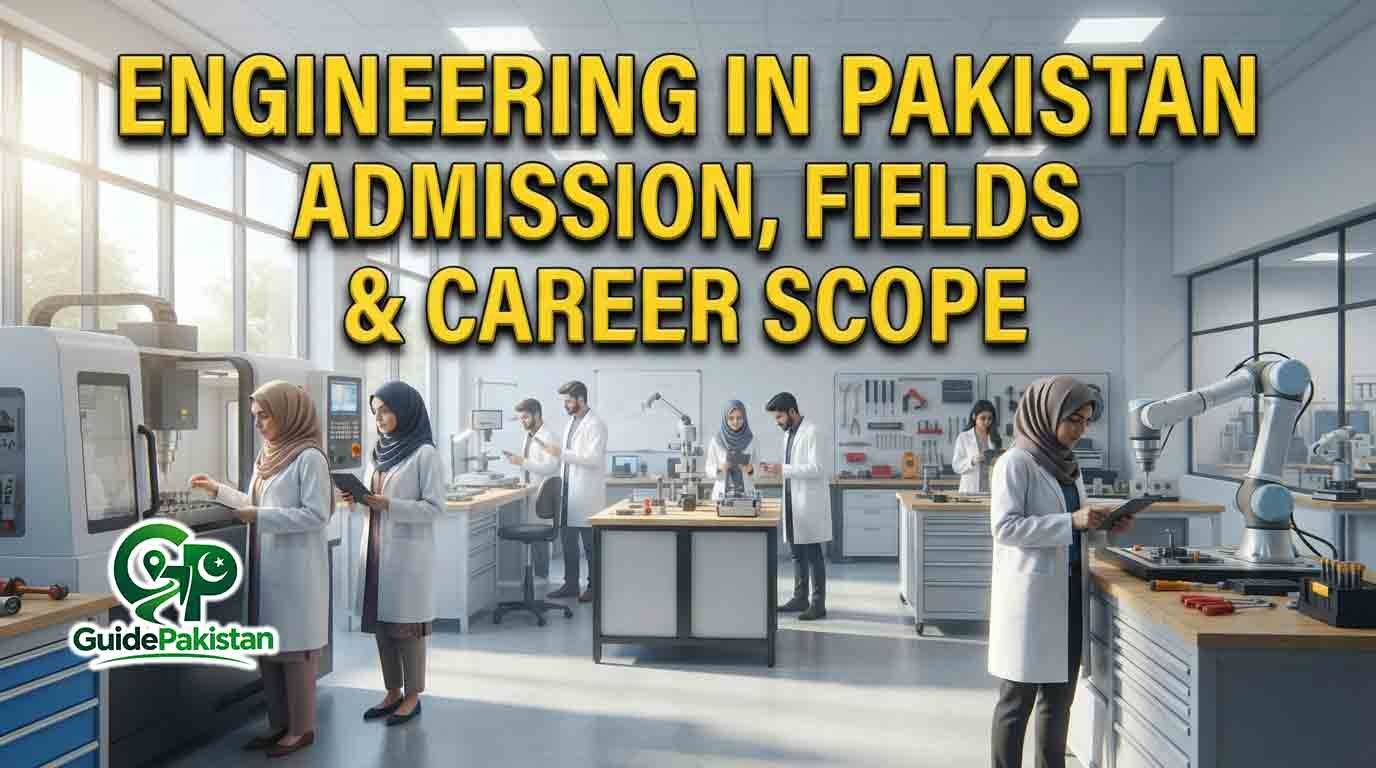
Engineering in Pakistan – Admission, Fields & Career Scope
Introduction
Engineering is one of the most important professional fields in Pakistan and plays a major role in the country's infrastructure, technology, manufacturing, energy, transportation, construction and industrial development.
Students who complete an engineering degree can work in areas such as civil construction, electrical systems, mechanical design, chemical industries, software development, telecommunications, petroleum, mining, environmental protection, aerospace, industrial production and many other technical fields.
Engineering education in Pakistan is offered by public and private universities and engineering institutions. However, students should not select an engineering university only because of its name or ranking. The recognition and accreditation status of the specific engineering program and campus is extremely important.
The Pakistan Engineering Council (PEC) maintains the official accreditation information for engineering programs in Pakistan. PEC's current accreditation data lists engineering programs under Level-I and Level-II categories and advises students and parents to check the accreditation status of the specific program, campus or affiliated college before admission.
What Is Engineering?
Engineering is the application of mathematics, science, technology and practical problem-solving to design, develop, construct, operate and improve products, systems, structures and processes.
Engineers use scientific principles to solve real-world problems.
For example:
-
Civil engineers design buildings, roads, bridges and water systems.
-
Electrical engineers work with electrical power, electronics and control systems.
-
Mechanical engineers design machines, engines and mechanical systems.
-
Chemical engineers work with industrial chemical processes.
-
Computer engineers work with computer hardware and embedded systems.
-
Software engineers design, develop and maintain software systems.
-
Environmental engineers work on pollution control, water treatment and environmental protection.
-
Aerospace engineers work with aircraft, spacecraft and aviation technologies.
Engineering therefore offers many different career directions.
Why Study Engineering in Pakistan?
Engineering can be a strong career choice for students who enjoy mathematics, science, technology, design and problem-solving.
Some major reasons to study engineering include:
-
Wide range of engineering disciplines
-
Opportunities in public and private sectors
-
Technical and professional career development
-
Opportunities for entrepreneurship
-
Possibility of international employment
-
Opportunities for postgraduate education
-
Growing demand for technology-related skills
-
Opportunities in construction and infrastructure
-
Industrial and manufacturing careers
-
Freelancing and technology-based work in selected fields
However, students should understand that an engineering degree alone does not guarantee a high-paying job. Practical skills, internships, software knowledge, communication skills and professional experience are increasingly important.
Engineering Admission in Pakistan
Engineering admission requirements vary by university, discipline and admission policy.
Generally, students applying for undergraduate engineering programs complete Intermediate or an equivalent qualification such as:
-
FSc Pre-Engineering
-
Relevant A-Level qualifications
-
ICS for selected computing-related programs
-
Other equivalent qualifications where permitted by the university
Universities may conduct their own entrance tests or accept recognized admission tests according to their admission policy.
Students should always check the latest admission advertisement and eligibility criteria of the university before applying.
Engineering Eligibility in Pakistan
For many traditional engineering programs, students normally need a strong background in Mathematics and Physics along with the subjects required by the relevant university.
Common academic backgrounds include:
-
FSc Pre-Engineering
-
A-Level with relevant subjects
-
Equivalent qualifications
-
Other backgrounds where specifically allowed
The exact minimum percentage varies among universities and programs.
Students should not assume that eligibility for one engineering program automatically applies to every engineering discipline.
Does Engineering Require Mathematics?
Mathematics is one of the most important subjects in engineering.
Engineering students commonly study mathematical concepts such as:
-
Algebra
-
Calculus
-
Differential equations
-
Linear algebra
-
Statistics
-
Numerical methods
-
Engineering mathematics
The amount and type of mathematics varies by discipline.
Civil, electrical, mechanical, chemical and many other engineering programs generally require substantial mathematical knowledge.
Students who are weak in mathematics should improve their basic concepts before starting an engineering degree.
Does Engineering Require Physics?
Physics is also an important foundation for many engineering disciplines.
Physics helps students understand:
-
Force
-
Motion
-
Energy
-
Electricity
-
Magnetism
-
Heat
-
Fluid mechanics
-
Waves
-
Materials
-
Mechanical systems
The importance of particular physics concepts depends on the selected engineering discipline.
Duration of Engineering Degree in Pakistan
A typical undergraduate engineering degree in Pakistan is a four-year bachelor's program, although the exact structure and academic requirements can vary according to the university and program.
Students normally study theoretical subjects, laboratory courses, practical work, design projects and a final-year project.
The final-year project is particularly important because it gives students an opportunity to apply engineering knowledge to a practical problem.
Major Engineering Fields in Pakistan
Pakistan offers many engineering disciplines.
Some of the major fields include:
-
Civil Engineering
-
Electrical Engineering
-
Mechanical Engineering
-
Chemical Engineering
-
Computer Engineering
-
Software Engineering
-
Electronics Engineering
-
Telecommunication Engineering
-
Mechatronics Engineering
-
Industrial Engineering
-
Environmental Engineering
-
Petroleum and Gas Engineering
-
Aerospace Engineering
-
Automotive Engineering
-
Agricultural Engineering
-
Textile Engineering
-
Mining Engineering
-
Metallurgical and Materials Engineering
-
Biomedical Engineering
-
Geoinformatics Engineering
-
Transportation Engineering
-
Naval Architecture Engineering
-
Polymer Engineering
-
Food Engineering
-
Information Security Engineering
PEC currently publishes curriculum and accreditation information covering many of these disciplines, including Civil, Electrical, Mechanical, Chemical, Computer, Software, Aerospace, Agricultural, Industrial, Mechatronics, Mining, Petroleum and Gas, Textile and other engineering fields.
Civil Engineering
Civil Engineering is one of the most popular engineering disciplines in Pakistan.
Civil engineers are involved in:
-
Buildings
-
Roads
-
Bridges
-
Dams
-
Water supply systems
-
Sewerage systems
-
Transportation infrastructure
-
Construction management
-
Structural design
-
Geotechnical engineering
-
Surveying
-
Urban infrastructure
Civil Engineering can be particularly suitable for students interested in construction, structures, infrastructure and project management.
Civil Engineering Career Opportunities
Civil engineers can work as:
-
Site Engineer
-
Structural Engineer
-
Design Engineer
-
Project Engineer
-
Quantity Surveyor
-
Planning Engineer
-
Geotechnical Engineer
-
Transportation Engineer
-
Construction Manager
-
Project Manager
Electrical Engineering
Electrical Engineering focuses on electricity, electronics, power systems, control systems and related technologies.
Important areas include:
-
Electrical power
-
Power generation
-
Transmission
-
Distribution
-
Electronics
-
Control systems
-
Renewable energy
-
Instrumentation
-
Automation
Electrical Engineering Career Opportunities
Graduates can work as:
-
Electrical Engineer
-
Power Engineer
-
Control Engineer
-
Electronics Engineer
-
Instrumentation Engineer
-
Automation Engineer
-
Maintenance Engineer
-
Project Engineer
-
Energy Engineer
Electrical engineering also has opportunities in renewable energy and industrial automation.
Mechanical Engineering
Mechanical Engineering deals with machines, mechanical systems, manufacturing and thermal systems.
Students study areas such as:
-
Thermodynamics
-
Fluid mechanics
-
Machine design
-
Manufacturing
-
Heat transfer
-
Mechanics
-
Materials
-
Engineering drawing
-
Mechanical systems
Mechanical Engineering Career Opportunities
Mechanical engineers can work in:
-
Manufacturing
-
Automotive industries
-
Power plants
-
HVAC
-
Oil and gas
-
Industrial plants
-
Maintenance
-
Production
-
Mechanical design
Common job titles include:
-
Mechanical Engineer
-
Design Engineer
-
Production Engineer
-
Maintenance Engineer
-
HVAC Engineer
-
Manufacturing Engineer
-
Project Engineer
Chemical Engineering
Chemical Engineering combines chemistry, mathematics, physics and engineering to develop and manage industrial processes.
Chemical engineers can work in:
-
Fertilizer
-
Petrochemical
-
Pharmaceuticals
-
Food processing
-
Cement
-
Oil and gas
-
Chemical manufacturing
-
Energy
-
Process industries
Important subjects may include:
-
Chemical process calculations
-
Thermodynamics
-
Fluid mechanics
-
Heat transfer
-
Mass transfer
-
Reaction engineering
-
Process control
Computer Engineering
Computer Engineering combines computer science, electronics and hardware engineering.
It may involve:
-
Computer architecture
-
Digital logic
-
Embedded systems
-
Microprocessors
-
Networking
-
Programming
-
Hardware design
-
Internet of Things
-
Robotics
Computer engineering can be suitable for students interested in both hardware and software.
Software Engineering
Software Engineering focuses on the systematic design, development, testing and maintenance of software systems.
Students commonly study:
-
Programming
-
Data structures
-
Algorithms
-
Software requirements
-
Software design
-
Databases
-
Software testing
-
Web technologies
-
Project management
-
Software architecture
Software engineering can lead to careers in software development, web development, mobile applications, cloud computing, DevOps and other technology fields.
Mechatronics Engineering
Mechatronics combines:
-
Mechanical engineering
-
Electrical engineering
-
Electronics
-
Control systems
-
Computer technology
Mechatronics is increasingly relevant to automation, robotics and smart manufacturing.
Potential careers include:
-
Automation Engineer
-
Robotics Engineer
-
Control Engineer
-
Mechatronics Engineer
-
Industrial Automation Engineer
Industrial Engineering
Industrial Engineering focuses on improving productivity, efficiency and quality in organizations and manufacturing systems.
Students may study:
-
Production systems
-
Operations research
-
Quality management
-
Supply chain
-
Manufacturing systems
-
Industrial management
-
Optimization
-
Process improvement
Industrial engineers can work in manufacturing, logistics, supply chain, quality control and operations management.
Environmental Engineering
Environmental Engineering focuses on protecting the environment and managing pollution and natural resources.
Areas include:
-
Water treatment
-
Wastewater treatment
-
Air pollution
-
Solid waste management
-
Environmental impact assessment
-
Environmental monitoring
-
Sustainability
Environmental engineers can work in government agencies, industries, consulting firms and environmental organizations.
Petroleum and Gas Engineering
Petroleum and Gas Engineering focuses on exploration, drilling, production and management of petroleum and natural gas resources.
Career areas include:
-
Drilling
-
Reservoir engineering
-
Production
-
Exploration
-
Well operations
-
Oilfield services
The petroleum sector can offer specialized career opportunities, although employment conditions may vary according to global energy markets.
Aerospace Engineering
Aerospace Engineering deals with aircraft, spacecraft and aviation systems.
Students may study:
-
Aerodynamics
-
Aircraft structures
-
Propulsion
-
Flight mechanics
-
Aerospace materials
-
Control systems
Career opportunities can exist in aviation, defense, research, manufacturing and aerospace-related industries.
Agricultural Engineering
Agricultural Engineering applies engineering principles to agriculture.
It can involve:
-
Irrigation systems
-
Agricultural machinery
-
Farm mechanization
-
Soil and water management
-
Food processing
-
Renewable agricultural technologies
This field can be particularly relevant to Pakistan because of the country's agricultural economy.
Textile Engineering
Textile Engineering is related to textile production and manufacturing.
Areas include:
-
Textile machinery
-
Fiber technology
-
Yarn manufacturing
-
Fabric production
-
Dyeing
-
Finishing
-
Quality control
Pakistan's textile industry makes textile engineering a relevant specialization for students interested in industrial production.
Mining Engineering
Mining Engineering deals with the extraction and management of minerals and natural resources.
Career areas include:
-
Mining operations
-
Mine planning
-
Mineral processing
-
Safety management
-
Resource evaluation
Pakistan's mineral resources create opportunities for specialized mining professionals.
Metallurgical and Materials Engineering
This field focuses on materials, metals and their properties.
Students may study:
-
Metals
-
Alloys
-
Material testing
-
Corrosion
-
Manufacturing materials
-
Material processing
Graduates can work in manufacturing, steel, automotive, aerospace, construction and research.
Biomedical Engineering
Biomedical Engineering combines engineering and medical sciences.
Potential areas include:
-
Medical equipment
-
Biomedical instrumentation
-
Prosthetics
-
Medical imaging
-
Healthcare technology
-
Rehabilitation technology
This is an interdisciplinary field suitable for students interested in both engineering and healthcare.
Engineering Subjects
Engineering subjects vary according to the selected discipline, but students generally study a combination of:
-
Engineering Mathematics
-
Physics
-
Chemistry
-
Programming
-
Engineering Drawing
-
Technical Communication
-
Computer Applications
-
Laboratory Work
-
Engineering Mechanics
-
Statistics
-
Professional Ethics
-
Design Courses
-
Final-Year Project
Specialized subjects are added according to the discipline.
Practical Training in Engineering
Engineering is not only about classroom learning.
Practical experience is extremely important.
Students should try to gain experience through:
-
Laboratories
-
Industrial visits
-
Internships
-
Workshops
-
Design projects
-
Final-year projects
-
Engineering competitions
-
Research projects
-
Professional training
Practical experience can improve employability after graduation.
Importance of PEC Accreditation
PEC accreditation is one of the most important factors students should consider before taking admission in an engineering program.
PEC maintains official lists of accredited engineering programs and their intake/batch details.
PEC specifically advises students and parents to check the accreditation status of the engineering program, campus or affiliated college before admission. PEC also states that it registers graduates from institutions offering accredited engineering programs.
Therefore, students should not simply check whether a university is famous. They should verify:
-
University recognition
-
Campus recognition
-
Engineering program accreditation
-
Relevant intake/batch
-
Accreditation level
-
Any conditions or restrictions
PEC Level-I and Level-II Accreditation
PEC publishes engineering programs under Level-I and Level-II.
PEC's current information describes Level-II programs as substantially equivalent to the Washington Accord.
The accreditation status is program-specific and can vary by university, campus and intake batch.
Therefore, students should check the official PEC record for the exact program and intake they are considering.
HEC Recognition and PEC Accreditation
HEC and PEC have different roles.
HEC deals broadly with higher education recognition and academic matters, while PEC regulates the engineering profession and engineering program accreditation.
For an engineering student, both are important.
A student should verify:
-
The institution/campus is recognized.
-
The engineering degree program is appropriately accredited by PEC.
-
The accreditation covers the relevant intake/batch.
Best Universities for Engineering in Pakistan
Pakistan has many universities offering engineering programs.
Some well-known institutions include:
-
National University of Sciences and Technology (NUST)
-
University of Engineering and Technology Lahore
-
University of Engineering and Technology Taxila
-
Ghulam Ishaq Khan Institute of Engineering Sciences and Technology
-
Pakistan Institute of Engineering and Applied Sciences
-
NED University of Engineering and Technology
-
Mehran University of Engineering and Technology
-
University of Engineering and Technology Peshawar
-
COMSATS University Islamabad
-
Air University
-
Bahria University
-
National University of Computer and Emerging Sciences
-
University of Punjab
-
University of Agriculture Faisalabad
-
Institute of Space Technology
-
University of Lahore
-
University of Sargodha
-
University of Wah
-
University of Gujrat
-
National Textile University
-
Other recognized engineering institutions
This is a practical list of prominent institutions, not an official national ranking.
Students should compare universities according to their specific engineering discipline, campus, accreditation status, faculty, laboratories, industry links, fees and location.
Best Engineering Universities by Field
The best university can vary depending on the engineering field.
Civil Engineering
Students may consider institutions such as:
-
UET Lahore
-
NUST
-
UET Taxila
-
NED University
-
UET Peshawar
-
Mehran University
Electrical Engineering
Students may consider:
-
NUST
-
UET Lahore
-
UET Taxila
-
NED University
-
GIKI
-
PIEAS
-
COMSATS
-
Air University
Mechanical Engineering
Potential options include:
-
NUST
-
GIKI
-
UET Lahore
-
UET Taxila
-
PIEAS
-
NED University
-
UET Peshawar
Computer and Software Engineering
Students may consider:
-
NUST
-
FAST
-
COMSATS
-
UET Lahore
-
GIKI
-
ITU
-
Air University
-
Bahria University
Students should verify the current PEC accreditation status of the exact engineering program before admission.
Public vs Private Engineering Universities
Both public and private universities can offer quality engineering education.
Public Universities
Advantages may include:
-
Lower tuition in many cases
-
Large campuses
-
Established engineering departments
-
Government scholarships
-
Strong alumni networks
Possible disadvantages include:
-
Highly competitive admission
-
Large class sizes
-
Limited seats
-
Administrative delays in some institutions
Private Universities
Advantages may include:
-
Modern facilities in some institutions
-
Smaller class sizes
-
Industry-focused programs
-
Modern laboratories
-
Flexible academic environments
Possible disadvantages may include:
-
Higher fees
-
Different scholarship structures
-
Significant variation in quality
The student should compare the specific program rather than judging a university only by whether it is public or private.
Engineering Fees in Pakistan
Engineering fees vary significantly according to:
-
University
-
Engineering discipline
-
Public or private sector
-
Campus
-
Laboratory charges
-
Admission charges
-
Hostel expenses
-
Transportation
-
Other university fees
Public-sector engineering universities are generally more affordable than many private institutions, but the exact fee should always be checked from the latest official fee schedule.
Students should calculate the complete cost rather than looking only at tuition.
Scholarships for Engineering Students
Engineering students may find scholarships through:
-
University merit scholarships
-
Need-based scholarships
-
Government scholarship programs
-
HEC-supported opportunities
-
Provincial scholarship schemes
-
Institutional financial aid
-
Alumni scholarships
-
External organizations
Students should apply early and carefully check the eligibility criteria of each scholarship.
Engineering Entry Tests
Different universities may use different admission tests.
Depending on the university and program, students may encounter:
-
University-specific entry tests
-
Engineering admission tests
-
Provincial admission systems
-
National or institutional testing arrangements
-
SAT or other accepted qualifications in selected institutions
The admission test policy can change from year to year.
Therefore, applicants should check the official admission advertisement for the year in which they are applying.
Engineering and Computer Skills
Modern engineering increasingly requires computer skills.
Depending on the discipline, useful skills can include:
-
AutoCAD
-
Revit
-
SolidWorks
-
MATLAB
-
Python
-
C/C++
-
PLC programming
-
Engineering simulation software
-
GIS
-
Data analysis
-
Microsoft Excel
-
Project management software
Students should select software according to their engineering field.
Importance of AutoCAD for Engineers
AutoCAD is particularly useful in fields such as:
-
Civil Engineering
-
Architecture-related technical work
-
Mechanical Engineering
-
Electrical Engineering
-
Industrial design
Civil engineering students can benefit from learning:
-
2D drafting
-
Floor plans
-
Structural drawings
-
Site plans
-
Survey drawings
-
Construction details
Advanced students may also learn specialized software such as Revit, Civil 3D and other engineering applications.
Engineering Internships
Internships help students understand how engineering works in real professional environments.
Students should try to complete internships during their degree.
Possible internship areas include:
-
Construction companies
-
Engineering consultancies
-
Manufacturing industries
-
Power companies
-
Oil and gas companies
-
Software companies
-
Telecom companies
-
Government departments
-
Research organizations
A strong internship can improve both technical knowledge and employment prospects.
Engineering Final-Year Project
The Final-Year Project is an important part of engineering education.
A good project should:
-
Solve a practical problem
-
Demonstrate engineering knowledge
-
Include proper design or analysis
-
Use relevant tools
-
Include testing where applicable
-
Have clear documentation
-
Demonstrate teamwork
Students should avoid selecting a project only because it appears easy.
A well-designed project can become an important part of a student's professional portfolio.
Engineering Career Scope in Pakistan
Engineering graduates can work in:
-
Construction
-
Manufacturing
-
Energy
-
Oil and gas
-
Telecommunications
-
Software
-
Automotive
-
Aerospace
-
Agriculture
-
Textile
-
Mining
-
Transportation
-
Environmental services
-
Government departments
-
Research organizations
-
Engineering consultancies
Career opportunities depend on the engineering discipline, university, practical skills, experience and economic conditions.
Engineering Jobs in Government Sector
Engineers can find opportunities in government organizations and public-sector departments.
Potential areas include:
-
Public works
-
Infrastructure
-
Energy
-
Water management
-
Transportation
-
Defense
-
Municipal services
-
Irrigation
-
Planning
-
Public-sector development projects
Government recruitment requirements vary according to the organization and position.
Engineering Jobs in Private Sector
The private sector employs engineers in:
-
Construction companies
-
Manufacturing
-
Engineering consultancies
-
Software companies
-
Industrial organizations
-
Power companies
-
Telecom companies
-
Oil and gas companies
-
Automotive companies
Private-sector salaries and career growth can vary significantly.
Engineering and Freelancing
Some engineering fields provide opportunities for freelancing.
Possible freelance services include:
-
CAD drafting
-
3D modeling
-
Structural drawing
-
Quantity estimation
-
BIM services
-
GIS mapping
-
Technical documentation
-
Engineering visualization
-
Programming
-
Simulation
-
Data analysis
Students should ensure that freelance work is based on their actual skills and does not involve professional work they are not qualified or authorized to perform.
Engineering and Remote Jobs
Technology-related engineering disciplines can offer remote opportunities.
Examples include:
-
Software Engineering
-
Computer Engineering
-
Automation
-
Data-related engineering work
-
CAD services
-
BIM
-
GIS
-
Technical support
Civil and mechanical engineering jobs are often more site-based, but specialized design and consulting work can sometimes be performed remotely.
Engineering Abroad
Engineering graduates can pursue opportunities abroad after completing their education and gaining relevant experience.
Popular destinations may include:
-
United Kingdom
-
United States
-
Canada
-
Australia
-
Germany
-
Gulf countries
-
Saudi Arabia
-
United Arab Emirates
-
Qatar
International employment requirements can include:
-
Degree verification
-
Professional registration
-
Licensing
-
English-language testing
-
Work experience
-
Technical assessments
Requirements vary by country and profession.
Professional Registration as an Engineer
Professional registration is an important part of an engineering career in Pakistan.
PEC provides registration pathways for engineers holding accredited engineering qualifications.
Students should therefore verify accreditation before admission because the status of the degree program can affect professional registration.
Registered Engineer and Professional Engineer
PEC provides different professional registration categories and pathways.
A graduate with an accredited engineering qualification can seek registration as a Registered Engineer according to PEC requirements.
Professional development and experience can later provide pathways toward higher professional recognition.
Engineers should consult PEC's latest regulations and registration requirements because professional requirements can change.
Engineering and Entrepreneurship
Engineers can also become entrepreneurs.
Possible businesses include:
-
Construction companies
-
Engineering consultancies
-
CAD services
-
Software companies
-
Manufacturing businesses
-
Solar and renewable-energy services
-
Automation businesses
-
Industrial services
-
Technical training institutes
-
Engineering design firms
Entrepreneurship requires technical knowledge as well as business, financial and management skills.
Skills Every Engineering Student Should Develop
A successful engineering student should develop:
-
Mathematics
-
Technical knowledge
-
Problem-solving
-
Communication
-
English
-
Computer skills
-
Technical drawing
-
Research skills
-
Teamwork
-
Project management
-
Presentation skills
-
Time management
-
Professional ethics
Soft skills are increasingly important in engineering careers.
Is Engineering Difficult?
Engineering can be challenging because it requires mathematics, science, technical concepts, laboratory work, assignments and projects.
However, engineering is manageable for students who maintain consistent study habits.
Students should focus on:
-
Understanding concepts
-
Practicing mathematics
-
Solving numerical problems
-
Attending laboratories
-
Completing assignments
-
Learning practical software
-
Working on projects
Memorization alone is generally not enough for engineering.
Engineering for Pre-Engineering Students
FSc Pre-Engineering is one of the most common academic backgrounds for engineering admission.
Students with Mathematics, Physics and Chemistry can apply to many traditional engineering programs according to university-specific eligibility requirements.
Engineering for ICS Students
Some universities may allow ICS students to apply to selected computing or engineering-related programs, depending on the admission policy.
Students should check the exact eligibility criteria before applying because requirements vary between universities and programs.
Engineering for Pre-Medical Students
Some engineering and computing programs may have specific pathways for students from non-traditional backgrounds, but eligibility is university- and program-specific.
Students should never assume that a Pre-Medical background automatically qualifies them for every engineering program.
Engineering vs Computer Science
Engineering and Computer Science are different academic areas.
Engineering generally focuses on applying science and mathematics to physical systems, technology and engineered solutions.
Computer Science focuses primarily on computation, algorithms, software and information systems.
Students interested in programming and software may prefer Computer Science, while students interested in physical systems, machines, infrastructure or electronics may prefer engineering.
Engineering vs Software Engineering
Engineering programs can include hardware, infrastructure, machines, energy and physical systems.
Software Engineering focuses specifically on software development and software systems.
Students interested in programming, applications, web systems, cloud technology and software development may prefer Software Engineering.
Engineering vs Architecture
Civil Engineering focuses heavily on structural, construction and infrastructure aspects.
Architecture focuses more on building design, spatial planning, aesthetics and architectural concepts.
There can be collaboration between architects and civil/structural engineers, but they are different professional fields.
How to Choose the Right Engineering Field
Students should ask themselves:
-
Which subjects do I enjoy?
-
Am I strong in mathematics?
-
Do I prefer construction or technology?
-
Do I enjoy machines?
-
Do I like programming?
-
Do I prefer fieldwork or office work?
-
Do I want to work in manufacturing?
-
Do I want international opportunities?
-
What industries are growing?
-
What are my financial limitations?
The best engineering field is not necessarily the one with the most popular name. It should match the student's interests, abilities and long-term goals.
How to Choose the Right Engineering University
Before admission, compare:
-
PEC accreditation
-
HEC recognition
-
Campus status
-
Engineering laboratories
-
Faculty
-
Industry links
-
Internship opportunities
-
Research facilities
-
Alumni network
-
Location
-
Hostel availability
-
Total cost
-
Scholarships
-
Admission merit
-
Career support
Most importantly, verify the exact engineering program and intake batch on the official PEC website.
Common Mistakes Engineering Students Make
Some common mistakes include:
-
Choosing a field because friends selected it
-
Ignoring PEC accreditation
-
Choosing a university only because of its name
-
Ignoring practical skills
-
Avoiding internships
-
Depending only on classroom learning
-
Ignoring English communication
-
Not learning relevant software
-
Selecting an unsuitable specialization
-
Ignoring the job market
-
Waiting until graduation to build a CV
Future of Engineering in Pakistan
The future of engineering will increasingly involve technology and interdisciplinary skills.
Important areas include:
-
Artificial Intelligence
-
Automation
-
Robotics
-
Renewable Energy
-
Smart Cities
-
Electric Vehicles
-
Industrial Automation
-
Sustainable Construction
-
Advanced Manufacturing
-
Cybersecurity
-
Data Analytics
-
Internet of Things
-
Digital Engineering
-
Smart Infrastructure
Engineers who combine traditional engineering knowledge with modern digital skills may have stronger career opportunities.
Final Advice for Engineering Students
Engineering can provide a strong professional foundation, but students should think beyond simply obtaining a degree.
Before admission, verify the university and exact program.
During the degree:
-
Build strong fundamentals
-
Learn relevant software
-
Complete internships
-
Work on practical projects
-
Improve English
-
Develop communication skills
-
Build a professional CV
-
Develop a portfolio
-
Learn industry tools
-
Follow professional standards
The most important decision is not simply choosing the most famous university. It is choosing the right engineering field and an appropriately recognized and accredited program that matches your career goals.
Always check the latest official information from the relevant university, HEC and PEC before submitting an admission application or paying fees.
Guide Information
Eligibility
* Intermediate/FSc or equivalent qualification according to the selected university and engineering program.
* FSc Pre-Engineering is a common route for traditional engineering programs.
* Mathematics and Physics are important prerequisites for many engineering disciplines.
* A-Level students may apply with relevant subjects and equivalence where required.
* ICS students may be eligible for selected engineering/computing programs depending on university policy.
* Pre-Medical students may be eligible for selected programs only where the university specifically permits it.
* Minimum marks vary by university, discipline and admission policy.
* Some universities require an entrance test.
* Some universities may use additional merit components such as academic marks and admission-test scores.
* Students must satisfy the specific eligibility requirements of the university and program selected.
Required Documents
* CNIC or B-Form
* Passport-size photographs
* Matric/SSC certificate
* Matric/SSC marks sheet
* Intermediate/HSSC certificate
* Intermediate/HSSC marks sheet
* A-Level certificate and equivalence, where applicable
* Domicile, where required
* Entrance-test result, where applicable
* Character certificate, where required
* Migration certificate, where required
* IBCC equivalence for foreign qualifications, where applicable
* Medical certificate, where required
* Parent/guardian information where required
* Scholarship or financial-aid documents, where applicable
* Any additional documents specified by the university
Fees
Engineering fees vary considerably between universities and disciplines.Public-sector engineering universities generally have lower tuition costs than many private institutions, while private universities may charge substantially higher fees.Students should calculate:* Admission fee* Tuition fee* Examination fee* Laboratory fee* Registration charges* Hostel fee* Transport fee* Library or activity charges* Security deposit* Other university chargesAlways check the latest official fee structure of the selected university before admission because fees can change from one academic year to another.
Processing Time
Engineering admission processing time depends on the university and admission cycle.A typical admission cycle may include:* Online application submission* Application processing* Entrance test* Merit calculation* Merit list* Fee submission* Document verification* EnrollmentThe complete process can take several weeks or longer depending on the university.WHEN TO APPLY:Engineering admissions in Pakistan are usually announced according to the academic calendar of each university.Students should monitor official university admission portals and announcements.Applicants should:* Check admission announcements regularly.* Prepare academic documents early.* Register for the required entry test before the deadline.* Submit the application before the closing date.* Keep copies of the submitted application.* Follow merit-list announcements.* Submit fees within the specified deadline.Admission dates vary by institution and year.
Application Method
Engineering admission is generally completed onlin
Validity Period
An engineering degree is an academic qualification and does not have a simple expiry date.However, p
Step-by-Step Process
- Decide whether engineering matches your interests and career goals.
- Explore different engineering disciplines.
- Compare Civil, Electrical, Mechanical, Chemical and other fields.
- Identify your preferred engineering discipline.
- Check the academic requirements for that discipline.
- Confirm your Intermediate or equivalent qualification.
- Check whether Mathematics is required.
- Check whether Physics is required.
- Check whether Chemistry or another subject is required.
- Shortlist suitable universities.
- Check HEC recognition of the institution/campus where applicable.
- Check the university's engineering programs.
- Visit the official PEC accreditation page.
- Search for the exact university.
- Search for the exact engineering discipline.
- Check the relevant campus.
- Check the accreditation status.
- Check the relevant intake/batch information.
- Review any conditions or restrictions shown by PEC.
- Compare university fee structures.
- Check available scholarships.
- Check hostel facilities.
- Check transportation facilities.
- Review the university's laboratories.
- Review faculty information.
- Check internship opportunities.
- Check industry collaboration.
- Check the university's admission schedule.
- Review the official eligibility criteria.
- Check the required entry test.
- Register for the required entrance test.
- Prepare for the admission test.
- Prepare academic documents.
- Prepare identification documents.
- Create an account on the official admission portal.
- Complete the personal-information section.
- Complete the academic-information section.
- Select the desired engineering program.
- Upload the required documents.
- Pay the application fee.
- Submit the online application.
- Save the application form or confirmation.
- Appear in the entrance test if required.
- Check the admission test result.
- Check the merit list.
- Review your selection status.
- Follow instructions for selected candidates.
- Submit required original or verified documents.
- Pay the admission fee within the deadline.
- Complete university enrollment.
- Obtain the student registration information.
- Attend orientation.
- Start engineering classes.
- Attend lectures regularly.
- Attend laboratory sessions.
- Develop mathematics and technical fundamentals.
- Learn relevant engineering software.
- Participate in practical projects.
- Search for internship opportunities.
- Complete an industry internship.
- Develop communication and presentation skills.
- Complete the Final-Year Project.
- Build a professional CV.
- Build a technical portfolio where applicable.
- Explore employment and postgraduate opportunities.
- Review PEC registration requirements before graduation.
- Apply for the appropriate professional registration after graduation.
- Continue professional development throughout your career.
Official Information
Official Website: https://www.hec.gov.pk/
Contact: Pakistan Engineering Council (PEC)Head Office:Attaturk Avenue (East), G-5/2,P.O. Box 1296, Islamabad, PakistanUAN:(+92-51) 111-111-732PABX:(+92-51) 9219500, 9206974Regional Office Lahore:2-3 M, Civic Center,Model Town Extension, LahoreRegional Office Karachi:ST-14/A, Block-2, Kehkashan-V, Clifton, KarachiRegional Office Peshawar:Plot No. 46-A, Sector B-2,Phase-V Hayatabad, PeshawarRegional Office Quetta:Samungli Road, QuettaFor admission-specific questions, students should also contact the official admission office of their selected university.
Frequently Asked Questions
Engineering is the application of mathematics, science and technology to design, develop and improve products, systems, structures and processes.
Engineering can be a good career for students who develop strong technical knowledge, practical skills and relevant professional experience.
Major fields include Civil, Electrical, Mechanical, Chemical, Computer, Software, Electronics, Telecommunication, Mechatronics, Industrial, Environmental, Petroleum, Aerospace, Agricultural, Textile, Mining and Materials Engineering.
There is no single best field for everyone. The right field depends on the student's interests, abilities, career goals and employment preferences.
Civil, Electrical and Mechanical Engineering have traditionally been popular, while software, computer, automation and technology-related fields have also become increasingly important.
FSc Pre-Engineering is a common route, but eligibility varies by university and program.
Some universities may allow ICS students into selected programs. Students should verify the exact eligibility criteria of the university.
Eligibility for Pre-Medical students varies by program and university. They should check the specific admission policy.
Mathematics is an important part of most traditional engineering programs.
Physics is an important foundation for many engineering disciplines, especially Civil, Electrical and Mechanical Engineering.
A typical undergraduate engineering degree is structured as a four-year bachelor's program, subject to the university and applicable regulations.
PEC stands for Pakistan Engineering Council. It regulates the engineering profession and maintains accreditation information for engineering programs.
PEC accreditation is important because professional engineering registration depends on an accredited engineering qualification according to PEC requirements.
Students should verify both institutional recognition and the accreditation status of the specific engineering program and campus.
PEC describes Level-II accredited engineering programs as substantially equivalent to the Washington Accord.
Level-I is one of the accreditation categories used by PEC for engineering programs in Pakistan.
Yes. Accreditation status can vary by program, campus and intake batch, so students should check the latest official PEC record.
Prominent institutions include NUST, UET Lahore, UET Taxila, GIKI, PIEAS, NED University, MUET, UET Peshawar and several other recognized institutions.
UET Lahore, NUST, UET Taxila, NED University, UET Peshawar and Mehran University are among the institutions students commonly consider, but the exact program accreditation should be checked.
NUST, UET Lahore, UET Taxila, NED University, GIKI, PIEAS, COMSATS and Air University are among the institutions students may consider.
NUST, GIKI, UET Lahore, UET Taxila, PIEAS, NED University and UET Peshawar are among the institutions students may consider.
Civil, Electrical, Mechanical, Chemical, Software, Computer and several specialized engineering fields can provide international opportunities, depending on licensing and market demand.
Yes. Engineers can seek international opportunities, but requirements vary by country and profession.
Yes. Engineering professionals are employed in Gulf countries in construction, energy, manufacturing, infrastructure, technology and other sectors.
Yes. Depending on their skills, students can freelance in areas such as CAD, BIM, GIS, programming, technical design and data-related work.
Civil engineers can provide certain design, drafting, quantity-estimation and technical services, subject to professional rules and the nature of the work.
AutoCAD is particularly useful for Civil, Mechanical and other engineering fields involving technical drafting and design.
Programming is increasingly useful in engineering, particularly in Computer, Software, Electrical, Automation, Mechatronics and data-related fields.
Yes. Internships provide practical exposure and can improve professional readiness.
Yes. It gives students an opportunity to apply engineering concepts to a practical problem.
Engineering can be challenging because of mathematics, technical subjects, laboratories and projects, but consistent study can make it manageable.
Yes, provided the student is willing to work consistently and strengthen mathematics, science and technical skills.
Salaries vary by discipline, experience, industry, location and skills. There is no universally highest-paying field in every situation.
Civil Engineering remains important because infrastructure, construction, transportation and development projects require civil engineering expertise.
Electrical Engineering can offer opportunities in power, electronics, automation, renewable energy, control systems and industrial sectors.
Mechanical Engineering can lead to careers in manufacturing, automotive, power, HVAC, maintenance, design and industrial operations.
Software Engineering is an engineering discipline focused specifically on software systems and software development.
Civil Engineering focuses on engineering, structural and construction aspects, while Architecture focuses primarily on building design, spatial planning and architectural concepts.
Engineering generally applies scientific principles to engineered systems, while Computer Science focuses primarily on computation, algorithms and software.
Yes. Engineers can establish construction firms, consultancies, technology companies, manufacturing businesses and other technical ventures.
Strong English communication is useful because technical documentation, research papers, professional communication and many international resources use English.
Yes. Modern engineers increasingly use specialized software, programming, simulation, CAD, data analysis and digital tools.
Check HEC recognition where applicable, PEC accreditation, exact campus, relevant intake/batch, eligibility, fees, scholarships, laboratories and career opportunities.
PEC registration depends on the qualification meeting applicable accreditation and registration requirements.
A Registered Engineer is an engineer registered with PEC according to its applicable requirements.
Professional Engineer status involves additional PEC requirements and professional experience. Graduates should check the latest PEC regulations.
Engineering is expected to increasingly integrate automation, AI, renewable energy, robotics, smart infrastructure, digital manufacturing and other emerging technologies.
No. Interest, aptitude, academic ability and long-term career goals should also be considered.
No. The exact engineering program, campus, accreditation, faculty, laboratories, fees and career opportunities should also be evaluated.
Students can verify the current engineering program and batch accreditation through the official Pakistan Engineering Council website.
PEC publishes registration guidelines and requirements through its official website.
Yes. Engineering graduates can pursue master's degrees, MS programs, research and doctoral studies depending on eligibility.
Yes. With experience and relevant education, engineers can move into project management, operations, technical management and business roles.
Yes. Engineering includes laboratories, projects, design work and practical applications, although the amount of fieldwork varies by discipline.
Verify the exact university, campus and engineering program's current accreditation status before paying admission fees.