eSIM in Pakistan: Advantages & Disadvantages - Complete 2026 Guide
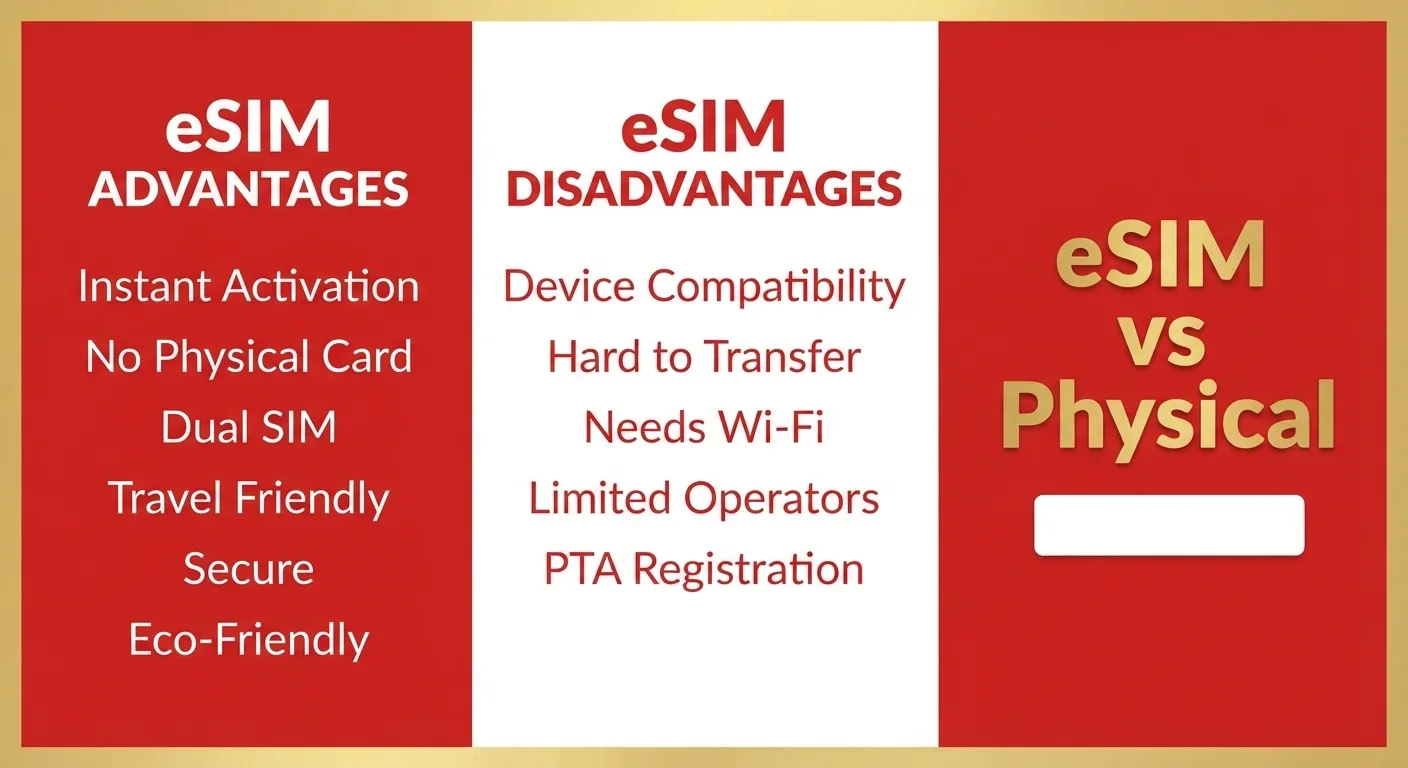
What is an eSIM?
An eSIM (embedded SIM) is a digital version of a traditional SIM card that is built directly into your device's hardware.[citation:1] Instead of inserting a physical plastic card, your mobile number is activated digitally through a QR code or app-based setup.[citation:1][citation:11]
The Pakistan Telecommunication Authority (PTA) introduced a revised eSIM policy effective August 17, 2026, which has made eSIM more affordable and accessible for Pakistani users.[citation:2][citation:5]
Advantages of Using eSIM in Pakistan
1. Instant Activation
With an eSIM, you can scan a QR code and be connected within minutes — no delivery or store visit needed.[citation:1]
The activation is fully digital, which means you can set up your mobile connection from anywhere with an internet connection.[citation:11]
2. Nothing to Lose or Damage
No physical card means no risk of bending, losing, or having it stolen.[citation:1]
Since the eSIM is embedded in your device, you cannot accidentally misplace it or damage it by mishandling.[citation:7]
3. Dual SIM Made Easy
You can run an eSIM and a physical SIM on the same phone at the same time without needing two SIM trays.[citation:1][citation:11]
This is particularly useful in Pakistan where many smartphones, especially iPhones, only have one physical SIM slot.
4. Travel-Friendly
You can add a local data plan abroad without removing your home SIM.[citation:1]
This means you stay reachable on your Pakistani number while using affordable local data rates.[citation:1]
International travel eSIMs for Pakistan start at less than $1 for small daily data packages.[citation:5]
5. Environmentally Friendly
eSIMs eliminate plastic waste, packaging, and shipping emissions.[citation:1][citation:11]
Studies show this is a more sustainable choice compared to traditional SIM cards.
6. Better Security
An eSIM is embedded in your device and cannot be physically extracted.[citation:1][citation:7]
If your phone is stolen, a thief cannot remove your SIM card, making it easier to track your device.[citation:7]
eSIMs are also extremely difficult to clone.[citation:1]
7. Fully Digital Management
You can switch plans, check usage, and get support through an app without visiting a franchise.[citation:1]
Everything about your mobile connection can be managed directly from your smartphone.
8. PTA Affordable Policy (2026)
Under the new PTA policy, the maximum eSIM issuance fee is capped at Rs. 1,500, and users can transfer their eSIM up to 10 times free of charge.[citation:2][citation:5][citation:6]
This addresses one of the biggest barriers to eSIM adoption in Pakistan.
Disadvantages of Using eSIM in Pakistan
1. Device Compatibility Required
Not all phones support eSIM, particularly older or budget models.[citation:1]
In Pakistan, only 8 to 12 percent of smartphones currently in use support eSIM technology, as eSIM chips are mainly built into flagship and mid-range devices.
2. Harder to Switch Devices Quickly
Moving to a new phone requires re-activation, unlike a physical SIM which you can simply move across.[citation:1][citation:7]
If your battery dies and you need to put your SIM in a friend's phone for an emergency call, you cannot do that with an eSIM.[citation:7]
3. Requires Wi-Fi for Activation
The QR code scan and profile download require a working internet connection.[citation:1]
This can be inconvenient if you don't have Wi-Fi access during the activation process.
4. Limited Operator Availability
Not every network in Pakistan offers eSIM yet.[citation:1]
While major operators like Jazz, Zong, Telenor, Ufone, and Onic support eSIM, smaller or regional providers may not.
5. Device Transfer Challenges
Previously, transferring an eSIM between devices in Pakistan required a physical visit to a service center and a fee of around Rs. 2,000.[citation:9]
While the new PTA policy allows 10 free transfers, the process still involves digital re-issuance rather than simply moving a card.[citation:7][citation:9]
6. Can Be Affected by Software Updates
Major OS updates can occasionally wipe the eSIM profile.[citation:1]
This is rare but can be inconvenient if you are not prepared to re-activate your eSIM.
7. PTA Registration Required
In Pakistan, all phones need to be PTA registered to access local mobile networks, and this applies to eSIM as well.[citation:11]
If your phone is not PTA registered, you cannot activate an eSIM or use any local network services on it.[citation:11]
8. No Difference in Signal Quality
Signal quality depends entirely on the mobile network, not the type of SIM you use.[citation:1]
Whether you are on an eSIM or a physical SIM from the same operator, you get the exact same signal strength, coverage, and data speeds.[citation:1]
Comparison Table: eSIM vs Physical SIM in Pakistan
| Feature | eSIM | Physical SIM |
|---|---|---|
| Activation Time | Minutes (QR code) | Requires store visit or delivery |
| Physical Safety | Cannot be lost or damaged | Can be lost, bent, or stolen |
| Dual SIM | Supports alongside physical SIM | Limited by SIM tray slots |
| Device Transfer | Digital process (10 free transfers under PTA policy) | Simply move card to new device |
| Security | Cannot be physically extracted | Can be removed and used in another device |
| PTA Policy (2026) | Max Rs. 1,500 issuance fee | Free (already have card) |
| Environmental Impact | Zero plastic, zero packaging | Plastic card and packaging |
| Emergency Flexibility | Cannot switch to another phone | Can move to any compatible device |
Guide Information
Eligibility
- A device that supports eSIM technology
- Mobile network operator that offers eSIM services
- PTA-registered device
- Valid CNIC for identity verification (for local operators)
- For travel eSIMs: No biometric verification required
---
Required Documents
For Local Operators (Jazz, Zong, Telenor, Ufone, Onic):
- Valid CNIC for biometric verification
- PTA-registered device
- Registered mobile number (if converting existing SIM)
For International Travel eSIMs:
- No documents required
- Only need an eSIM-compatible device
---
Fees
| Item | Fee ||------|-----|| eSIM Issuance (PTA Policy 2026) | Maximum Rs. 1,500 || Physical-to-eSIM Conversion | Maximum Rs. 1,500 || eSIM Transfers | First 10 transfers free || International Travel eSIM Plans | Starting from less than $1 |---
Processing Time
| Activity | Time ||----------|------|| eSIM Activation | 1-5 minutes || Device Transfer | Instant (digital process) |---
Application Method
Method 1: For Local Operators1. Visit your mobile
Validity Period
- Local eSIM profiles: Valid until account closure or deactivation- Travel eSIMs: Valid for specific
Step-by-Step Process
- Step-by-Step: Get an eSIM in Pakistan
- Check if your device supports eSIM:
- On iPhone: Settings > General > About > look for "eSIM"
- On Android: Settings > Connections > SIM Manager > look for eSIM option
- Quick method: Dial *#06# - if EID number appears, device supports eSIM
- Choose your network operator:
- Visit operator's website or Customer Service Centre
- Request eSIM issuance or physical-to-eSIM conversion
- Complete biometric verification (for local operators)
- Receive your QR code:
- Get QR code via email or physical voucher
- On your device, go to Settings > Mobile Network > Add Cellular Plan
- Scan the QR code
- Follow on-screen instructions to install the eSIM profile
- Activate and test:
- The eSIM activates within minutes
- Test by making a call or using mobile data
- Your number remains the same
- Step-by-Step: Switch from Physical SIM to eSIM
- Contact your network operator
- Request conversion from physical SIM to eSIM
- Complete biometric verification at operator's centre
- Receive QR code and scan it on your device
- Your number transfers to eSIM
- Physical SIM automatically deactivates
- Step-by-Step: Transfer eSIM to a New Device
- Under PTA's 2026 policy, you get 10 free transfers
- On new device: Settings > Mobile Network > Add eSIM
- Select "Transfer from another device"
- Confirm on old device
- Complete the transfer process (no charge for first 10 transfers)
- --
Official Information
Contact: Jazz Helpline: 4444PTA Helpline: 0800-55055---
Frequently Asked Questions
Key advantages include instant activation, no physical card to lose, dual SIM support, travel convenience, better security, and zero environmental waste[citation:1][citation:7].
Disadvantages include device compatibility limitations, difficulty switching devices quickly, requirement for Wi-Fi during activation, and operator availability[citation:1].
Yes, an eSIM is embedded in your device and cannot be physically extracted, reducing the risk of theft or cloning[citation:1][citation:7]. It is also protected by your device's security features[citation:1].
No, signal quality depends on the mobile network, not the SIM type. You get the same signal strength whether using eSIM or physical SIM from the same operator[citation:1].
Under the PTA policy effective August 17, 2026, the maximum eSIM issuance fee is Rs. 1,500, and users can transfer eSIM up to 10 times free of charge[citation:2][citation:5].
No, all phones need to be PTA registered to access local mobile networks in Pakistan, and this applies to eSIM as well[citation:11].
Yes, you can convert your physical SIM to eSIM while keeping your existing number[citation:11].
Yes, WhatsApp and banking apps are tied to your phone number, not your SIM type. They will continue to work normally after switching to eSIM[citation:11].
Yes, many modern smartphones allow you to run an eSIM and a physical SIM simultaneously on the same device[citation:1][citation:11].
Yes, eSIMs are excellent for travel. You can purchase a local data plan before you arrive, avoiding roaming fees and the need to find a physical SIM store[citation:1][citation:5].
Your eSIM cannot be removed from the device, so your mobile identity is more protected. You should contact your carrier to deactivate the eSIM[citation:7].
Yes, you can switch back to a physical SIM. Contact your network operator to request deactivation of eSIM and issuance of a physical SIM[citation:11].
---