How to Apply for a Bank Cheque Book in Pakistan (2026)
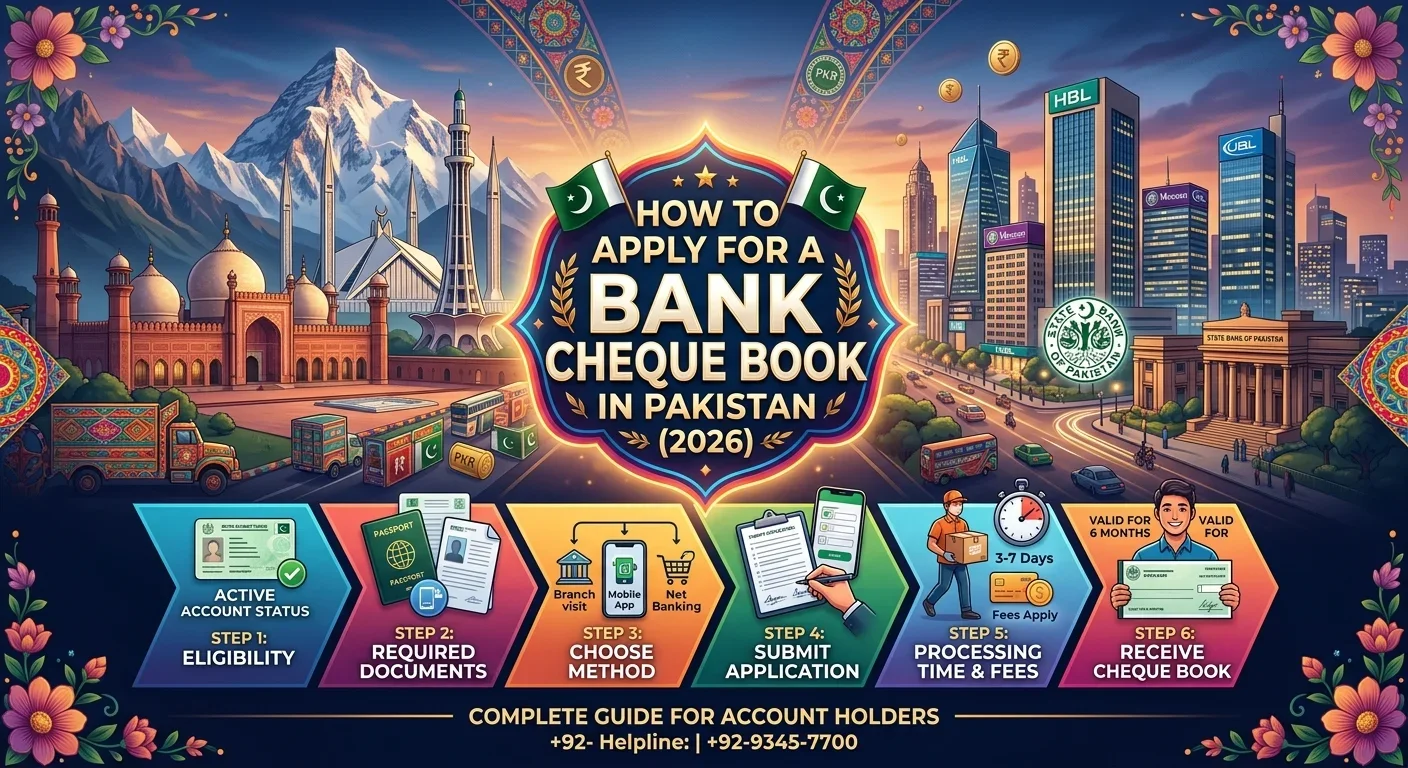
How to Apply for a Bank Cheque Book in Pakistan (2026)
1. Introduction
A cheque book is a useful banking facility that allows account holders to make payments without using cash. In Pakistan, cheque books are commonly used for personal payments, business transactions, rent, school or university fees, supplier payments, and other financial needs. A cheque provides written instructions to a bank to pay a specified amount from the customer's account to another person or organization.
Customers with eligible bank accounts can usually request a cheque book through their bank branch, mobile banking app, internet banking, ATM, or other available banking channels. The exact procedure depends on the bank and type of account.
If you want to know how to apply for a bank cheque book in Pakistan in 2026, this guide explains the complete process in simple language. It covers eligibility, required information, application methods, cheque book charges, delivery, safety precautions, common problems, and frequently asked questions.
2. What Is a Bank Cheque Book?
A bank cheque book is a booklet containing several printed cheques issued by a bank to an eligible account holder. Each cheque contains important details such as the bank name, account information, cheque number, and spaces for the date, payee, amount, and signature.
When you issue a cheque, you instruct your bank to pay the amount written on it from your account, subject to applicable banking procedures and sufficient funds.
Cheque books are generally linked to current or other eligible deposit accounts. Not every account automatically comes with a cheque book, so customers should confirm the facility with their bank.
3. Who Can Apply for a Cheque Book?
The eligibility requirements depend on the bank and account type.
Generally, an account holder may apply for a cheque book if:
-
The bank account is active.
-
The account type supports cheque book facilities.
-
The customer's identity and account information are properly verified.
-
The account is not restricted from cheque transactions.
-
The customer meets the bank's internal requirements.
Current account holders commonly use cheque books, while some savings accounts may also provide cheque facilities depending on the bank's product terms.
For joint accounts, the bank may apply specific signing or operating instructions depending on how the account was opened.
4. When Should You Apply for a Cheque Book?
You should request a cheque book when you expect to make payments through cheques or when the existing cheque leaves are running out.
If your current cheque book has only a few unused leaves remaining, apply for a new one early. This can help prevent delays when you need to make an urgent payment.
Some banks may automatically issue a new cheque book under specific arrangements, while others require customers to place a fresh request.
5. How to Apply for a Cheque Book Through a Bank Branch
Visiting the bank branch is one of the traditional ways to request a cheque book.
The general process is:
-
Visit your bank branch.
-
Ask for the cheque book request form.
-
Enter your account information.
-
Select the required cheque book option if choices are available.
-
Sign the request according to your bank records.
-
Submit the form to the relevant bank representative.
-
Complete any required verification.
-
Pay the applicable fee if required.
-
Receive information about collection or delivery.
-
Collect the cheque book after the bank confirms it is ready.
The bank may verify your identity before processing the request.
6. How to Apply for a Cheque Book Through Mobile Banking
Many banks in Pakistan have introduced digital banking services that allow customers to request cheque books through their mobile applications.
The exact menu can differ between banks, but the process generally involves these steps:
-
Open the official mobile banking application.
-
Log in securely.
-
Go to the Accounts or Services section.
-
Select Cheque Book or Cheque Management.
-
Choose the relevant account.
-
Select the number of cheque leaves if the option is available.
-
Enter or confirm the delivery address.
-
Review the request.
-
Complete OTP or other required verification.
-
Submit the request.
After submission, the application may display a request or tracking reference.
Keep this reference until the cheque book is received.
7. How to Apply Through Internet Banking
Some banks also provide cheque book requests through internet banking.
Log in to the bank's official online banking portal and look for options such as:
-
Cheque Book Request
-
Account Services
-
Cheque Management
-
Request Services
-
Customer Services
Select the account for which you want the cheque book and follow the instructions.
Always access internet banking through the bank's official website. Avoid entering your banking username, password, or OTP on links received from unknown sources.
8. Can You Request a Cheque Book Through an ATM?
Some banks may provide cheque book request facilities through their ATMs, although availability varies.
If your bank offers this service, insert your debit card and enter your PIN. Select the relevant service menu and look for an option related to cheque book requests.
Follow the on-screen instructions carefully.
If the cheque book request option is not available, use the bank's mobile app, internet banking, helpline, or branch instead.
9. Required Information for a Cheque Book Request
The information required can vary between banks and request methods.
A customer may need to provide:
-
Account number
-
Account holder's name
-
CNIC or identification details
-
Registered mobile number
-
Signature
-
Number of cheque leaves required
-
Delivery or branch collection information
If you are applying through a digital banking channel, much of this information may already be available in your account profile.
For a branch request, take your original identification document if the bank requires it for verification.
10. What Documents Are Required?
For a normal cheque book request, banks may not require a large number of documents because the account already exists.
The bank may require identity verification and account information. In some cases, additional documentation may be required depending on the account type or request.
For example, if there is a change in account information, signature, address, or account operating instructions, the bank may require additional verification before issuing a cheque book.
Always follow the specific requirements of your bank.
11. How Many Cheques Are Included in a Cheque Book?
The number of cheque leaves depends on the bank and the type of cheque book selected.
Some banks may offer different cheque book sizes, while others issue a standard number of leaves.
Before submitting your request, check whether your bank allows you to select the number of leaves.
If you frequently make cheque payments, choosing an appropriate cheque book size can reduce the need for repeated requests.
12. Is There a Fee for a Cheque Book?
Cheque book charges vary between banks, account types, and the number of leaves.
Some accounts may offer free cheque books under certain conditions, while other accounts may have charges.
Possible charges can include:
-
Cheque book issuance fee
-
Additional cheque book fee
-
Delivery charges
-
Urgent processing charges, where applicable
-
Replacement charges for certain situations
Banks periodically update their Schedule of Charges, so customers should check the latest charges applicable to their account before placing a request.
13. How Long Does It Take to Receive a Cheque Book?
Processing and delivery time varies from one bank to another.
If you request the cheque book through a branch, the bank may provide a collection date or ask you to wait until the cheque book is prepared.
For digital requests, the bank may deliver the cheque book to the registered address or make it available at a designated branch.
Processing can depend on the bank, location, request method, and whether additional verification is required.
If the cheque book is urgent, contact your bank and ask whether an urgent or branch-collection option is available.
14. How Is the Cheque Book Delivered?
Banks may provide different delivery options.
Depending on the bank, the cheque book may be:
-
Delivered to the registered address
-
Sent to a designated branch
-
Collected from the account-holding branch
-
Delivered through an approved courier service
The customer may receive an SMS or other notification when the cheque book is ready or dispatched.
Make sure your registered contact and address information is updated with the bank.
15. How to Check the Status of a Cheque Book Request
If your bank provides digital tracking, you may be able to check the request status through mobile banking or internet banking.
You can also contact the bank's official helpline or visit the branch.
Keep the request reference number because it can help the bank locate your application quickly.
If the expected delivery period has passed, contact the bank instead of submitting repeated requests without checking the previous request.
16. How to Fill Out a Bank Cheque Correctly
A cheque should be completed carefully.
Normally, you need to enter:
-
Date
-
Name of the person or organization receiving payment
-
Amount in figures
-
Amount in words
-
Signature according to the bank's records
Make sure the written and numerical amounts match.
Do not leave unnecessary blank spaces where another person could add information.
Avoid making alterations or overwriting. If you make a mistake, it is generally safer to use a fresh cheque rather than making unauthorized corrections.
17. What Is a Crossed Cheque?
A crossed cheque generally contains two parallel lines on the front.
Crossing a cheque can restrict how it is paid and may direct the payment through a bank account rather than allowing straightforward cash payment, depending on the crossing and applicable banking rules.
Customers should understand the type of cheque they are issuing and follow their bank's guidance when making important payment.
Guide Information
Eligibility
The eligibility requirements for a cheque book depend on the bank and account type. However, customers generally need to meet the following conditions.
You Must Have an Eligible Bank Account
You must have an active bank account that is eligible for cheque book facilities.
Some account types may have restrictions. For example, certain specialised accounts may not offer cheque books or other negotiable instruments. The eligibility of your account should therefore be confirmed directly with your bank.
Your Account Should Be Active
Your account should normally be active and operational. If an account is dormant, restricted, frozen or under review, the bank may require additional procedures before issuing a cheque book.
You Must Be the Account Holder or an Authorised Person
The account holder can normally request a cheque book. For joint or business accounts, the request may need to follow the operating instructions already registered with the bank.
Identity Verification May Be Required
The bank may verify your identity before processing the request. This is particularly common when applying through a branch.
Your Account Must Meet Bank Requirements
Some banks may have account-specific conditions, such as a minimum account balance or other service requirements. These conditions vary from bank to bank.
Required Documents
The exact requirements can differ, but customers may generally need the following documents or information:
Original valid CNIC.
Bank account number or IBAN.
Registered mobile number.
Cheque book request form, if applying through a branch.
Debit card or banking credentials, where required for digital requests.
Account information.
Additional documents for business or joint accounts, if required.
For a branch application, it is recommended to carry your original CNIC for identification.
Customers applying through mobile banking or internet banking may not need to upload documents if their account and digital banking profile are already verified. However, the bank may require security verification, such as an OTP or transaction password.
Fees
Cheque book charges can vary depending on the bank, account type and number of cheque leaves requested. Some accounts may include a certain cheque book facility without an additional charge, while other accounts may have cheque book printing or service charges. For specialised banking products, banks may also have different pricing structures. The State Bank of Pakistan notes that charges for products and services such as cheque books can vary between banks, and customers should check the concerned bank's current Schedule of Charges. Before confirming your request, you should: Check your bank's latest Schedule of Charges. Ask whether cheque book charges apply. Confirm the number of cheque leaves included. Check whether delivery charges apply. Ensure sufficient balance if the bank deducts a service charge. Because bank charges can change, customers should always confirm the latest information directly with their own bank.
Processing Time
The time required to receive a cheque book depends on several factors, including the bank's internal procedure, printing arrangements and delivery method. A cheque book may be available within a few working days, but the actual processing time can vary. The delivery or collection time may depend on: Bank policy. Branch location. Account type. Number of cheque books requested. Printing and processing arrangements. Courier service, if applicable. Public holidays or non-working days. For example, some banks offer delivery or branch collection arrangements with processing periods that depend on the selected delivery method. Always ask your bank for the estimated processing and collection time for your specific request.
Application Method
The available application method depends on your b
Validity Period
A cheque book itself does not normally have a simple fixed expiry period printed as a general servic
Step-by-Step Process
-
➤ Step 1: Check Whether Your Account Is Eligible – Before visiting the branch, confirm that your account type can receive a cheque book.
-
➤ Step 2: Visit Your Bank Branch – Visit your account-maintaining branch or another branch authorised by your bank to process cheque book requests.
-
➤ Step 3: Carry Your Original CNIC – Take your original valid CNIC for identity verification.
-
➤ Step 4: Request a Cheque Book Application Form – Ask the bank representative for the cheque book request form, if a physical form is required.
-
➤ Step 5: Enter Your Account Details – Write your account number and other required information carefully.
-
➤ Step 6: Select the Number of Cheque Leaves – If your bank provides different cheque book sizes, select the available option that suits your needs.
-
➤ Step 7: Complete the Required Information – Enter the required details and sign the request according to your bank's instructions.
-
➤ Step 8: Submit the Application – Submit the completed request to the authorised bank representative.
-
➤ Step 9: Complete Verification – The bank may verify your identity, signature and account status before processing the request.
-
➤ Step 10: Receive the Request Confirmation – Ask for a receipt, acknowledgement or reference number for your records.
-
➤ Step 11: Wait for Processing – The bank will process the cheque book request according to its internal procedure.
-
➤ Step 12: Collect Your Cheque Book – Collect the cheque book from the designated branch or receive it through another delivery method offered by your bank.
Official Information
Official Website: https://www.sbp.org.pk/
Contact: For assistance with a cheque book request, contact your own bank through its official: Customer service helpline. Bank branch. Mobile banking application. Internet banking support. Official website. Complaint Management Unit. Before contacting the bank, keep the following information ready: Account number. CNIC details. Registered mobile number. Cheque book request reference number, if available. If your cheque book request is delayed or there is another service issue, first raise the matter through your bank's official complaint channel.
Frequently Asked Questions
Yes, some banks allow eligible customers to request a cheque book through official mobile banking or internet banking services.
Yes, a bank branch is a common method for requesting a cheque book.
You may need your original CNIC, account information and a completed cheque book request form, depending on your bank.
Processing time varies depending on the bank, branch location and delivery method.
Charges may vary by bank, account type and number of cheque leaves. Check your bank's current Schedule of Charges.
Not necessarily. Eligibility depends on the type of account and the bank's service conditions.
Generally, eligible account holders can request another cheque book according to their bank's procedure.
Some banks provide different cheque book sizes, but available options depend on the bank and account type.
Contact your bank immediately and request instructions for securing or stopping the unused cheque leaves.
This depends on the bank's policy. The bank may require identity verification or an authorised collection procedure.
Some banks provide this facility through their official mobile applications.
If your bank applies a cheque book charge, you may need sufficient available balance to cover the applicable amount.