Pakistani Passport Types Explained – Ordinary, Official and Diplomatic
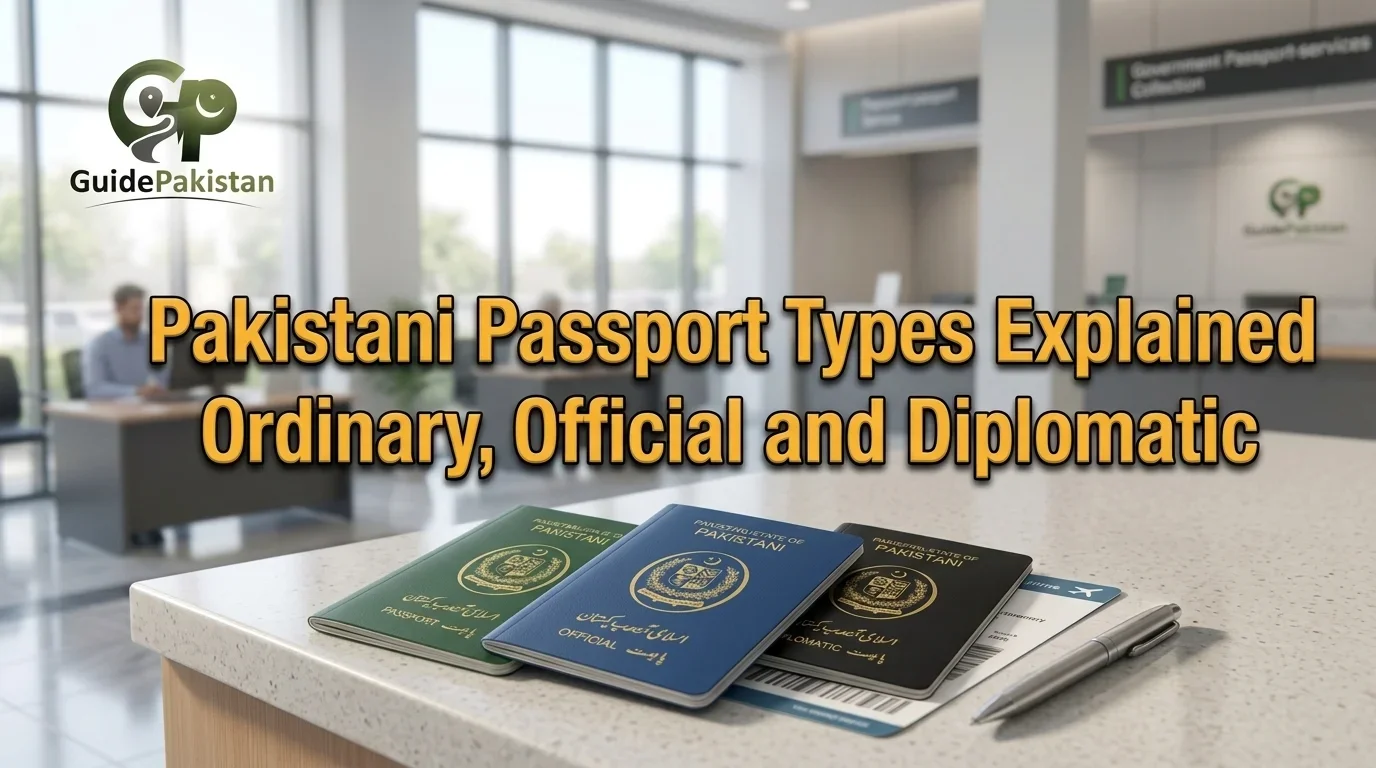
Pakistani Passport Types Explained – Ordinary, Official and Diplomatic
A Pakistani passport is an important travel document that establishes the identity and nationality of a Pakistani citizen when travelling outside the country. However, not every Pakistani passport is issued for the same purpose. Pakistan has different passport categories for ordinary citizens, government officials travelling on official assignments, diplomats, and other entitled dignitaries.
The three major categories most commonly discussed are the Ordinary Passport, Official Passport, and Diplomatic Passport. Each category has a different purpose and eligibility basis. The category a person receives depends mainly on their status, official position, assignment, and the applicable rules.
The Directorate General of Immigration & Passports (DGI&P), Ministry of Interior, states that Pakistani passports are regulated by the Passport Act 1974, Passport Rules 2021 and subsequent amendments. DGI&P identifies Ordinary, Official and Diplomatic Passports among the principal passport subtypes.
This guide explains the differences in simple terms and helps you understand which passport category normally applies to which type of Pakistani citizen or official.
What Are the Main Types of Pakistani Passports?
For practical purposes, three important categories are:
-
Ordinary Passport
-
Official Passport
-
Diplomatic Passport
DGI&P also lists an Emergency Travel Document (ETD) as a separate travel document for Pakistanis abroad who need to return to Pakistan in an emergency. An ETD should not be confused with an ordinary, official, or diplomatic passport.
There is another important distinction. Passport category and passport technology are not exactly the same thing.
DGI&P states that passports are issued as Machine-Readable Passports (MRPs) and e-Passports, and these can exist within the applicable passport categories. Therefore, "ordinary" describes the category or status of the passport, while "MRP" and "e-Passport" describe the passport format or technology.
1. Ordinary Pakistani Passport
The Ordinary Passport is the standard passport issued to Pakistani citizens for international travel.
DGI&P states that an ordinary passport is issued to citizens of Pakistan, subject to completion of the required formalities. It is the passport normally held by members of the general public when they travel abroad for tourism, business, education, employment, family visits, medical treatment, or other personal purposes.
For example, a Pakistani teacher travelling to Saudi Arabia for Umrah, a student travelling to the United Kingdom for education, a businessperson travelling to the UAE, or a family travelling abroad for tourism would ordinarily use an ordinary passport unless the person is entitled to another passport category.
Who Normally Uses an Ordinary Passport?
The ordinary passport is generally used by Pakistani citizens who are not travelling under a government or diplomatic passport entitlement.
It can include:
-
Private-sector employees
-
Teachers and students
-
Businesspersons
-
Self-employed individuals
-
Farmers and workers
-
Retired citizens
-
Children
-
Senior citizens
-
Pakistani citizens travelling for tourism
-
Pakistani citizens travelling for family visits
-
Pakistani citizens travelling for medical purposes
-
Pakistani citizens travelling for education
-
Pakistani citizens travelling for private employment abroad
Being a government employee does not automatically mean that a person should use an official passport for every journey. The official category is connected with the person's entitlement and official assignment under the applicable rules.
DGI&P specifically notes that government, semi-government and autonomous-body employees may need an NOC from their department when applying for a passport.
Ordinary Passport Does Not Mean "Low-Level" Passport
A common misunderstanding is that an ordinary passport is somehow an inferior passport.
That is not the correct way to understand the category.
"Ordinary" mainly identifies the normal civilian passport category. It does not mean that the passport holder has a particular social, professional, or financial status.
A Pakistani citizen can be a highly qualified professional, successful businessperson, university professor, doctor, engineer, or senior private-sector executive and still normally hold an ordinary passport for private travel.
The category is primarily connected with the legal purpose and entitlement of the passport, not a person's wealth or social position.
Ordinary MRP and Ordinary e-Passport
DGI&P currently provides both Machine-Readable Passport and e-Passport facilities for eligible applicants. The ordinary passport category therefore should not automatically be confused with the older idea of a paper-only passport.
The current DGI&P information lists ordinary MRP options of 36, 72 and 100 pages, while the ordinary e-Passport fee schedule lists 36-page and 72-page options.
An applicant should check the current official fee and service information before applying because government fees and service arrangements can change.
Ordinary Passport Validity
DGI&P states that ordinary MRP passports may be issued with five-year or ten-year validity, subject to the applicable rules and fee.
There is an important rule for children: applicants below 15 years of age are issued passports with five-year validity only.
Passport validity should not be confused with the number of passport pages. A passport can have a five-year or ten-year validity while also having different page-count options.
2. Official Pakistani Passport
The Official Passport is a special category intended for Pakistani nationals who fall within the official entitlement provided under the Passport Rules.
It is generally associated with government officials, certain public office holders, and other persons who are entitled to an official passport under the applicable rules and who are travelling for official purposes.
DGI&P states that official passports are issued under Schedule-III of the Passport Rules 2021 and the relevant amendment rules. Its official passport guidance gives examples including Senators, MNAs, Provincial Ministers, Judges of the Supreme Court and High Courts, and government officers proceeding abroad on official assignments.
This means that simply being a government employee does not by itself establish that every employee is entitled to an official passport. The person's category and official assignment must fall within the applicable rules.
Who May Receive an Official Passport?
The exact entitlement is governed by the relevant schedule of the Passport Rules rather than by a general rule that every government employee automatically receives one.
DGI&P gives examples of persons who may be issued official passports, including:
-
Senators
-
Members of the National Assembly
-
Provincial Ministers
-
Judges of the Supreme Court
-
Judges of High Courts
-
Government officers proceeding abroad on official assignments
-
Other persons falling within the relevant official categories under Schedule-III
The exact eligibility should be checked against the current Passport Rules and the applicant's official position and assignment.
Official Passport Is Connected With Official Duties
One of the biggest differences between an ordinary and official passport is the purpose for which the official passport is issued.
For example, if an eligible government officer is selected for an official training course, posting, deputation, secondment, or another approved assignment abroad, the department may initiate the official passport process according to the applicable procedure.
DGI&P's current SOP says that the designated officer of the concerned Ministry, Division or Department forwards a recommendation for issuance of an official passport. The recommendation includes details such as the purpose of the foreign visit, duration and countries to be visited.
This is different from an ordinary passport application, where an individual citizen normally approaches the relevant passport office with the required identity and passport documents.
Documents for an Official Passport
The exact documentation can depend on the applicant's official circumstances and the nature of the assignment.
DGI&P's official passport SOP identifies documents including:
-
CNIC and official pass/card
-
Attested copy of the final selection letter for course, training, posting, deputation or secondment
-
Previous passport, if one has been issued
The concerned department or authorized officer also submits the recommendation and assignment information to DGI&P.
Applicants should therefore follow the instructions of their concerned ministry, division, department or authorized office rather than assuming that the ordinary citizen application process applies to them.
How Is an Official Passport Processed?
According to DGI&P's current SOP, the designated officer of the relevant government department forwards the recommendation. DGI&P then conveys authorization to the relevant Regional Passport Office or Pakistan Mission abroad according to the applicant's location.
The applicant subsequently visits the relevant passport office or mission for data capture and photography with the required authorization and original documents.
DGI&P currently states that official passports are delivered after four working days under the cited SOP.
Because government procedures can be revised, applicants should confirm the current procedure with their department and DGI&P before travelling to the passport office.
3. Diplomatic Pakistani Passport
The Diplomatic Passport is another special category. It is not a general passport available to every Pakistani citizen or every government employee.
DGI&P states that diplomatic passports are issued to dignitaries of the State, diplomats and other entitled categories in accordance with Schedule-IV of the Passport Rules 2021 and relevant amendments.
Approval of diplomatic passports is the responsibility of the Ministry of Foreign Affairs (MOFA). DGI&P's guidance states that Machine-Readable Diplomatic Passports are processed and issued by DGI&P Headquarters, Islamabad, on the basis of authorization issued by the Ministry of Foreign Affairs.
Who Is Eligible for a Diplomatic Passport?
Eligibility is determined by Schedule-IV of the applicable Passport Rules.
The category generally covers eligible state dignitaries, diplomats and other persons specifically entitled under the rules. It should not be assumed that every government servant, elected representative, or public official automatically receives a diplomatic passport.
The exact entitlement depends on the office or position held and the relevant provisions in force at the time.
For this reason, a person should not select "Diplomatic" simply because they work for the government. The correct category must be based on the person's actual passport entitlement.
Who Decides About Diplomatic Passports?
Diplomatic passport authorization involves the Ministry of Foreign Affairs.
DGI&P specifically states that approval of diplomatic passports is the responsibility of MOFA, while DGI&P Headquarters in Islamabad processes and issues Machine-Readable Diplomatic Passports on the basis of MOFA authorization.
This makes the diplomatic passport process different from the normal ordinary passport application made by a citizen.
Ordinary vs Official vs Diplomatic Passport
The simplest way to understand the three categories is to look at their purpose and eligibility.
Ordinary Passport
The ordinary passport is the normal travel document for Pakistani citizens travelling internationally for personal or general purposes.
Official Passport
The official passport is for Pakistani nationals who fall within the official categories under the rules, particularly persons travelling abroad on qualifying official assignments.
Diplomatic Passport
The diplomatic passport is for diplomats, state dignitaries and other categories specifically entitled under the applicable rules.
The distinction is therefore primarily about legal entitlement and purpose, not simply about the person's job title.
Are Official and Diplomatic Passports the Same?
No.
Both are special passport categories, but they are legally distinct.
DGI&P places official passports under Schedule-III and diplomatic passports under Schedule-IV of the Passport Rules 2021. Diplomatic passport approval is handled by the Ministry of Foreign Affairs, while the official passport procedure involves the relevant government ministry, division or department and DGI&P authorization.
The two categories may also receive different treatment by foreign countries under bilateral agreements or visa arrangements. DGI&P's published visa information, for example, identifies countries where visa exemptions apply specifically to diplomatic, official, or both categories. Such arrangements vary by country and can change, so travellers should check the latest destination-country requirements before travel.
Does a Diplomatic or Official Passport Automatically Mean Visa-Free Travel?
No.
Holding a diplomatic or official passport does not mean that every country will automatically allow visa-free entry.
Visa exemptions are determined by the destination country's laws, bilateral agreements, treaties and current policies.
Pakistan's DGI&P publishes information on visa-abolition and exemption agreements, including arrangements that apply to diplomatic and/or official passport holders for particular countries. The published list shows that the duration and categories can differ from one country to another.
Therefore, passport type and visa requirements are related but separate issues.
Can a Person Hold Both Ordinary and Official Passports?
The Passport Rules contain specific provisions about holding ordinary and official passports.
The rules state that a person may be allowed to hold two types of passport at one time. Where an official passport is issued to someone who already has a valid ordinary passport, the fact of holding another passport may be indicated through cross entries on the passports.
The rules also contain specific provisions about what happens after an official assignment or when official service ends.
This is another reason why people should not simply assume that an ordinary passport must always be cancelled when an official passport is issued.
Can a Diplomatic Passport Holder Keep Another Passport?
The rules treat diplomatic passports differently.
According to Passport Rules 2021, a diplomatic passport holder is not allowed to retain another type of passport. The rules also contain specific provisions concerning surrender and changing passport type while abroad.
Because these are legal and administrative rules, anyone affected by them should follow the instructions of the Ministry of Foreign Affairs and DGI&P rather than relying on general information.
What Is an Emergency Travel Document?
An Emergency Travel Document, or ETD, is not another version of the ordinary, official or diplomatic passport.
DGI&P explains that an ETD may be issued to Pakistanis abroad in an emergency to allow them to travel back to Pakistan one time.
For example, a Pakistani citizen who is abroad and faces a qualifying emergency involving their travel document may be directed toward the ETD procedure through the relevant Pakistan Mission.
An ETD should therefore not be treated as a substitute for a normal passport for future international travel.
Does Passport Color Determine the Category?
People sometimes try to identify passport categories solely by color. This can cause confusion.
The legally important issue is the passport category and the person's entitlement, not simply what someone assumes from the appearance of a passport.
When completing a visa application, always select the passport type exactly as shown or required by the relevant official instructions.
Pakistan's Ministry of Foreign Affairs has published visa guidance explaining that ordinary passports are normally used by common citizens, while diplomatic and official passports belong to special categories. It also warns that selecting the wrong passport type in a visa application can cause problems with the visa application.
Passport Type vs Passport Technology
Another common source of confusion is the difference between a passport category and its technology.
A passport can be discussed in terms of:
-
Ordinary
-
Official
-
Diplomatic
It can also be discussed in terms of:
-
Machine-Readable Passport (MRP)
-
e-Passport
These are not exactly the same classification.
DGI&P's passport information explains that MRP and e-Passport are the two major passport types in its technology-based classification, while each is further divided into applicable passport subtypes such as ordinary, official and diplomatic.
Therefore, saying "I have an e-Passport" does not by itself tell someone whether it is ordinary, official, or diplomatic.
What Passport Does a Normal Pakistani Citizen Need?
For most Pakistani citizens travelling abroad for personal reasons, the relevant category is the Ordinary Passport.
DGI&P states that the ordinary passport is issued to Pakistani citizens subject to completion of the required formalities.
If you are a private employee, student, teacher, businessperson, farmer, worker, retiree or another ordinary citizen travelling for personal purposes, you would normally apply for an ordinary passport unless a specific legal entitlement applies to you.
What If You Are a Government Employee?
Government employment by itself does not mean that you should automatically apply for an official passport.
The official passport category is governed by the Passport Rules and the relevant entitlement. DGI&P specifically refers to government officers proceeding abroad on official assignments and other persons covered by Schedule-III.
A government employee should therefore ask their concerned department whether the planned foreign trip qualifies for an official passport and whether the department will issue the required recommendation or authorization.
For ordinary personal travel, the applicable passport arrangement may be different.
What If You Are a Diplomat?
A diplomat or another person specifically entitled to a diplomatic passport should follow the Ministry of Foreign Affairs and DGI&P procedures applicable to diplomatic passports.
DGI&P states that diplomatic passport approval is the responsibility of MOFA and that issuance by DGI&P Headquarters is based on MOFA authorization.
Do Ordinary, Official and Diplomatic Passports Have the Same Visa Privileges?
Not necessarily.
Visa privileges depend on the destination country and the applicable agreement or immigration rules.
Pakistan's official visa information contains separate categories for diplomatic and official passport holders in various bilateral visa exemption arrangements. Some countries may provide exemptions to both categories, while others may distinguish between diplomatic and official passports.
An ordinary passport holder should therefore not assume that an exemption available to diplomatic or official passport holders also applies to ordinary passport holders.
Likewise, an official or diplomatic passport holder should confirm the exact current rules for the destination country.
Does Passport Type Affect the Right to Travel?
A passport is an important document for international travel, but possession of a passport does not by itself guarantee entry into another country.
The destination country controls its own immigration and visa requirements.
DGI&P describes the Pakistani passport as a document that establishes the identity of the citizen abroad and facilitates international travel.
Travellers should therefore check both their Pakistani passport requirements and the immigration requirements of the destination country before travelling.
How to Choose the Correct Passport Type
The correct category is generally determined by your legal entitlement and the purpose of the passport.
Ask yourself:
Are you a normal Pakistani citizen travelling privately?
The ordinary passport is generally the relevant category.
Are you an eligible government/public official travelling under an official assignment?
You may fall within the official passport category, subject to the applicable rules and departmental authorization.
Are you a diplomat, state dignitary, or another person specifically entitled under Schedule-IV?
The diplomatic passport category may apply, subject to MOFA authorization and the relevant rules.
Do not select a category simply because it appears more prestigious or because someone else has that type of passport. The passport category must correspond to the person's actual entitlement.
Important Difference Between Job Status and Passport Status
A person's occupation and passport category are not always the same thing.
For example, a government employee may have an ordinary passport for private travel while also being eligible for an official passport for a qualifying official assignment, subject to the rules.
Similarly, being a senior public figure does not mean that a person can simply request a diplomatic passport without falling within the applicable legal category.
The rules, not personal preference, determine eligibility.
Current Ordinary Passport Fees
Ordinary passport fees are separate from the general explanation of passport categories and can change through government notifications.
At the time of this guide's preparation, DGI&P's published MRP fee schedule lists ordinary MRP fees according to page count, validity period and normal/urgent service. The published schedule includes 36-, 72- and 100-page ordinary MRP options.
DGI&P also publishes separate fees for ordinary e-Passports. Its current published e-Passport schedule lists 36-page and 72-page options and states that Fast Track service is not available for e-Passport delivery.
Because fees are subject to government revision, applicants should always check the current DGI&P fee schedule before making payment.
Current Processing Information
For ordinary MRP applications, DGI&P currently lists different processing priorities, including Fast Track, Urgent and Normal categories. The published information states that the listed processing periods begin after successful processing and do not include additional courier/shipment time for remote areas or Pakistani Missions abroad.
Official passport processing is governed by its separate departmental procedure. DGI&P's current official passport SOP states that official passports are delivered after four working days.
Diplomatic passport processing follows the authorization procedure involving the Ministry of Foreign Affairs and DGI&P Headquarters.
Final Summary
The three main Pakistani passport categories discussed in this guide serve different purposes:
Ordinary Passport: The standard passport for Pakistani citizens travelling internationally, particularly for personal or general travel.
Official Passport: A special passport for persons entitled under the official passport provisions, including eligible officials travelling on qualifying official assignments.
Diplomatic Passport: A special passport for diplomats, state dignitaries and other categories specifically entitled under the diplomatic passport provisions.
The most important point is that passport category is based on legal entitlement and purpose, not simply on a person's occupation, wealth or social position.
For ordinary citizens, the ordinary passport is generally the relevant passport. Government officials should confirm whether their assignment qualifies for an official passport through their department. Diplomatic passport matters are handled through the applicable Ministry of Foreign Affairs and DGI&P procedures.
For the latest requirements, fees, processing arrangements and rules, always consult the official Directorate General of Immigration & Passports information before applying because government procedures can change.
Guide Information
Eligibility
Ordinary Passport: Pakistani citizens who meet the applicable passport requirements. Official Passport: Pakistani nationals who fall within the official categories prescribed under Schedule-III of the Passport Rules and applicable amendments, including eligible officials travelling on qualifying official assignments. Diplomatic Passport: diplomats, state dignitaries and other categories specifically entitled under Schedule-IV, subject to the applicable rules and authorization.
Required Documents
For an Ordinary Passport, requirements depend on the application type. DGI&P generally requires identity documents such as a valid CNIC/NICOP and previous passport where applicable; government employees may also require an NOC from their department. Official Passport applicants follow departmental SOPs and may need CNIC, official pass/card, departmental recommendation/authorization, assignment or selection letter and previous passport where applicable. Diplomatic Passport applicants follow the Ministry of Foreign Affairs authorization process and applicable DGI&P requirements.
Fees
Ordinary passport fees depend on passport format, page count, validity and processing category. DGI&P currently publishes separate fee schedules for ordinary MRP and ordinary e-Passport. Official and diplomatic passport arrangements are governed by their respective official procedures and eligibility rules; applicants should confirm any applicable charges or fee treatment directly with the concerned authority before applying. Do not rely on outdated fee information.
Processing Time
Ordinary MRP processing is currently listed by DGI&P under Fast Track, Urgent and Normal categories, subject to successful processing and excluding certain additional courier/shipment time. DGI&P's official passport SOP states that official passports are delivered after four working days. Diplomatic passport processing depends on Ministry of Foreign Affairs authorization and DGI&P processing. Confirm the latest processing time before applying.WHEN TO APPLY:Apply before planned international travel with enough time for passport processing, delivery and any required visa. Government officials should begin the official passport process as soon as their foreign assignment, training, posting, deputation or other qualifying assignment is confirmed. Diplomatic passport cases should follow the relevant Ministry of Foreign Affairs procedure.
Application Method
Ordinary passport applications are processed throu
Validity Period
Ordinary MRP passports may be issued with five-year or ten-year validity subject to the applicable r
Step-by-Step Process
- Determine why you need a Pakistani passport.
- Decide whether your travel is personal or connected with an official assignment.
- Confirm that you are a Pakistani citizen.
- If you are an ordinary citizen travelling privately, identify the ordinary passport category.
- If you are a government or public official, ask your department whether you are entitled to an official passport.
- If you believe you are entitled to a diplomatic passport, confirm your entitlement under the applicable rules.
- Do not select official or diplomatic status merely because of your job title.
- Check the latest DGI&P passport information.
- Check the current Passport Rules and relevant amendments if your case involves an official or diplomatic category.
- Ordinary applicants should verify the required CNIC/NICOP information.
- Ordinary applicants should keep their previous passport available if one was previously issued.
- Government employees should obtain an NOC where the applicable ordinary passport procedure requires one.
- Official passport applicants should contact the designated officer of their Ministry, Division or Department.
- Provide the department with the information needed for the official assignment.
- The concerned department should prepare the required recommendation for an official passport.
- Include the purpose of the foreign visit in the departmental recommendation where required.
- Include the expected duration of the assignment where required.
- Include the countries to be visited where required.
- Provide the required official identity/pass information.
- Provide the applicable training, posting, deputation, secondment or selection letter where required.
- Provide the previous passport if applicable.
- Wait for the relevant authorization from DGI&P or the competent authority.
- Visit the designated passport office or Pakistan Mission when instructed.
- Bring original identity and authorization documents required for the case.
- Complete data capture and photograph requirements.
- Review your personal information carefully before final processing.
- Confirm that your name and other identity details match your official identity record.
- For diplomatic cases, follow the Ministry of Foreign Affairs authorization procedure.
- Diplomatic passport cases are processed by DGI&P Headquarters on the basis of applicable MOFA authorization.
- Do not assume that an official passport and diplomatic passport have identical privileges.
- Check the visa rules of the country you intend to visit.
- Confirm whether the destination has a visa exemption for your specific passport category.
- Do not assume that a visa exemption for diplomatic passport holders also applies to ordinary passport holders.
- Check your passport validity before travel.
- Make sure your passport has sufficient pages if frequent travel is expected.
- Pay the applicable passport fee for ordinary passport services where required.
- Keep your payment evidence and application information safely.
- Track the application through the applicable official system where tracking is available.
- Wait for the passport to be dispatched or made available for collection.
- Collect the passport according to the instructions provided by DGI&P or the relevant authority.
- Check the passport immediately for spelling, date and personal-information errors.
- If you find an error, contact the relevant passport authority promptly.
- Keep the passport secure after receiving it.
- Before travelling, separately check visa, airline and destination-country entry requirements.
- Recheck official government information if your travel date is several months away because rules, fees and procedures may change.
Official Information
Official Website: https://dgip.gov.pk/
Contact: Directorate General of Immigration & Passports (DGI&P), Ministry of Interior, Government of Pakistan. Official website: [DGI&P – Directorate General of Immigration & Passports](https://dgip.gov.pk/?utm_source=chatgpt.com). DGI&P lists its general contact number as +92-51-111-344-777. For passport policy queries, DGI&P lists [passport.policy@dgip.gov.pk](mailto:passport.policy@dgip.gov.pk). Applicants should verify contact details on the official website before using them.
Frequently Asked Questions
The main categories discussed here are Ordinary, Official and Diplomatic Passports. DGI&P also identifies Emergency Travel Documents as a separate travel document.
It is the standard passport issued to Pakistani citizens for international travel, subject to the required formalities.
Most Pakistani citizens travelling for personal or general purposes use an ordinary passport.
No. Ordinary passports are used by Pakistani citizens from many occupations and backgrounds.
Yes. A private businessperson can normally hold an ordinary passport for international travel.
Yes. A teacher travelling for personal purposes can normally use an ordinary passport.
No. Official passport entitlement depends on the applicable Passport Rules and the person's qualifying category or assignment.
It is a special passport issued to Pakistani nationals who fall within the official categories prescribed by the Passport Rules.
DGI&P gives examples including certain Senators, MNAs, Provincial Ministers, superior-court judges and government officers travelling abroad on official assignments, subject to the applicable rules.
Not automatically. The officer must fall within the applicable entitlement and follow the required official procedure.
It is a special passport issued to diplomats, state dignitaries and other entitled categories under the relevant rules.
DGI&P states that approval of diplomatic passports is the responsibility of the Ministry of Foreign Affairs.
DGI&P Headquarters in Islamabad processes and issues Machine-Readable Diplomatic Passports on the basis of authorization from the Ministry of Foreign Affairs.
No. They are separate categories governed by different provisions of the Passport Rules.
Ordinary passports are generally for citizens' international travel, while official passports are for eligible persons travelling under qualifying official circumstances.
Official passports cover specified official categories, while diplomatic passports cover diplomats, state dignitaries and other categories specifically entitled under the diplomatic provisions.
No. Passport category is based on legal entitlement and purpose, not wealth.
No. The relevant rules and circumstances determine entitlement.
Yes. Government employment does not by itself mean that every journey must use an official passport.
The Passport Rules contain provisions allowing a person to hold two types of passport at one time in specified circumstances.
The Passport Rules specifically state that a diplomatic passport holder is not allowed to retain another type of passport.
It is a document issued to Pakistanis abroad in an emergency for one-time return travel to Pakistan.
No. It is a separate emergency travel document.
MRP means Machine-Readable Passport.
It is a passport using electronic passport technology and is distinct from the ordinary/official/diplomatic category classification.
No. Ordinary describes the passport category, while MRP describes the passport format or technology.
Yes. DGI&P provides an ordinary e-Passport facility.
Yes, subject to the applicable rules and age requirements. Children under 15 are issued five-year passports only.
No. Page count is a separate feature of the passport.
No. Visa exemptions depend on the destination country's laws and applicable agreements.
No. Visa treatment varies by destination country and applicable agreements.
They should not assume so. Visa privileges are determined by the destination country's rules and applicable agreements.
Passport use should follow the applicable rules and the circumstances for which the passport was issued. The holder should obtain guidance from the relevant authority where necessary.
Select the passport type that actually corresponds to your passport and follow the destination country's official visa instructions.
It can create visa-processing problems or lead to rejection in some systems, so passport information should be entered carefully.
Check the official Directorate General of Immigration & Passports website and the applicable Passport Rules.
Check the current fee information published by DGI&P before payment.
Check DGI&P's official Official Passport guidance and consult the designated officer of the concerned government department.
Check DGI&P's diplomatic passport guidance and follow the applicable Ministry of Foreign Affairs authorization procedure.
Yes. Applicants should verify current rules, fees and procedures before applying.