Kumrat Valley Travel Guide 2026 – Best Places, Hotels, Routes & Travel Tips
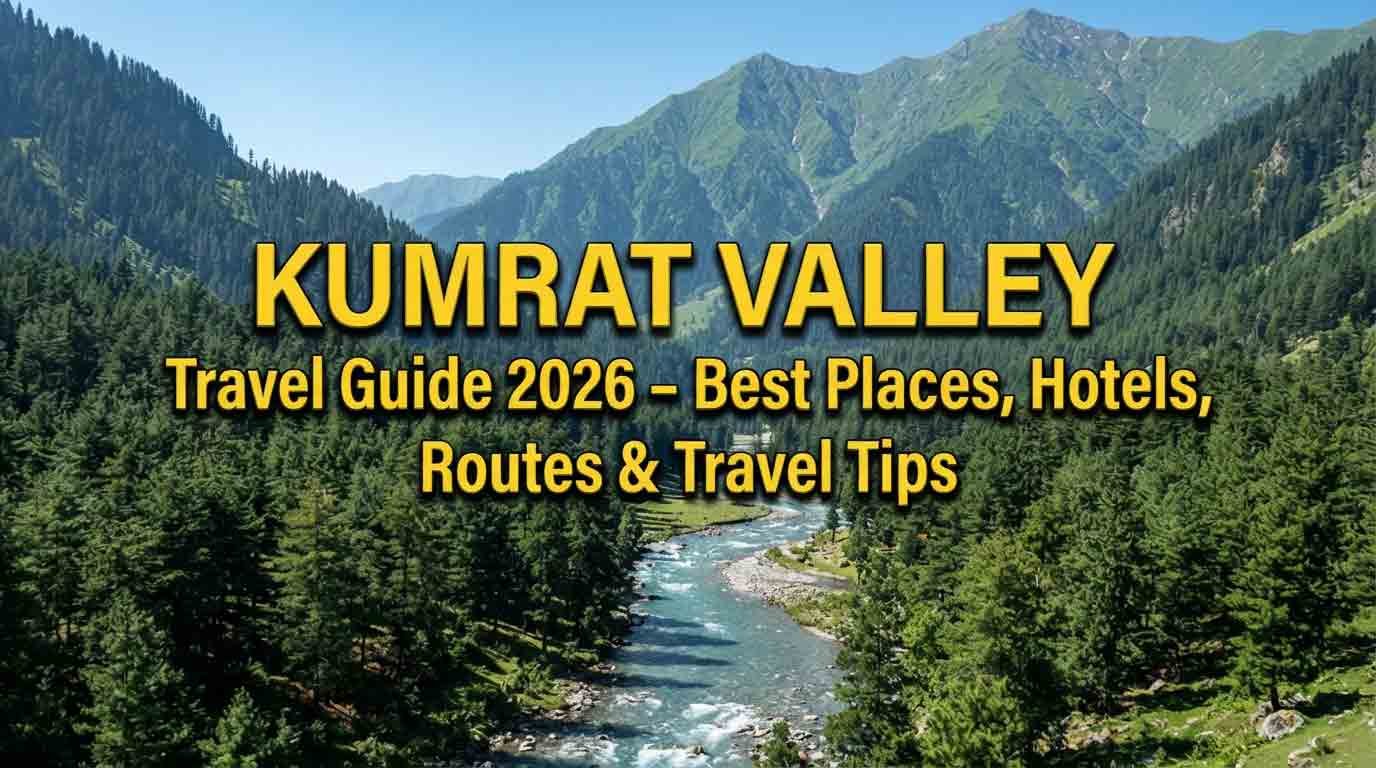
Kumrat Valley Travel Guide 2026 – Best Places, Hotels, Routes & Travel Tips
Kumrat Valley is one of the most beautiful and increasingly popular mountain destinations in Khyber Pakhtunkhwa, Pakistan. Located in Upper Dir District, the valley is famous for its dense deodar forests, the flowing Panjkora River, waterfalls, green meadows, wooden huts, camping areas and spectacular mountain scenery.
Unlike highly commercialized destinations, Kumrat offers a more natural and adventurous experience. The valley is especially popular among travelers who enjoy camping, photography, trekking, riverside stays and peaceful mountain landscapes.
The main Kumrat experience is centered around the forested valley, Panjkora River and Kumrat Waterfall, while higher destinations such as Jahaz Banda and Katora Lake require additional travel, jeep rides and trekking.
Current 2026 travel information places Kumrat roughly 370–385 km from Islamabad, with the journey generally passing through Chakdara, Timergara, Dir and Thal before the rougher jeep track into the valley. The final approach is an important part of planning because ordinary cars are generally not suitable for the rough track beyond Thal.
Kumrat is therefore best understood as two different travel experiences: a relatively relaxed forest-and-river vacation in the main valley and a more demanding mountain adventure toward Jahaz Banda and Katora Lake.
Kumrat Valley at a Glance
| Feature | Details |
|---|---|
| Location | Upper Dir District, Khyber Pakhtunkhwa, Pakistan |
| Region | Hindu Kush mountain region |
| Nearest Gateway Town | Thal |
| Famous River | Panjkora River |
| Famous Attraction | Kumrat Waterfall |
| Famous Forest | Deodar forest |
| Famous Meadow | Jahaz Banda |
| Famous Lake | Katora Lake |
| Main Activities | Camping, sightseeing, trekking, photography and nature tourism |
| Best General Season | May to September, with summer generally most suitable |
| Recommended Stay | 3–5 days |
| High-Altitude Trek | Jahaz Banda and Katora Lake |
| Main Transport Issue | Rough road beyond Thal |
| 2026 Travel Cost | Depends on transport, group size, accommodation and itinerary |
Kumrat's main valley is generally associated with forest, river and waterfall experiences, while Jahaz Banda and Katora Lake are higher-altitude trekking destinations.
Why Visit Kumrat Valley in 2026?
Kumrat is ideal for travelers who want a combination of:
-
Dense deodar forests
-
Mountain scenery
-
Riverside camping
-
Waterfalls
-
Alpine meadows
-
Trekking
-
Photography
-
Fresh mountain air
-
Peaceful landscapes
-
Adventure travel
-
Family nature trips
-
Friends' camping trips
-
High-altitude trekking
The valley's natural character is one of its biggest attractions. The Panjkora River passes through the landscape while thick forests create a distinctive green mountain environment.
Kumrat is also attractive because travelers can choose their level of adventure. A visitor can stay near the river, enjoy the forest and waterfall without doing a difficult trek, or extend the journey toward Jahaz Banda and Katora Lake.
Where Is Kumrat Valley?
Kumrat Valley is located in Upper Dir District of Khyber Pakhtunkhwa.
Thal is the main gateway for travelers entering the Kumrat side. From the Islamabad direction, travelers generally travel through the Swat Motorway toward Chakdara and then continue through Timergara and Dir toward Thal.
The distance from Islamabad is commonly estimated at roughly 370–385 km, although the actual travel time varies depending on traffic, road conditions, stops and the final jeep journey.
Best Places to Visit in Kumrat Valley
The major attractions include:
-
Kumrat Forest
-
Panjkora River
-
Kumrat Waterfall
-
Kala Chashma
-
Do Janga
-
Jahaz Banda Meadows
-
Katora Lake
-
Upper Kumrat areas
-
Riverside camping areas
-
Local mountain villages and viewpoints
Not every attraction is equally accessible. Kumrat Forest, the Panjkora River and the main waterfall are relatively easier to include in a normal trip, while Jahaz Banda and Katora Lake require considerably more effort.
Kumrat Forest
The deodar forest is one of the defining features of Kumrat Valley.
The tall trees, mountain air, river and green surroundings make the forest especially attractive for:
-
Nature photography
-
Walking
-
Camping
-
Picnics
-
Relaxation
-
Landscape photography
The forest is particularly beautiful during the greener summer months.
Visitors should avoid damaging trees, leaving waste or making excessive noise.
Panjkora River
The Panjkora River is one of the major natural features of Kumrat.
Riverside locations provide opportunities for:
-
Photography
-
Camping
-
Relaxation
-
Picnic stops
-
Nature observation
However, travelers should remain careful around fast-flowing water, particularly after rain.
Do not camp directly beside dangerous river sections or near unstable riverbanks.
Kumrat Waterfall
Kumrat Waterfall is one of the valley's most famous attractions.
The waterfall is surrounded by forest and mountain scenery and is generally much easier to visit than the higher trekking destinations.
The exact access distance depends on where you stay and current road conditions.
A visit should include time to explore the surrounding forest and river rather than treating the waterfall as a quick photo stop.
Kala Chashma
Kala Chashma is a natural spring and stream attraction associated with the wider Kumrat area.
It is generally approached as a jeep-accessible excursion.
The route can be rough, so local transport and current road conditions should be confirmed before departure.
Do Janga
Do Janga is associated with the more remote side of Kumrat.
The journey can involve rough jeep tracks and walking, depending on the current access point and conditions.
Travelers should allow additional time rather than treating it as a short sightseeing stop.
Heavy rain can change mountain-road conditions quickly, so local advice is important.
Jahaz Banda Meadows
Jahaz Banda is one of the most spectacular high-altitude destinations associated with Kumrat.
The meadow sits at roughly 3,000–3,100 metres above sea level and provides broad alpine scenery surrounded by mountains.
The route generally involves a jeep journey toward the appropriate trailhead followed by trekking.
Current travel guides commonly describe the walk from the upper access point as taking around two to three hours, although the actual time depends on fitness, weather, trail conditions and the starting point.
Jahaz Banda is especially attractive for:
-
Alpine landscapes
-
Camping
-
Photography
-
Trekking
-
Sunrise and sunset views
-
Mountain scenery
Travelers should carry warm clothing because temperatures can drop considerably after sunset.
Katora Lake
Katora Lake is one of the most famous high-altitude attractions associated with Kumrat.
The name "Katora" refers to a bowl or cup, reflecting the lake's distinctive shape.
The lake is located at high altitude beyond Jahaz Banda and requires a demanding trek.
Different 2026 travel sources give varying distances and trekking times depending on the route and starting point, but travelers should treat Katora Lake as a serious mountain trek rather than a casual sightseeing excursion.
A proper Katora Lake trip should include:
-
Good hiking shoes
-
Warm clothing
-
Water
-
Snacks
-
Sun protection
-
Offline maps
-
Local guide
-
Adequate physical preparation
Weather can change rapidly at high altitude, so travelers should not start the trek without checking local conditions.
Kumrat Valley Hotels and Accommodation
Accommodation in Kumrat is different from destinations such as Murree or Nathiagali.
Travelers can find:
-
Hotels
-
Guesthouses
-
Riverside huts
-
Wooden cabins
-
Glamping resorts
-
Camping sites
-
Tented accommodation
Camping remains an important part of the Kumrat experience, while the number of organized accommodation options has increased.
Current listings include accommodation such as:
-
KhanaBadosh Glamps Kumrat
-
The Woodpecker – Glamps and Resorts
-
Ecotourism Huts Kumrat
-
Kumrat Glamping Resorts
-
Cedar Huts
-
Latitude Resort
-
Mountain Lodge Resort
-
Kumrat Maskan Hotel
-
Panjkora Hotel & Resort
-
Amaan Resorts
Availability, prices and facilities should be confirmed directly before booking because seasonal demand can change considerably.
For families, a private room or glamping accommodation may be more comfortable.
For groups of friends, camping can provide a more traditional Kumrat experience.
For Jahaz Banda and Katora Lake, travelers should expect much simpler accommodation and camping facilities than in the main valley.
Estimated Accommodation Cost 2026
Accommodation prices vary according to season, location and facilities.
As a planning range:
-
Basic camping: approximately PKR 1,500–3,000 per person per night
-
Basic room or hut: approximately PKR 2,000–5,000+ per night
-
Mid-range accommodation: approximately PKR 5,000–12,000+ per night
-
Better glamping/resort accommodation: approximately PKR 10,000–25,000+ per night
-
Premium options: may exceed PKR 25,000 during peak periods
These should be treated as planning estimates rather than fixed official rates. Current sources indicate that peak summer demand can significantly increase accommodation prices.
How to Reach Kumrat Valley
The most common route from Islamabad is:
Islamabad → Swat Motorway → Chakdara → Timergara → Dir → Thal → Kumrat Valley
The final part of the journey is significantly different from the main highway route.
From Thal, travelers generally need a local 4x4 jeep for the rough track into Kumrat.
Ordinary cars should not be assumed to be suitable for the final rough section.
Islamabad to Kumrat Valley Route
A typical Islamabad route is:
Islamabad → M-1/Swat Motorway → Chakdara → Timergara → Dir → Thal → Kumrat
The total distance is generally around 370–385 km, with published 2026 estimates putting the road journey to Thal at roughly 8–9 hours under favorable conditions. The jeep section adds additional time.
Travelers should leave early because reaching Thal late can make the final mountain section more difficult.
Lahore to Kumrat Valley Route
Travelers from Lahore generally travel toward Islamabad and then continue through the Swat Motorway and Dir route.
A practical route is:
Lahore → Islamabad/Rawalpindi → Swat Motorway → Chakdara → Timergara → Dir → Thal → Kumrat
The journey can take approximately 12–14 hours or longer depending on traffic and stops, so many travelers prefer to divide the journey.
Peshawar to Kumrat Valley Route
A typical route from Peshawar follows the northern road network toward Malakand/Chakdara and then continues through Dir and Thal.
The total journey depends on the exact starting point, traffic and road conditions.
Can You Take a Car to Kumrat?
A normal car can generally be used for the main road journey toward Thal.
However, the rough track beyond Thal is a different matter.
A local 4x4 jeep is generally recommended for the rough valley section.
Do not risk a low-clearance family car on a rough mountain track simply to save money.
A jeep also provides access to additional locations within the valley.
Kumrat Valley Jeep Rent
Jeep costs can vary according to:
-
Route
-
Season
-
Vehicle type
-
Number of passengers
-
Waiting time
-
Road condition
-
Destination
Current 2026 travel information reports local jeep rates around PKR 22,000 for travel toward the Kumrat forest area and around PKR 12,000 toward some Jahaz Banda-related routes, but these figures should be confirmed at the local jeep stand before departure.
Since jeep charges are commonly calculated per vehicle rather than per passenger, groups can reduce the per-person cost by sharing a jeep.
Kumrat Valley Travel Cost 2026
The total cost depends on:
-
Departure city
-
Number of travelers
-
Private or shared transport
-
Jeep requirements
-
Number of nights
-
Hotel category
-
Camping
-
Food
-
Trekking guide
-
Horse or porter
-
Additional destinations
-
Travel season
Current 2026 package information shows group trips can range from approximately PKR 14,500–16,500 per person for basic three-day arrangements, while longer trips including Katora Lake can cost substantially more. Other sources list four-day group camping packages around PKR 22,000–32,000 per person and five-day Katora packages around PKR 30,000–40,000 per person.
For independent travelers, it is better to calculate transport, jeep, accommodation, food and activities separately.
Estimated Budget for Two People
A reasonable planning budget for two people can be approximately:
| Expense | Planning Range |
|---|---|
| Islamabad–Kumrat transport | PKR 20,000–40,000+ |
| Local jeep | PKR 12,000–25,000+ |
| Accommodation/camping | PKR 6,000–20,000+ |
| Food | PKR 6,000–12,000+ |
| Local sightseeing | PKR 3,000–8,000+ |
| Miscellaneous | PKR 5,000–10,000+ |
A practical overall budget can therefore be around PKR 55,000–115,000+ for two people, depending heavily on transport type, hotel choice, jeep sharing and itinerary.
A Katora Lake adventure or private vehicle can increase the total significantly.
Estimated Family Trip Cost
A family of four can expect a higher budget because of transport and accommodation requirements.
A short three-to-five-day family trip can reasonably require approximately:
PKR 90,000–180,000+
depending on:
-
Private transport
-
Hotel category
-
Number of rooms
-
Jeep rental
-
Food
-
Number of attractions
-
Travel season
Families should keep an emergency reserve for unexpected delays or road-related changes.
Food in Kumrat Valley
Food options are simpler than in major cities.
Travelers may find:
-
Paratha
-
Eggs
-
Tea
-
Dal
-
Rice
-
Chicken
-
BBQ
-
Tikka
-
Local bread
-
Snacks
-
Basic restaurant meals
Camping and roadside restaurants provide basic food, but travelers should carry snacks and water because shops become less common as you travel deeper into the mountains.
Current travel information also recommends carrying additional supplies because facilities become limited beyond Thal.
Best Time to Visit Kumrat Valley
The best time depends on your purpose.
May
May can be attractive for travelers looking for:
-
Spring scenery
-
Fresh greenery
-
Fewer crowds
-
Pleasant daytime temperatures
However, higher trekking areas can still have difficult conditions.
June
June is generally an excellent period for the main valley.
The forests become greener and outdoor activities become more practical.
July and August
These are among the busiest months.
Advantages include:
-
Green landscapes
-
Better access to high-altitude areas
-
Trekking opportunities
-
Camping season
Disadvantages include:
-
Higher accommodation demand
-
Higher prices
-
More crowds
-
Possible rain-related road issues
September
September can be an excellent month for travelers who want:
-
Cooler weather
-
Fewer crowds
-
Trekking
-
Photography
-
Mountain scenery
October
October can still be attractive for the lower valley, but higher-altitude routes become more weather-dependent.
Best Months for Kumrat Valley
For a general Kumrat trip, May to September is a practical planning period, with June to September commonly considered the more reliable period for the valley and high-altitude trekking.
Always check current road and weather conditions before traveling.
How Many Days Are Enough for Kumrat?
2 Days
Suitable for a quick visit focused on:
-
Kumrat Forest
-
Panjkora River
-
Waterfall
3 Days
A good choice for first-time travelers who want to explore the main valley.
4 Days
Better for combining the main valley with Jahaz Banda.
5 Days
Recommended for travelers who want to include Katora Lake without rushing.
6–7 Days
Suitable for a slower adventure with additional trekking, camping and weather flexibility.
Suggested 3-Day Kumrat Itinerary
Day 1
Travel from Islamabad toward Thal.
Take a local jeep toward Kumrat.
Check into a hotel, hut or campsite.
Explore the riverside and forest.
Overnight in Kumrat.
Day 2
Visit Kumrat Waterfall.
Explore the deodar forest.
Visit Kala Chashma if road conditions allow.
Return to accommodation.
Enjoy the riverside evening.
Day 3
Enjoy breakfast in Kumrat.
Take photographs and explore nearby areas.
Begin the return journey.
Suggested 4-Day Kumrat and Jahaz Banda Itinerary
Day 1
Islamabad to Thal.
Jeep toward Kumrat.
Check in.
Explore the main valley.
Overnight in Kumrat.
Day 2
Visit Kumrat Waterfall.
Explore Kala Chashma or another accessible attraction.
Prepare for the upper journey.
Overnight in Kumrat.
Day 3
Take a jeep toward the Jahaz Banda trailhead.
Trek toward Jahaz Banda.
Explore the meadow.
Camp or stay in available local accommodation.
Day 4
Return from Jahaz Banda.
Continue toward Kumrat.
Begin the return journey depending on weather and road conditions.
Suggested 5-Day Kumrat and Katora Lake Itinerary
Day 1
Travel from Islamabad toward Thal.
Continue by jeep to Kumrat.
Overnight in the valley.
Day 2
Explore Kumrat Forest.
Visit Panjkora River and Kumrat Waterfall.
Overnight in Kumrat.
Day 3
Travel toward the Jahaz Banda trailhead.
Trek to Jahaz Banda.
Overnight at the meadow if suitable facilities and weather conditions are available.
Day 4
Start early for the Katora Lake trek.
Complete the trek according to fitness and weather conditions.
Return to Jahaz Banda or the lower camp.
Day 5
Return toward Kumrat and Thal.
Begin the journey back home.
Katora Lake should not be treated as an easy sightseeing stop. It is a high-altitude trek requiring appropriate fitness and preparation.
Kumrat Valley for Families
Kumrat can be a good family destination for families who are comfortable with long road journeys.
Families may prefer:
-
Riverside hotels
-
Glamping accommodation
-
Wooden huts
-
Short sightseeing trips
-
Waterfall visits
Families with young children should be more careful with:
-
Riverbanks
-
Rough jeep tracks
-
Long drives
-
Cold nights
-
High-altitude trekking
Katora Lake is not necessary for a family trip.
Kumrat Valley for Couples
Kumrat is suitable for couples interested in:
-
Mountain scenery
-
Riverside stays
-
Camping
-
Photography
-
Forest walks
-
Peaceful landscapes
-
Adventure
A three-to-four-day trip is generally enough for a relaxed couple's visit.
Kumrat Valley for Adventure Travelers
Adventure travelers can combine:
-
Kumrat Forest
-
Waterfall
-
Kala Chashma
-
Do Janga
-
Jahaz Banda
-
Katora Lake
-
Camping
-
Mountain trekking
A local guide is strongly recommended for challenging upper routes, particularly where trails become unclear or weather deteriorates.
Camping in Kumrat Valley
Camping is one of the most popular ways to experience Kumrat.
Travelers can choose between:
-
Organized camps
-
Rented tents
-
Glamping
-
Private tents
-
Riverside camping
Camping is especially attractive for groups of friends.
However, travelers should choose a safe campsite away from dangerous riverbanks and unstable slopes.
Peak summer weekends can become crowded, so travelers looking for peace should consider weekdays or shoulder-season travel.
Mobile Network and Internet
Mobile connectivity can become unreliable as travelers move deeper into the valley.
Travelers should:
-
Download offline maps
-
Save important phone numbers
-
Inform family members about the itinerary
-
Avoid relying completely on mobile internet
-
Carry a power bank
Do not assume that every campsite or mountain area will have reliable internet.
ATM and Cash
Travelers should carry sufficient cash before entering remote areas.
There may be limited banking and card facilities in the valley.
Keep money for:
-
Jeep rental
-
Accommodation
-
Food
-
Guides
-
Camping
-
Emergency expenses
It is better to carry enough cash from a larger town rather than depending on an ATM in the mountains.
What to Pack for Kumrat Valley
Recommended items include:
-
Comfortable hiking shoes
-
Warm jacket
-
Rain jacket
-
Thermal clothing
-
Extra socks
-
Sunglasses
-
Sunscreen
-
Cap
-
Water bottle
-
Power bank
-
Flashlight
-
First-aid kit
-
Personal medicines
-
Camera
-
Small backpack
-
Offline maps
-
Cash
-
Identification documents
-
Sleeping bag for high-altitude camping
For Katora Lake, sturdy footwear and warm clothing are especially important.
Road and Weather Safety
Mountain weather can change quickly.
Potential problems include:
-
Heavy rain
-
Landslides
-
Rockfall
-
Flooding
-
Muddy tracks
-
Damaged bridges
-
Snow at higher elevations
-
Temporary road closures
Travelers should check local conditions immediately before departure.
Do not rely only on an old social-media post about road conditions.
Is Kumrat Valley Safe?
Kumrat can be enjoyed safely with proper planning, but it is still a mountain destination.
Important precautions include:
-
Avoid unnecessary night driving.
-
Use experienced local drivers.
-
Use a reliable 4x4 jeep.
-
Do not approach dangerous river sections.
-
Check weather conditions.
-
Avoid solo trekking on unfamiliar routes.
-
Keep emergency contacts.
-
Inform family members about your location.
-
Follow local instructions.
-
Keep extra time in the itinerary.
Responsible Tourism in Kumrat
Kumrat's natural beauty depends on responsible tourism.
Visitors should:
-
Avoid littering.
-
Take plastic waste back with them.
-
Avoid damaging trees.
-
Avoid loud music in peaceful areas.
-
Respect local communities.
-
Do not pollute the river.
-
Do not leave campfires unattended.
-
Avoid disturbing wildlife.
-
Use designated camping areas where possible.
-
Support local businesses.
Responsible tourism helps preserve Kumrat for future generations.
Kumrat Valley vs Swat
Swat generally has easier road access and a wider range of established tourism facilities.
Kumrat is more forested and offers a stronger wilderness and camping experience.
Choose Kumrat if you want:
-
Deodar forests
-
Riverside camping
-
Waterfalls
-
Jahaz Banda
-
Katora Lake
-
A more adventurous journey
Kumrat Valley vs Naran
Naran has a much larger tourism infrastructure and many established hotels and restaurants.
Kumrat offers a quieter forest environment and a more adventurous road experience.
Naran may be easier for first-time family travelers, while Kumrat is particularly attractive to people who enjoy camping and mountain adventure.
Kumrat Valley vs Hunza
Hunza is famous for dramatic dry mountain landscapes, developed tourism facilities and major cultural attractions.
Kumrat is greener and more forested.
Kumrat is especially attractive for travelers looking for:
-
Forests
-
Rivers
-
Camping
-
Waterfalls
-
Trekking
-
Alpine meadows
Travel Tips for First-Time Visitors
-
Start your journey early.
-
Check the weather before departure.
-
Confirm road conditions.
-
Plan the jeep journey from Thal.
-
Do not assume an ordinary car can handle the final track.
-
Carry enough cash.
-
Download offline maps.
-
Keep a power bank.
-
Book accommodation during peak season.
-
Carry warm clothing.
-
Carry rain protection.
-
Wear comfortable hiking shoes.
-
Keep drinking water available.
-
Carry basic medicines.
-
Avoid unnecessary night driving.
-
Use experienced local drivers.
-
Confirm jeep charges before starting.
-
Ask what the jeep fare includes.
-
Avoid dangerous riverbanks.
-
Keep children away from fast-flowing water.
-
Do not litter.
-
Respect local communities.
-
Keep emergency money separately.
-
Allow extra time for mountain roads.
-
Do not rush toward Katora Lake.
-
Use a local guide for difficult trekking routes.
-
Check altitude and weather conditions.
-
Carry warm sleeping equipment for high camps.
-
Keep your family informed about your itinerary.
-
Prioritize safety over saving money.
Common Mistakes to Avoid
One of the biggest mistakes is assuming that Kumrat, Jahaz Banda and Katora Lake are all easily accessible from the same location.
They are not.
The main Kumrat valley is suitable for relaxed sightseeing, while Jahaz Banda and Katora Lake require additional transport and trekking.
Other common mistakes include:
-
Arriving late at Thal
-
Not arranging a jeep
-
Carrying insufficient cash
-
Underestimating trekking difficulty
-
Traveling without warm clothing
-
Ignoring weather forecasts
-
Booking accommodation too late
-
Planning too many destinations in one day
-
Relying completely on mobile internet
-
Driving unfamiliar mountain tracks at night
Final Thoughts
Kumrat Valley is one of Pakistan's most rewarding destinations for travelers who want forests, rivers, waterfalls, camping and mountain adventure.
The valley's biggest attractions include the deodar forests, Panjkora River, Kumrat Waterfall, Kala Chashma, Jahaz Banda and Katora Lake.
A three-day trip is suitable for travelers who mainly want to experience the main valley. Four days provides more time for Jahaz Banda, while five or more days are better for travelers who want to attempt Katora Lake.
The most important thing to remember is that Kumrat is not simply a roadside tourist destination. The journey, jeep track, mountain weather and trekking requirements are all part of the experience.
With proper preparation, enough cash, suitable clothing, reliable local transport and a flexible itinerary, Kumrat Valley can provide an unforgettable mountain adventure in Pakistan.
Guide Information
Eligibility
Kumrat Valley does not require a tourist visa or special eligibility for Pakistani domestic travelers. Visitors should simply be physically and practically prepared for mountain travel.
International travelers should carry their valid passport, visa and required travel documents according to Pakistani immigration requirements.
Travelers planning Jahaz Banda or Katora Lake should have suitable physical fitness, appropriate clothing and trekking preparation.
Children, older travelers and people who are not comfortable with long mountain journeys should consider staying in the main Kumrat Valley instead of attempting difficult high-altitude treks.
Required Documents
* CNIC for Pakistani travelers
* Passport for international travelers
* Valid Pakistani visa where applicable
* Hotel or accommodation booking details
* Transport or tour booking information
* Emergency contact information
* Travel insurance documents where applicable
* Copies of important identification documents
* Trekking or tour operator contact information
Fees
There is no standard official entrance fee presented as a fixed nationwide tourist fee for Kumrat Valley.Travel expenses mainly consist of transportation, local jeep charges, accommodation, camping, food, guides and optional trekking services.Planning ranges for 2026 may include:* Group tours: approximately PKR 14,500–16,500+ per person for basic three-day arrangements* Four-day group camping tours: approximately PKR 22,000–32,000+ per person* Five-day packages including Katora Lake: approximately PKR 30,000–40,000+ per person* Private trips: can be considerably higher* Local jeep: approximately PKR 12,000–25,000+ depending on route and vehicle* Accommodation: approximately PKR 2,000–25,000+ depending on type and seasonAll prices are planning estimates and should be reconfirmed before travel.
Processing Time
Not applicable for domestic tourism.Travel planning may require:* 1–3 days for a basic independent trip* Several days to arrange accommodation and transport during peak season* Earlier booking for July, August, Eid holidays and long weekends* Additional planning time for Katora Lake and other trekking routesWHEN TO APPLY:There is no formal application period for visiting Kumrat Valley.For travel planning:* May and June: book according to availability* July and August: book accommodation and transport well in advance* September: advance booking is still recommended for weekends* October: check weather and road conditions before traveling* Katora Lake trips: confirm trail and weather conditions before departure
Application Method
Kumrat Valley travel is normally arranged through
Validity Period
A Kumrat Valley trip has no fixed validity period.A normal visit may last:* 2 days for a short visit
Step-by-Step Process
- Decide how many days you want to spend in Kumrat.
- Choose whether you want a family, couple, camping or adventure trip.
- Decide whether you want to visit only the main valley or include Jahaz Banda.
- Decide whether Katora Lake is part of your itinerary.
- Select your departure city.
- Check the latest weather forecast.
- Check current road conditions.
- Select your transport method.
- Estimate your total travel budget.
- Reserve your intercity transportation if necessary.
- Select your accommodation category.
- Book your hotel or campsite during peak season.
- Confirm the accommodation location.
- Confirm whether meals are included.
- Confirm check-in and check-out times.
- Plan your route toward Thal.
- Download offline maps before leaving.
- Save important emergency contacts.
- Carry sufficient cash.
- Keep emergency money separately.
- Travel toward Dir and Thal.
- Reach Thal during daylight whenever possible.
- Arrange a suitable local 4x4 jeep.
- Confirm the jeep fare before departure.
- Confirm the exact destinations included in the jeep trip.
- Travel from Thal toward Kumrat.
- Check into your hotel, hut or campsite.
- Explore the Panjkora River and surrounding forest.
- Visit Kumrat Waterfall.
- Visit Kala Chashma if road conditions allow.
- Plan the next day's activities.
- If trekking to Jahaz Banda, arrange a local guide where appropriate.
- Prepare warm clothing and trekking equipment.
- Travel toward the relevant trailhead by jeep.
- Trek toward Jahaz Banda.
- Follow local guidance on the trail.
- Stay hydrated.
- Avoid rushing at high altitude.
- Camp or stay at available accommodation in Jahaz Banda if conditions permit.
- For Katora Lake, begin early and check the weather first.
- Carry enough water and food for the trek.
- Use a local guide for difficult or unclear sections.
- Return safely from the high-altitude area.
- Return toward the main Kumrat Valley.
- Check your belongings before leaving the campsite.
- Collect all personal waste.
- Confirm the return jeep arrangement.
- Travel back toward Thal.
- Begin the return journey to your departure city.
- Keep extra time for mountain-road delays.
- Avoid unnecessary night driving.
- Inform family members when you leave the valley.
- Confirm that all documents and valuables are secure.
- Keep emergency funds available until the end of the trip.
- Follow local safety instructions throughout the journey.
- Avoid dangerous river areas.
- Respect the local environment.
- Respect local communities.
- Recheck the route before the final return drive.
- Complete the journey safely and keep Kumrat clean for future visitors.
Official Information
Official Website: https://www.kp.gov.pk/
Contact: For accommodation, jeep rental and local trekking arrangements, travelers should contact their selected hotel, campsite, tour operator or local jeep driver directly before departure.For road and weather conditions, travelers should verify the latest information locally before entering remote mountain areas.
Frequently Asked Questions
Kumrat Valley is located in Upper Dir District of Khyber Pakhtunkhwa, Pakistan.
Kumrat is famous for its deodar forests, Panjkora River, Kumrat Waterfall, camping, Jahaz Banda and Katora Lake.
The road distance is commonly estimated at approximately 370–385 km, although the actual journey depends on the route and final jeep section.
The journey to Thal can take roughly 8–9 hours under favorable conditions, while the jeep journey into Kumrat adds additional time.
A common route is Islamabad, Swat Motorway, Chakdara, Timergara, Dir, Thal and then Kumrat.
A normal car can generally be used for the main road journey toward Thal, but a 4x4 jeep is recommended for the rough track beyond Thal.
Thal is the main gateway where travelers can arrange local jeep transportation.
Jeep fares vary by route and season. Current 2026 planning information suggests roughly PKR 12,000–25,000+ for different routes, but travelers should confirm the local rate before departure.
May to September is a practical general travel period, with June to September particularly suitable for the main valley and trekking.
Winter can bring snow and difficult road conditions, especially at higher elevations. Current access should always be confirmed before winter travel.
Yes. Families can enjoy the forest, river and waterfall areas, although young children require extra supervision near water and on rough tracks.
Yes. Couples can enjoy riverside stays, forests, photography, camping and peaceful mountain scenery.
Three days are suitable for the main valley, while four to five days are better if you want to include Jahaz Banda or Katora Lake.
Jahaz Banda is a high-altitude alpine meadow associated with the upper Kumrat region and is reached through a combination of jeep travel and trekking.
Jahaz Banda is generally described at around 3,000–3,100 metres above sea level.
Katora Lake is a high-altitude lake beyond Jahaz Banda and is one of the most famous trekking destinations associated with Kumrat.
No. Katora Lake requires a demanding mountain trek and should not be treated as a simple sightseeing stop.
A local guide is strongly recommended, particularly when weather conditions reduce visibility or the trail becomes difficult to follow.
Take sturdy hiking shoes, warm clothing, water, snacks, sun protection, a first-aid kit, offline maps and other essential trekking equipment.
The trek can be demanding, so families should carefully consider children's fitness, age, weather and trail conditions before attempting it.
Kumrat has hotels, guesthouses, wooden huts, glamping resorts and organized camping facilities.
Yes. Camping is one of the most popular accommodation choices in the valley.
Planning estimates can range from approximately PKR 1,500–3,000 per person per night, depending on the campsite, season and included facilities.
Basic accommodation may start around PKR 2,000–5,000+, while better hotels and glamping properties can cost considerably more.
Prices can rise during July, August, Eid holidays and busy weekends because demand increases.
Yes, especially during peak summer and public holidays.
Connectivity can be limited and unreliable in remote parts of the valley.
Travelers should not depend on ATMs in remote areas and should carry enough cash before entering the valley.
Visitors can generally find simple meals such as paratha, eggs, tea, dal, rice, chicken, BBQ and snacks.
Kumrat can be enjoyed safely with proper preparation, reliable transport, weather awareness and responsible behavior around rivers and mountain roads.
Unnecessary night driving should be avoided because mountain roads and weather can make nighttime travel more difficult.
Pack hiking shoes, warm clothes, rain protection, extra socks, water, power bank, flashlight, medicines, cash and identification documents.
It depends on your preferences. Naran has more developed tourism infrastructure, while Kumrat offers a greener forest environment and a stronger camping and adventure experience.
Swat generally offers easier access and more developed facilities, while Kumrat provides a more forested and adventurous mountain experience.
Yes, especially if they start with the main valley, arrange reliable transport and avoid rushing into difficult trekking routes.
Yes. Hotels, huts and glamping accommodations are available, although camping remains an important part of the Kumrat experience.
Yes, but the journey will be long and the itinerary should focus on the main valley rather than difficult trekking.
Three days can provide a good introduction to the main forest, river and waterfall areas.
Five days can be suitable if the weather, transport and physical fitness are favorable and the itinerary is carefully planned.
A common mistake is assuming that Kumrat, Jahaz Banda and Katora Lake are all easily accessible from the same location.
Yes. Carry enough cash for accommodation, food, jeeps, guides and emergencies.
Stop or modify the journey when necessary, follow local advice and avoid taking unnecessary risks on mountain roads or trekking routes.
Yes. The forest, river, waterfalls, meadows and mountains provide excellent opportunities for landscape photography.
Peak summer weekends and holidays can become busy, while weekdays and shoulder-season periods can offer a quieter experience.
Yes, but advance accommodation and transport planning is strongly recommended because demand can become very high.
The final section is rougher than the main highways and generally requires a suitable 4x4 jeep.
Local jeep arrangements can usually be made according to the destination and route, but the fare and terms should be confirmed before starting.
A guide is particularly useful for Jahaz Banda, Katora Lake and other less familiar trekking routes.
Avoid littering, protect trees, keep waste with you, avoid polluting the river and respect local communities.
Yes. Kumrat offers a distinctive combination of deodar forests, rivers, waterfalls, camping, alpine meadows and high-altitude trekking.