Traffic Rules in Pakistan 2026: Complete Guide to Driving Laws, Fines and Safety
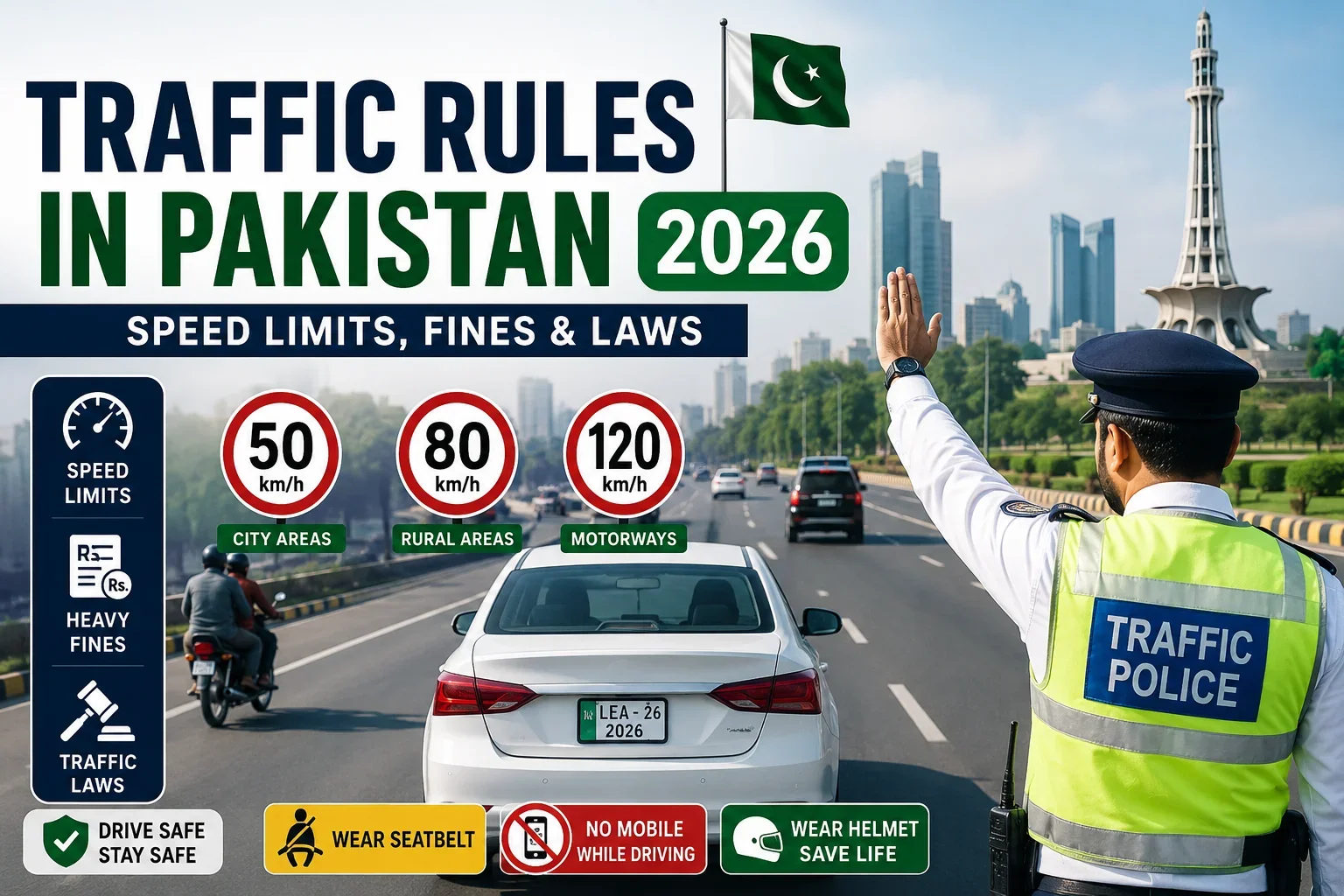
What Are the Main Traffic Rules in Pakistan in 2026?
1. Always Carry a Valid Driving Licence
Anyone driving a vehicle in Pakistan must have a valid driving licence appropriate for the type of vehicle being driven.
Drivers should also have the required vehicle documents available. Depending on the vehicle and its use, these may include registration documents, a fitness certificate, route permit or other legally required paperwork.
Driving without the appropriate licence can result in a traffic violation and financial penalty.
2. Obey Traffic Signals and Road Signs
Drivers must follow traffic lights, stop lines, road signs, lane markings and other traffic-control instructions.
This includes:
-
Stopping at red lights
-
Following one-way restrictions
-
Obeying stop signs and regulatory signs
-
Staying within marked lanes
-
Following temporary signs at construction sites
-
Giving way where required
Traffic-signal violations can result in fines, with the exact amount depending on the relevant jurisdiction and vehicle category.
3. Follow the Posted Speed Limit
Speed restrictions depend on the type of road, vehicle and location. General speed-limit guidance commonly cited for Pakistan includes:
| Road Type | Vehicle Type | General Speed Limit |
|---|---|---|
| Motorways | Cars/LTVs | 120 km/h |
| Motorways | HTVs/PSVs | 110 km/h |
| Highways | Cars/LTVs | 100 km/h |
| Highways | HTVs | 90 km/h |
| Urban arterial roads | All vehicles | 80 km/h |
| Residential and hilly areas | All vehicles | 50–70 km/h |
| Areas near schools, hospitals, colleges and mosques | All vehicles | 40 km/h |
These should be treated as general guidance rather than a substitute for road signs. A particular section of road may have a lower speed restriction because of construction, weather, traffic conditions or other safety concerns.
4. Maintain Proper Lane Discipline
Drivers should remain in the appropriate lane and use indicators before changing lanes or turning.
Avoid:
-
Sudden lane changes
-
Unnecessary weaving
-
Cutting between vehicles
-
Driving continuously in an overtaking lane
-
Changing lanes without signalling
On motorways and highways, overtaking is generally carried out from the right. Once the overtaking manoeuvre is complete, drivers should return to the appropriate cruising lane when safe to do so.
Good lane discipline reduces the risk of collisions and helps maintain a smooth traffic flow.
5. Wear a Seat Belt
Drivers and passengers should use seat belts whenever they are required.
The driver should ensure that the seat belt is fastened before the vehicle starts moving. Children should be secured using an appropriate seat belt or child-restraint system suitable for their age and size.
Seat-belt requirements and penalties can differ between jurisdictions, so drivers should follow the rules applicable in their area.
6. Motorcycle Riders Must Wear Helmets
Motorcycle riders should wear a properly fitted and securely fastened crash helmet.
In Punjab, the currently published traffic schedule includes a Rs. 2,000 penalty for riding a two-wheeler without a crash helmet.
Helmet requirements for passengers and the exact penalty may differ between cities and provinces. Riders should therefore follow the local traffic authority's requirements rather than assuming that the same rule applies everywhere.
7. Avoid Using a Handheld Mobile Phone While Driving
Using a handheld mobile phone while operating a vehicle can result in a traffic violation.
Drivers should not:
-
Hold a phone while driving
-
Send text messages
-
Browse social media
-
Watch videos
-
Make calls while manually holding the phone
If you need to make a call or send a message, stop at a safe and legally permitted location first.
Hands-free systems may be treated differently under applicable traffic rules, but drivers should still avoid anything that distracts them from the road.
8. Follow Parking and One-Way Restrictions
Drivers must park only where parking is permitted and should not obstruct traffic, pedestrian movement, entrances or emergency access.
They should also follow one-way road restrictions and never intentionally drive against the designated direction of traffic.
Parking violations can attract different penalties depending on the province, vehicle category and nature of the offence.
What Changed in Pakistan's Traffic Rules in 2026?
One of the most notable traffic-related developments in 2026 involved motorway and highway speed limits.
Speed limits were temporarily reduced as part of fuel-conservation measures. Those temporary restrictions were subsequently withdrawn, restoring the motorway limits generally used for cars/LTVs and PSVs/HTVs.
The currently restored general motorway limits are:
-
Cars/LTVs: 120 km/h
-
PSVs/HTVs: 110 km/h
However, motorists should always follow the speed displayed on roadside signs. Construction zones, weather conditions, traffic density and other circumstances can require a lower speed.
Most other developments during 2026 have focused on stricter enforcement, digital challans and province- or city-specific measures rather than the introduction of one completely new nationwide traffic code.
How Do Traffic Rules Differ Across Pakistan?
The basic principles of safe driving are broadly similar throughout the country, but traffic laws, fines and enforcement procedures can vary between jurisdictions.
Punjab
Traffic Police Punjab maintains its own traffic regulations, safety guidance and offence/penalty schedules. Drivers should check the latest provincial notifications when determining the applicable fine.
Sindh
Sindh Police uses the TRACS system for traffic citations and publishes information regarding traffic violations and penalties.
Khyber Pakhtunkhwa
Traffic authorities in Khyber Pakhtunkhwa publish traffic rules and fine information. Some published tables may represent proposed rather than finally notified penalties, so drivers should verify the current official position.
Balochistan
Traffic enforcement in Balochistan operates under the applicable provincial motor-vehicle laws and police regulations.
Islamabad
Islamabad Traffic Police separately administers and enforces traffic rules within the federal capital.
Motorways and National Highways
The National Highways & Motorway Police (NHMP) is responsible for traffic enforcement on designated national highways and motorways. Drivers must follow NHMP regulations as well as the speed limits and other restrictions displayed on the road.
What Are the Traffic Fines in Pakistan in 2026?
There is no single fine schedule covering every traffic violation throughout Pakistan. Penalties can differ according to the province, city, road type, vehicle category and issuing authority.
Some currently published examples include:
| Violation | Jurisdiction | Published Penalty |
|---|---|---|
| Riding a motorcycle without a helmet | Punjab | Rs. 2,000 |
| Using a handheld phone while driving | Punjab | Rs. 2,000–15,000 |
| Parking violation | Punjab | Rs. 2,000–15,000 |
| Driving without a licence | Sindh TRACS | Rs. 25,000 |
| Exceeding the prescribed speed limit | Sindh TRACS | Rs. 10,000 |
These amounts should not be interpreted as a nationwide fine table. Before relying on a particular penalty, check the authority and jurisdiction mentioned on the challan.
Important Documents for Drivers in Pakistan
Before driving, make sure you have the documents required for your vehicle and situation.
These may include:
-
Valid driving licence
-
Vehicle registration documents
-
Proof of insurance, where required
-
Token tax documentation
-
Fitness certificate for applicable vehicles
-
Route permit for applicable commercial/public-service vehicles
Requirements can differ depending on the vehicle type and province.
Basic Road-Safety Rules Every Driver Should Follow
Following traffic rules is about more than avoiding a challan. Drivers should also:
-
Keep a safe distance from other vehicles
-
Use indicators before turning or changing lanes
-
Slow down in crowded areas
-
Give priority to pedestrians where required
-
Avoid aggressive driving
-
Never drive while seriously distracted
-
Follow temporary road signs
-
Take extra care during fog, rain and poor visibility
-
Never exceed the speed shown on a local road sign
The safest approach is to follow the applicable traffic law even when enforcement appears limited.
Frequently Asked Questions
What is the motorway speed limit in Pakistan in 2026?
The generally restored motorway speed limit is 120 km/h for cars and LTVs and 110 km/h for PSVs and HTVs. However, a lower speed displayed on a particular section of motorway takes precedence.
Is a helmet mandatory for motorcycle passengers in Pakistan?
The requirements can vary by jurisdiction. Some cities have specific rules requiring helmets for both motorcycle riders and pillion passengers. Riders should check the traffic regulations applicable in their city or province.
Can I use my mobile phone while driving in Pakistan?
Drivers should not use a handheld mobile phone while operating a vehicle. Using a phone while driving can result in a traffic violation and can also significantly increase the risk of an accident.
Who has the right of way at an unmarked intersection?
Drivers should approach an unmarked intersection cautiously and give way according to the applicable traffic rules. At roundabouts, vehicles already circulating generally have priority over vehicles entering, unless signs or traffic signals indicate otherwise.
What documents should I have when driving in Pakistan?
Drivers should have a valid driving licence and the required vehicle documents. Depending on the vehicle, these can include registration documents, insurance evidence, token-tax documentation, fitness certificates and route permits.
Are traffic fines the same throughout Pakistan?
No. Traffic penalties are not uniform across the country. Punjab, Sindh, Khyber Pakhtunkhwa, Balochistan, Islamabad and roads controlled by NHMP can have different enforcement procedures and penalty schedules.
What should I do after receiving a traffic challan?
First check which traffic authority issued the challan and verify the violation, vehicle information and applicable penalty. Use the relevant official system or authorized payment channel to check and pay the challan.
Final Advice for Pakistani Drivers
Before starting your journey, make sure your driving licence and vehicle documents are valid. Wear the required safety equipment, obey traffic signals and road signs, follow the posted speed limit and maintain proper lane discipline.
Do not use a handheld phone while driving, and take extra care around schools, hospitals, residential areas, pedestrians and busy intersections.
Traffic fines can change over time, but safe driving principles remain the same: follow the signs, respect other road users and drive according to the conditions of the road.
Guide Information
Step-by-Step Process
-
# Steps to Follow Traffic Rules in Pakistan
-
Follow these simple steps before and during every journey:
-
### Step 1: Check Your Driving Licence
-
Make sure your driving licence is valid and covers the category of vehicle you are driving.
-
### Step 2: Check Your Vehicle Documents
-
Keep the required registration and other vehicle documents with you. Commercial vehicles may need additional documents such as fitness certificates or route permits.
-
### Step 3: Check Your Vehicle Before Driving
-
Before starting your journey, check the brakes, tyres, lights, indicators, mirrors and other important safety equipment.
-
### Step 4: Fasten Your Seat Belt or Wear a Helmet
-
Car occupants should use seat belts where required. Motorcycle riders should wear a properly fitted and securely fastened helmet.
-
### Step 5: Follow Traffic Signals
-
Obey red, yellow and green lights, stop lines, road signs and instructions from traffic officers.
-
### Step 6: Stay Within the Posted Speed Limit
-
Check the speed-limit signs and adjust your speed according to the road, traffic, weather and visibility conditions.
-
### Step 7: Maintain Lane Discipline
-
Stay in your designated lane, use indicators before changing lanes and avoid sudden or unnecessary lane changes.
-
### Step 8: Overtake Safely
-
Overtake only when it is legal and safe. On motorways and highways, follow the applicable overtaking rules and return to the appropriate lane after passing.
-
### Step 9: Keep Your Phone Away
-
Do not hold or operate a mobile phone while driving. If you need to make a call or send a message, stop somewhere safe and legally permitted.
-
### Step 10: Follow Parking Rules
-
Park only in permitted areas and make sure your vehicle does not block traffic, entrances, pedestrians or emergency access.
-
### Step 11: Follow One-Way Restrictions
-
Always drive in the permitted direction and never enter a one-way road from the wrong direction.
-
### Step 12: Be Extra Careful in Sensitive Areas
-
Reduce your speed and remain alert near schools, hospitals, mosques, residential areas, pedestrian crossings and busy intersections.
-
### Step 13: Follow Temporary Road Restrictions
-
Construction zones, diversions, fog, accidents and other conditions may result in temporary restrictions. Always follow the latest signs and instructions.
-
### Step 14: Check Your Challan if You Receive One
-
If you receive a traffic challan, verify the issuing authority, violation and applicable penalty before making payment.
-
### Step 15: Keep Safety as the Priority
-
Do not drive aggressively or take unnecessary risks simply to reach your destination faster. Following traffic rules protects you, your passengers and other road users.
Frequently Asked Questions
The main rules cover valid driving licences, traffic signals, speed limits, lane discipline, seat belts, motorcycle helmets, parking, overtaking, mobile-phone use and required vehicle documents.
Traffic rules help reduce accidents, control traffic movement, protect pedestrians and make roads safer for drivers, passengers and other road users.
The basic principles are similar, but traffic fines, enforcement procedures and some specific requirements can differ between provinces, cities and road authorities.
Traffic rules are enforced by provincial traffic police, Islamabad Traffic Police and the National Highways & Motorway Police on designated national highways and motorways.
Traffic police enforce road laws, manage traffic, issue challans, monitor violations and promote road safety.
NHMP stands for National Highways & Motorway Police. It is responsible for traffic enforcement and road safety on designated national highways and motorways.
The generally restored motorway limit is 120 km/h for cars and LTVs and 110 km/h for PSVs and HTVs, unless a lower limit is displayed.
The general motorway speed limit for cars is 120 km/h, subject to posted signs and temporary restrictions.
The generally applicable motorway limit for LTVs is 120 km/h, unless a lower limit is posted.
The general limit for HTVs is 110 km/h, although specific sections may have lower restrictions.
The generally restored limit for PSVs is 110 km/h, subject to road signs and applicable restrictions.
General guidance commonly places the highway limit at around 100 km/h for cars and LTVs and 90 km/h for HTVs, but drivers must follow the posted speed limit.
Urban speed limits vary according to the road and local authority. Major arterial roads may have higher limits than residential streets.
Lower speed restrictions can apply around schools. A commonly cited general guideline is 40 km/h, but the posted local speed limit always takes priority.
Speed restrictions may be reduced near hospitals and other sensitive locations. Drivers should follow the signs displayed on the road.
Yes. Authorities can impose temporary restrictions because of construction, fog, weather, traffic conditions or other safety concerns.
Yes. A specific posted speed limit takes priority over a general speed limit for that road category.
Overspeeding can result in a traffic challan and financial penalty. The amount depends on the jurisdiction, vehicle category and applicable traffic schedule.
Yes. Drivers must remain within the applicable speed limit and adjust their speed according to road and traffic conditions.
Yes. Anyone driving a motor vehicle must have the appropriate valid licence for the vehicle category being operated.
Drivers should not operate a vehicle with an expired licence. The licence should be renewed according to the applicable authority's requirements.
A licence must cover the appropriate vehicle category. A motorcycle licence should not be assumed to authorize driving a car.
Driving without the required licence is a traffic offence and can lead to a challan, fine or other legal consequences.
Drivers should carry a valid driving licence and the required vehicle documents. Depending on the vehicle, additional documents may be required.
Yes. Motor vehicles must be registered according to the applicable motor-vehicle laws.
Yes. Depending on the type and use of the vehicle, commercial and public-service vehicles may require documents such as fitness certificates and route permits.
A fitness certificate confirms that an applicable vehicle has met the required safety and operational standards.
A route permit is a required authorization for certain commercial or public-service vehicles to operate on specified routes.
Insurance requirements depend on the applicable law and vehicle type. Drivers should maintain any insurance documentation required for their vehicle.
Drivers must obey traffic lights, stop lines, road signs and instructions given by authorized traffic officers.
A red traffic light requires traffic to stop before the designated stop line and remain stopped until movement is permitted.
A yellow light generally indicates that the signal is changing. Drivers should slow down and stop when it is safe and required.
A green light generally permits vehicles to proceed when the way is clear and no other traffic restriction applies.
No. Drivers must obey traffic signals even when the road appears empty.
The penalty varies by jurisdiction and vehicle category. Drivers should check the current fine schedule of the authority that issued the challan.
Lane discipline means staying in the appropriate lane, following lane markings and using indicators when changing lanes or turning.
Proper lane discipline reduces sudden movements, improves traffic flow and lowers the risk of collisions.
Yes. Drivers should signal in advance before changing lanes and make sure the manoeuvre is safe.
Sudden lane changes are dangerous and should be avoided. Drivers should check surrounding traffic, signal and change lanes only when safe.
Overtaking is generally carried out from the right where permitted, subject to road signs and applicable traffic rules.
Drivers should follow the applicable overtaking rules and road markings. Overtaking should only be performed where it is safe and legally permitted.
The overtaking lane should not normally be treated as a permanent cruising lane. Drivers should return to the appropriate lane after overtaking when safe.
Check mirrors and blind spots, ensure there is sufficient visibility and space, signal appropriately and confirm that overtaking is permitted.
Unsafe or prohibited overtaking can result in a traffic violation and may cause serious accidents.
Seat-belt requirements depend on the applicable road and jurisdiction, but drivers and passengers should use seat belts whenever required and for safety.
Drivers and passengers should use the available seat belts according to applicable traffic requirements.
Children should be properly secured using an appropriate seat belt or child-restraint system suitable for their size and age.
A seat-belt violation can result in a traffic challan where the requirement is enforceable.
Motorcycle riders must follow the helmet requirements applicable in their jurisdiction. Wearing a properly secured helmet is an essential road-safety measure.
Punjab's currently published traffic schedule lists a Rs. 2,000 penalty for riding a two-wheeler without a crash helmet.
Passenger helmet requirements vary between jurisdictions. Riders should check the latest local traffic regulations.
Riders should use a properly fitted, approved crash helmet and secure it correctly before riding.
Drivers should not assume that a short journey is exempt from helmet requirements. The applicable helmet rule remains in force regardless of journey length.
Drivers should not use a handheld mobile phone while operating a vehicle because it is distracting and can constitute a traffic violation.
Drivers should never type or send messages while driving. If communication is necessary, stop in a safe and permitted location first.
Holding and operating a mobile phone while driving can result in a violation. It is safer to stop before making a call.
Hands-free systems may be treated differently from handheld phone use, but drivers must still avoid distraction and comply with local regulations.
Punjab's published traffic schedule includes penalties ranging from Rs. 2,000 to Rs. 15,000 depending on the vehicle category and offence.
Drivers should park only in permitted locations and must not block traffic, pedestrians, entrances, emergency access or areas where parking is prohibited.
Yes. Parking in a prohibited location or obstructing traffic can result in a challan and fine.
Punjab's current published schedule includes parking-related penalties ranging from Rs. 2,000 to Rs. 15,000 depending on the applicable vehicle category and offence.
Drivers should not park where parking is prohibited or where their vehicle could obstruct emergency access or hospital operations.
Drivers should not park on pedestrian areas or footpaths where parking is prohibited, as this can obstruct pedestrians and create safety risks.
Drivers must travel only in the direction permitted by one-way signs and road markings.
No. Driving against the designated direction of traffic is dangerous and can result in a traffic violation.
Drivers should follow signs, lane markings and traffic signals. Vehicles already circulating in a roundabout generally have priority over vehicles entering.
Drivers should approach carefully and follow the applicable priority rules. Where the relevant rule gives priority to traffic approaching from the right, that traffic should be given way.
Drivers must remain alert around pedestrians and give way where required by traffic signals, crossings and applicable road rules.
Slow down, remain alert and give pedestrians the required opportunity to cross safely.
Drivers should remain calm, avoid blocking the ambulance and provide a safe path when possible while following traffic rules and directions from traffic officers.
Drivers should give the emergency vehicle a safe and clear path where possible and follow the instructions of traffic officers.
Punjab has its own traffic enforcement system and published offence and penalty schedules.
Lahore follows Punjab's applicable traffic laws and traffic-police regulations, along with local road signs and restrictions.
Traffic Police Punjab is responsible for traffic enforcement in Lahore.
Karachi follows the applicable traffic laws and regulations enforced by Sindh's traffic authorities, along with local road signs and restrictions.
Sindh Police and its relevant traffic authorities are responsible for traffic enforcement in Karachi.
Islamabad follows the traffic regulations enforced by Islamabad Traffic Police and other applicable authorities.
Islamabad Traffic Police is responsible for traffic enforcement within the federal capital.
Traffic rules in Khyber Pakhtunkhwa operate under the applicable provincial laws and traffic authorities. Drivers should check the latest official notifications for current penalties.
Traffic regulations in Balochistan operate under the applicable provincial motor-vehicle framework and police regulations.
No. Fine amounts and enforcement procedures can differ between provinces and cities.
An e-challan is a digitally recorded or issued traffic ticket for a violation detected or recorded by the relevant traffic authority.
The checking process depends on the authority that issued the challan. Drivers should use the relevant official traffic-police or government platform.
Payment methods vary by jurisdiction. Drivers should use an official or authorized payment channel after verifying the challan information.
Depending on the system, you may need information such as the vehicle registration number, challan number, CNIC details or other requested information.
Contact the authority that issued the challan and follow its procedure for submitting a complaint, objection or request for review.
If you believe a challan was issued incorrectly, you can contact the relevant traffic authority and follow the applicable dispute or review process.
The currently published Sindh TRACS information lists Rs. 25,000 for driving without a licence. Drivers should verify the latest official information before relying on a specific amount.
Sindh TRACS currently lists Rs. 10,000 for exceeding the prescribed speed limit. The latest official traffic information should be checked for confirmation.
Drivers should obey traffic signals and signs, remain within the applicable speed limit, maintain control of their vehicle and follow all relevant road-safety requirements.
Check your licence and vehicle documents, tyres, brakes, lights, indicators, mirrors, fuel level and other essential safety equipment before starting your journey.
Make sure your motorcycle is roadworthy, check the brakes, tyres and lights, carry the required documents and wear a properly secured helmet.
Reduce speed, increase your following distance, use appropriate vehicle lights, remain alert and follow any temporary restrictions or instructions issued by the road authority.
Yes. Temporary speed limits, lane closures, diversions and other restrictions may be introduced during construction.
Drivers should follow lawful instructions from authorized traffic officers managing traffic, even when those instructions differ from the normal signal sequence.
Depending on the circumstances and applicable law, more than one violation may be recorded. The challan should identify the relevant offences.
Repeated violations can lead to additional fines or other legal consequences depending on the nature and frequency of the offences and the applicable law.
Follow the speed limit, obey signals, maintain lane discipline, carry valid documents, wear required safety equipment, park legally and avoid distracted or dangerous driving.
Stay within the posted speed limit, maintain a safe following distance, use lanes correctly, signal before manoeuvres, take breaks on long journeys and remain alert to changing road conditions.
Move the vehicle to a safe location if possible, use hazard lights, remain away from moving traffic and contact the appropriate motorway or emergency service for assistance.
No. Traffic rules exist primarily to improve road safety, reduce accidents, protect vulnerable road users and maintain orderly traffic movement.
Drivers should consult the official traffic authority responsible for their location, such as the relevant provincial traffic police, Islamabad Traffic Police or NHMP, because rules and penalties can change. licence and vehicle documents, wearing seat belts and helmets, following parking rules, and avoiding handheld mobile-phone use while driving. **Q: What is the speed limit on motorways in Pakistan in 2026?** **A:** The generally restored motorway speed limit is 120 km/h for cars and LTVs and 110 km/h for PSVs and HTVs. Drivers must follow a lower speed limit if one is displayed for a particular section. **Q: What is the speed limit on highways in Pakistan?** **A:** General speed limits can vary according to the road and vehicle category. A commonly cited guideline is 100 km/h for cars/LTVs and 90 km/h for HTVs on highways, but posted road signs always take priority. **Q: Is a driving licence mandatory in Pakistan?** **A:** Yes. Drivers must have a valid driving licence appropriate for the category of vehicle they are operating. **Q: Can I drive without a driving licence in Pakistan?** **A:** No. Driving without the required valid licence is a traffic offence and can result in a fine or other legal action. **Q: What documents should I carry while driving in Pakistan?** **A:** Drivers should have a valid driving licence and the required vehicle documents. Depending on the vehicle, additional documents may include registration papers, insurance evidence, token-tax documentation, fitness certificates and route permits. **Q: Is a vehicle registration certificate required in Pakistan?** **A:** Vehicles must be properly registered according to the applicable motor-vehicle laws. Drivers should keep the required registration documentation available when using the vehicle. **Q: Is wearing a seat belt mandatory in Pakistan?** **A:** Seat-belt requirements apply to drivers and, where applicable, passengers on notified roads and in specific jurisdictions. Drivers should always use seat belts for safety, regardless of whether enforcement is present. **Q: Is a helmet compulsory for motorcycle riders in Pakistan?** **A:** Motorcycle riders are required to follow applicable helmet regulations. A properly fitted and securely fastened crash helmet should be worn whenever riding a motorcycle. **Q: What is the fine for riding a motorcycle without a helmet in Punjab?** **A:** Punjab's currently published traffic offence schedule lists a Rs. 2,000 penalty for riding a two-wheeler without a crash helmet. **Q: Is a helmet required for motorcycle passengers in Pakistan?** **A:** Passenger helmet requirements can vary by city and province. Riders and passengers should follow the latest rules issued by their local traffic authority. **Q: Can I use my mobile phone while driving in Pakistan?** **A:** Drivers should not use a handheld mobile phone while driving. Using a phone can distract the driver and may result in a traffic violation and fine. **Q: What is the fine for using a mobile phone while driving in Pakistan?** **A:** The penalty depends on the jurisdiction and vehicle category. Punjab's current published schedule includes penalties ranging from Rs. 2,000 to Rs. 15,000 for the relevant mobile-phone offence. **Q: Can I use Bluetooth while driving in Pakistan?** **A:** Hands-free systems may be treated differently from handheld phone use, but drivers should ensure that using any device does not distract them from driving or violate local traffic regulations. **Q: What happens if I run a red light in Pakistan?** **A:** Running a red light or ignoring a traffic signal is a traffic offence. The applicable fine depends on the province, city and vehicle category. **Q: What are the traffic signal rules in Pakistan?** **A:** Drivers must obey red, yellow and green signals, stop lines and instructions from traffic officers. They should not enter an intersection when doing so would violate a signal or create a traffic hazard. **Q: What does a red traffic light mean in Pakistan?** **A:** A red light means drivers must stop before the designated stop line and should proceed only when permitted by the signal or an authorized traffic officer. **Q: What does a yellow traffic light mean?** **A:** A yellow signal generally warns drivers that the signal is changing. Drivers should slow down and stop where it is safe and required rather than accelerating through the intersection. **Q: What does a green traffic light mean?** **A:** A green signal generally permits traffic to proceed, provided the road is clear and there is no other sign, officer instruction or restriction requiring the driver to stop. **Q: What are the lane discipline rules in Pakistan?** **A:** Drivers should remain in the appropriate lane, use indicators before changing lanes, avoid unnecessary weaving and follow lane markings and road signs. **Q: Which side should you overtake from in Pakistan?** **A:** Overtaking is generally carried out from the right on roads where such manoeuvres are permitted. Drivers should always follow road markings, signs and local traffic regulations. **Q: Can I drive continuously in the overtaking lane on a motorway?** **A:** The overtaking lane should not normally be used as a permanent cruising lane. Once an overtaking manoeuvre is completed, drivers should return to the appropriate lane when it is safe. **Q: What are the parking rules in Pakistan?** **A:** Vehicles should be parked only where parking is permitted. Drivers should not block traffic, pedestrian routes, entrances, emergency access or areas where parking is prohibited by signs or markings. **Q: What is the fine for illegal parking in Pakistan?** **A:** Parking penalties vary by jurisdiction and vehicle category. Punjab's currently published schedule includes parking-related penalties ranging from Rs. 2,000 to Rs. 15,000. **Q: Can I park my car anywhere on a public road?** **A:** No. Parking is subject to local restrictions, road signs and traffic regulations. A vehicle should not be left where it obstructs traffic or creates a safety hazard. **Q: Is driving on the wrong side of a one-way road illegal in Pakistan?** **A:** Yes. Drivers must follow the designated direction of traffic on one-way roads and should never intentionally drive against the permitted direction. **Q: What are the rules for driving on a one-way road?** **A:** Drivers must travel only in the permitted direction, follow lane markings and signs, and avoid entering the road from an incorrect direction. **Q: Who has the right of way at a roundabout in Pakistan?** **A:** Vehicles already circulating in a roundabout generally have priority over vehicles entering it, unless traffic signals, signs or an authorized officer direct otherwise. **Q: Who has priority at an unmarked intersection in Pakistan?** **A:** Drivers should approach unmarked intersections carefully and give way according to the applicable traffic rules. Where the relevant rule gives priority to traffic approaching from the right, drivers must follow that requirement. **Q: What are the rules for pedestrians in Pakistan?** **A:** Drivers should remain alert around pedestrians, slow down where necessary and give way where required by traffic signals, crossings and applicable road rules. **Q: Are traffic rules the same throughout Pakistan?** **A:** The basic principles are similar, but fines, enforcement procedures and some specific requirements differ between Punjab, Sindh, Khyber Pakhtunkhwa, Balochistan, Islamabad and roads controlled by NHMP. **Q: Who enforces traffic rules in Punjab?** **A:** Traffic Police Punjab is responsible for enforcing traffic regulations in the relevant areas of Punjab. **Q: Who enforces traffic rules in Sindh?** **A:** Sindh Police and its relevant traffic authorities enforce traffic rules in Sindh, including the applicable traffic citation system. **Q: Who enforces traffic rules in Islamabad?** **A:** Islamabad Traffic Police is responsible for traffic enforcement within Islamabad. **Q: Who controls traffic on Pakistan's motorways?** **A:** The National Highways & Motorway Police (NHMP) is responsible for traffic enforcement on designated motorways and national highways. **Q: What is NHMP in Pakistan?** **A:** NHMP stands for National Highways & Motorway Police. It is responsible for enforcing traffic laws and promoting road safety on designated national highways and motorways. **Q: Are traffic fines the same in Punjab and Sindh?** **A:** No. Punjab and Sindh have their own traffic enforcement systems and published penalty schedules, so the fine for the same type of violation may differ. **Q: What is the fine for driving without a licence in Sindh?** **A:** The currently published Sindh TRACS information lists a Rs. 25,000 penalty for driving without a licence. Drivers should verify the latest official schedule before relying on a specific amount. **Q: What is the fine for overspeeding in Sindh?** **A:** Sindh TRACS currently lists a Rs. 10,000 penalty for exceeding the prescribed speed limit. The applicable amount should be verified against the latest official traffic information. **Q: What is an e-challan in Pakistan?** **A:** An e-challan is a digitally issued traffic violation ticket. Depending on the jurisdiction, traffic violations may be recorded and processed through an electronic system. **Q: How can I check my traffic challan in Pakistan?** **A:** The checking method depends on the authority that issued the challan. Drivers should use the relevant official traffic-police or government system and provide the requested vehicle or challan information. **Q: How can I pay a traffic challan in Pakistan?** **A:** Payment options depend on the issuing authority. Drivers should use an official or authorized payment method after verifying the challan details and amount. **Q: What should I do if I receive a wrong traffic challan?** **A:** Check the challan details carefully and contact the traffic authority that issued it. If the information is incorrect, follow that authority's procedure for submitting a complaint or requesting a review. **Q: Can traffic police stop a vehicle for a traffic violation?** **A:** Authorized traffic officers can stop vehicles for traffic enforcement and safety purposes. Drivers should follow lawful instructions and provide the required documents when requested. **Q: What should I do when an emergency vehicle approaches?** **A:** Drivers should remain alert and provide a safe path for emergency vehicles such as ambulances, fire engines and police vehicles when required, while following traffic officers' instructions. **Q: Are speed limits lower near schools and hospitals in Pakistan?** **A:** Specific lower limits may apply in sensitive areas. A commonly cited general guideline is 40 km/h near schools, colleges, hospitals and mosques, but drivers must follow the speed displayed on local road signs. **Q: Can construction zones have a lower speed limit?** **A:** Yes. Temporary restrictions can apply in construction zones and other hazardous areas. Drivers must follow the speed limit and instructions displayed on temporary road signs. **Q: Can weather conditions affect the speed limit?** **A:** Poor weather, fog and reduced visibility can require drivers to slow down significantly. On motorways and highways, drivers must follow any temporary restrictions or instructions issued by the relevant authority. **Q: What should I do before driving on a motorway in Pakistan?** **A:** Check your vehicle's condition, confirm that your documents are valid, fasten your seat belt, know the applicable speed limit, check fuel levels and make sure your tyres, lights, brakes and indicators are working properly. **Q: What is the most important traffic rule in Pakistan?** **A:** The most important principle is to drive safely and obey the traffic laws, road signs and instructions applicable to the road. This includes controlling speed, maintaining a safe distance, following signals and avoiding distracted or dangerous driving.