What Is the Difference Between a Hybrid and an Electric Vehicle?
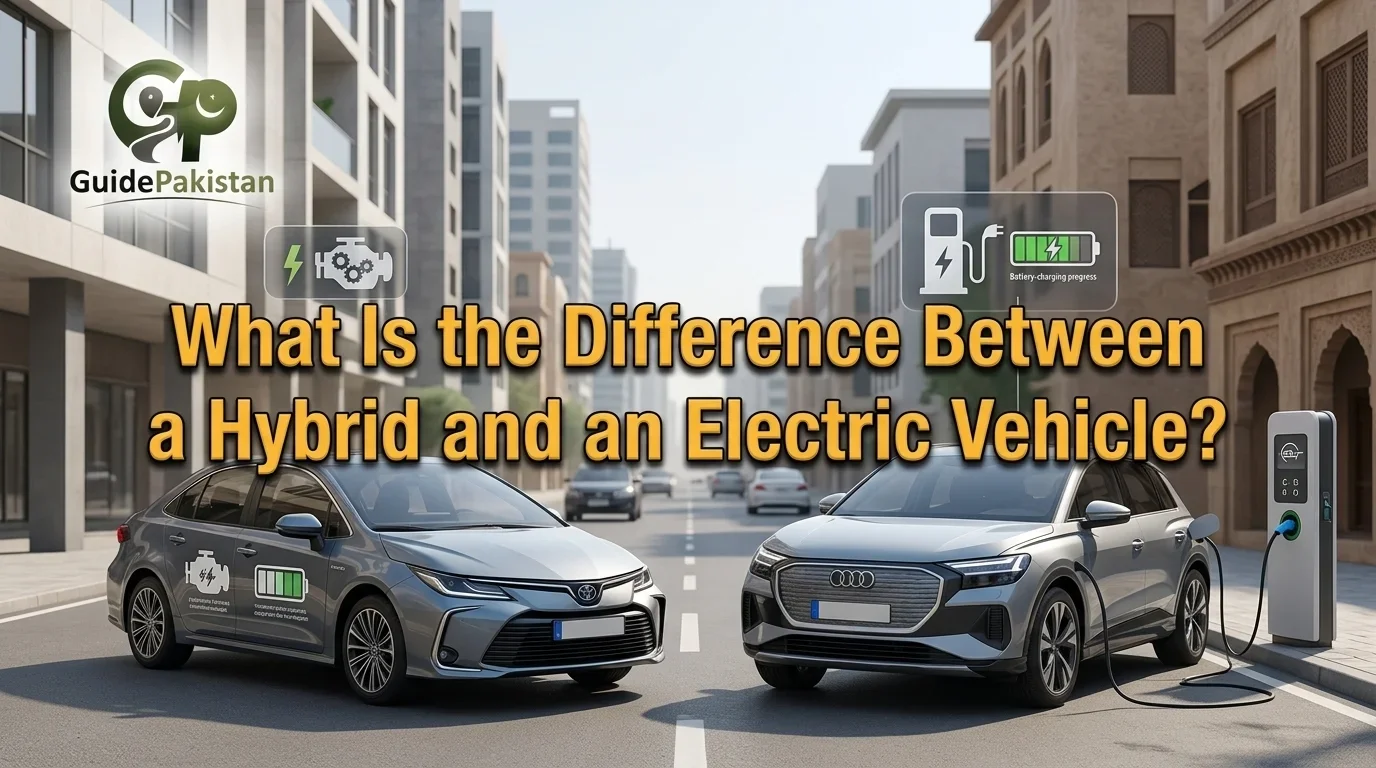
What Is the Difference Between a Hybrid and an Electric Vehicle?
Hybrid and electric vehicles are becoming increasingly common as drivers look for alternatives to traditional petrol and diesel cars. In Pakistan, interest in these vehicles is also growing as manufacturers, importers and policymakers expand the new-energy vehicle market.
Although both hybrid and electric vehicles use electric motors and batteries, they are not the same. The biggest difference is that a conventional hybrid still has a petrol engine, while a fully electric vehicle runs entirely on electricity.
Understanding this difference is important before buying a vehicle because the two technologies have different requirements for fuel, charging, maintenance, driving range and infrastructure.
What Is a Hybrid Vehicle?
A hybrid vehicle, commonly called a Hybrid Electric Vehicle (HEV), combines two sources of propulsion:
-
An internal combustion engine, normally powered by petrol
-
One or more electric motors powered by a battery
The vehicle's computer system manages the engine, electric motor and battery according to driving conditions.
A conventional hybrid does not normally need to be plugged into an external charger. Its battery is charged mainly through regenerative braking and by the vehicle's engine. Regenerative braking captures some of the energy that would otherwise be lost as heat during braking and stores it in the battery.
Depending on the hybrid design, the electric motor may help the petrol engine, operate the vehicle at low speeds for short periods, or provide additional power during acceleration.
How Does a Hybrid Work?
When a hybrid car starts or moves slowly, its electric motor may provide some or all of the propulsion, depending on the vehicle design.
When more power is required, the petrol engine starts and works with the electric motor. During braking or deceleration, the electric motor can operate as a generator and recover energy for the battery.
At a traffic light, some hybrid systems can automatically switch the petrol engine off. The engine can restart when the vehicle needs to move again.
This combination can reduce fuel consumption compared with a similar conventional petrol vehicle.
What Is an Electric Vehicle?
A fully electric vehicle is generally called a Battery Electric Vehicle (BEV). It uses:
-
A large rechargeable battery pack
-
One or more electric motors
-
Power electronics
-
A charging system
Unlike a conventional hybrid, a battery-electric vehicle does not have a petrol engine for propulsion.
The battery is charged by connecting the vehicle to an external electricity supply. The stored electrical energy then powers the electric motor.
Because there is no petrol engine, a fully electric vehicle has no direct tailpipe emissions while driving.
Hybrid vs Electric Vehicle: The Basic Difference
The simplest way to understand the difference is:
Hybrid vehicle = petrol engine + electric motor + battery
Fully electric vehicle = electric motor + battery, with no petrol engine
A conventional hybrid gets its energy from petrol and recovers electrical energy through regenerative braking. A fully electric vehicle gets its driving energy from electricity stored in its battery.
Comparison of Hybrid and Electric Vehicles
| Feature | Hybrid Vehicle (HEV) | Fully Electric Vehicle (BEV) |
|---|---|---|
| Petrol engine | Yes | No |
| Electric motor | Yes | Yes |
| Large traction battery | No, generally smaller | Yes |
| Petrol required | Yes | No |
| External charging | Normally no | Yes |
| Tailpipe emissions | Yes | No direct tailpipe emissions |
| Regenerative braking | Yes | Yes |
| Petrol station needed | Yes | No |
| Charging station needed | Normally no | Yes |
| Electric-only driving | Usually limited, depending on design | Yes |
| Engine maintenance | Required | No petrol engine maintenance |
| Long-distance operation | Can refuel with petrol | Requires charging planning |
| Energy source | Petrol + recovered electrical energy | Electricity |
The exact specifications vary by vehicle model and hybrid system, so buyers should always check the manufacturer's specifications before making a purchase.
What Is a Plug-In Hybrid?
A plug-in hybrid electric vehicle, or PHEV, sits between a conventional hybrid and a fully electric vehicle.
A PHEV has both:
-
A petrol or other internal-combustion engine
-
An electric motor
-
A larger battery than a conventional hybrid
-
An external charging port
Unlike a conventional HEV, a PHEV can be plugged into an external power source to charge its battery. It can then travel a certain distance using electricity before the petrol engine becomes necessary or is used by the vehicle's control system.
This makes the PHEV different from both a normal hybrid and a battery-electric vehicle.
For example, a driver might use electric power for shorter daily journeys and rely on the petrol engine for longer trips.
Hybrid vs Plug-In Hybrid vs Fully Electric
There are three terms that buyers commonly encounter:
1. Hybrid Electric Vehicle (HEV)
A conventional hybrid has a petrol engine and electric motor.
It normally cannot be plugged into an external charger. Its battery is charged through regenerative braking and the engine.
2. Plug-In Hybrid Electric Vehicle (PHEV)
A PHEV has a petrol engine and electric motor but also has a larger battery and an external charging port.
It can drive using electricity alone for a limited range, after which the petrol engine can provide propulsion.
3. Battery Electric Vehicle (BEV)
A BEV is a fully electric vehicle.
It has no petrol engine and depends on electrical energy stored in its battery.
Pakistan's New Energy Vehicles Policy 2025–30 uses the broader NEV category to cover technologies including BEVs, PHEVs, range-extended electric vehicles and fuel-cell electric vehicles. The policy document also sets different definitions for qualifying NEVs by vehicle category.
How Are the Batteries Different?
One of the major technical differences is battery size.
A conventional hybrid normally has a much smaller traction battery because its petrol engine remains an important source of propulsion. The battery mainly supports the electric motor and is repeatedly charged through the vehicle's energy-recovery system.
A fully electric car needs a much larger battery because the battery is the vehicle's primary energy source.
Most modern plug-in hybrids and battery-electric vehicles use lithium-ion battery technology, although battery chemistry and design vary between manufacturers and models.
Do Hybrid Cars Need Charging?
A conventional hybrid generally does not require external charging.
This is one of the biggest practical differences between a normal hybrid and a fully electric vehicle.
When the vehicle slows down, regenerative braking can recover some energy and store it in the battery. The engine can also help recharge the battery.
Therefore, the driver normally refuels a conventional hybrid with petrol rather than connecting it to a charger.
A plug-in hybrid is different because it has an external charging port.
Do Electric Vehicles Need Petrol?
No.
A battery-electric vehicle does not use a petrol engine for propulsion. It receives electricity from an external charging source and stores that energy in its battery.
The vehicle then uses the battery to power its electric motor.
This means an EV owner must consider access to suitable charging facilities before buying the vehicle.
What Is Regenerative Braking?
Regenerative braking is an important technology used in both hybrid and electric vehicles.
In a conventional car, much of the vehicle's kinetic energy is converted into heat through the braking system when the driver slows down.
In an electrified vehicle, the electric motor can operate as a generator during some braking and deceleration conditions. It can recover part of that energy and send it back to the battery.
Both HEVs and BEVs can use regenerative braking.
Fuel Cost Difference
A conventional hybrid still uses petrol, so its running cost remains partly connected to petrol prices.
However, the electric motor and energy-recovery system can improve efficiency and reduce fuel consumption compared with a similar conventional petrol vehicle.
A fully electric vehicle does not purchase petrol for propulsion. Its energy cost depends mainly on electricity consumption and the price of electricity used for charging.
The actual financial difference depends on the vehicle, electricity tariff, petrol price, driving style, annual mileage and charging arrangements.
For Pakistani buyers, these factors can vary significantly, so it is better to calculate the expected cost for the specific vehicle rather than assuming that every EV or hybrid will produce the same savings.
What About Maintenance?
A conventional hybrid still contains a petrol engine, transmission-related components and other systems associated with an internal-combustion vehicle.
As a result, it still requires engine-related maintenance.
A fully electric vehicle does not have a petrol engine, so it avoids many engine-related maintenance requirements.
However, an EV is not maintenance-free. It still has tyres, brakes, suspension, steering, electrical systems, cooling systems and other components that require inspection and servicing.
High-voltage components should be serviced by appropriately trained technicians. NHTSA advises that qualified technicians with EV-specific high-voltage training should work on high-voltage EV and hybrid systems.
Which Has Better Driving Range?
There is no universal answer because driving range depends on the vehicle model, battery size, fuel tank, driving conditions and driving habits.
A conventional hybrid can be refuelled with petrol, which makes long-distance travel relatively straightforward where petrol stations are available.
A battery-electric vehicle must be recharged when its battery becomes low.
Modern EVs can have substantial driving ranges, but actual range varies with speed, temperature, road conditions, driving style, load and use of heating or air conditioning.
For Pakistani drivers, the availability of charging facilities along the intended route can therefore be an important consideration.
Which Is More Convenient for Long Trips?
A conventional hybrid can be convenient for long-distance driving because it can be refuelled at a petrol station and does not normally depend on external charging.
An EV requires charging planning.
For a long journey, an EV driver should consider:
-
Starting battery charge
-
Destination distance
-
Available charging stations
-
Charger compatibility
-
Charging speed
-
Expected traffic and weather conditions
-
Possible detours
-
Availability of charging at the destination
This does not mean an EV cannot be used for long trips. It means that charging needs to be included in the journey plan.
Which Is Better for City Driving?
Both technologies can work well in city traffic.
Hybrid vehicles can benefit from frequent stopping and starting because regenerative braking can recover energy and some hybrid systems can switch the petrol engine off while the vehicle is stopped.
EVs can also benefit from regenerative braking and electric-drive efficiency in urban conditions. The U.S. Department of Energy notes that all-electric vehicles are generally more efficient in city driving than highway driving because frequent stops allow greater use of regenerative braking.
The actual result depends on the vehicle and driving conditions.
What Happens During a Power Outage?
This is an important practical consideration for EV owners.
If a home or charging location has no electricity, a vehicle normally cannot receive energy from that charger during the outage.
A conventional hybrid does not depend on an external charger for its traction battery, so its operation is less directly affected by the availability of household charging electricity.
This can be particularly relevant when considering an EV in an area where electricity supply or home-charging arrangements may be inconsistent.
However, the impact depends on the vehicle owner's charging routine and whether alternative charging facilities are available.
What About Charging Infrastructure in Pakistan?
Charging infrastructure is an important part of EV adoption in Pakistan.
Pakistan's Ministry of Industries & Production lists a New Energy Vehicles Policy 2025–30 among its policies. The policy document identifies charging infrastructure as a key part of the transition and discusses the development of a nationwide charging network.
The policy document proposes 3,000 charging stations by 2030 and discusses Level 2 and Level 3 charging infrastructure. These are policy targets rather than a guarantee that every location will have a charger available, so drivers should check the actual charging network in their area before purchasing an EV.
Environmental Difference
A conventional hybrid still burns petrol, so it produces tailpipe emissions.
A battery-electric vehicle has no direct tailpipe emissions while driving.
However, comparing environmental impact is more complicated than simply looking at the exhaust pipe. Electricity generation can itself involve emissions, and manufacturing batteries and vehicles also has environmental impacts.
The U.S. Department of Energy notes that life-cycle emissions involve fuel production, electricity generation, vehicle manufacturing and end-of-life considerations, not just tailpipe emissions.
Therefore, it is more accurate to say that a BEV has zero direct tailpipe emissions rather than claiming that an EV has absolutely no environmental impact.
Hybrid Vehicle Advantages
A conventional hybrid can offer several practical benefits:
No Regular External Charging
A normal HEV does not need to be connected to a charger.
Petrol Refuelling
The vehicle can continue using petrol infrastructure for refuelling.
Improved Fuel Efficiency
The electric motor, regenerative braking and engine-management system can reduce fuel consumption compared with comparable conventional vehicles.
Familiar Driving Experience
A hybrid still has a petrol engine, which may make the transition easier for drivers who are accustomed to conventional cars.
Useful for Long Journeys
The ability to refuel with petrol can reduce concerns about finding charging facilities during long-distance travel.
Hybrid Vehicle Disadvantages
Hybrids also have limitations:
-
They still require petrol.
-
They still produce tailpipe emissions.
-
They contain both an engine and an electric-drive system.
-
Their traction battery is smaller than that of a BEV.
-
They still require engine-related servicing.
-
The vehicle can be more technically complex than a conventional petrol car.
Electric Vehicle Advantages
A fully electric vehicle offers different benefits:
No Petrol Engine
There is no internal-combustion engine.
No Direct Tailpipe Emissions
A BEV produces no direct exhaust emissions while driving.
Electric-Only Operation
The vehicle is powered by its battery and electric motor.
Regenerative Braking
Electric vehicles can recover some energy during braking and deceleration.
Less Engine-Related Maintenance
Because there is no petrol engine, many engine-specific maintenance tasks are eliminated.
Home Charging Potential
An EV can potentially be charged at home if the vehicle and electrical installation support appropriate charging equipment.
Electric Vehicle Disadvantages
Potential limitations include:
-
Dependence on charging infrastructure
-
Need to plan longer journeys around charging
-
Charging time
-
Higher initial purchase price for some models
-
Battery performance can be affected by temperature and driving conditions
-
High-voltage systems require qualified service personnel
-
Battery replacement can be a major consideration if the vehicle eventually requires a new traction battery
Battery life varies by vehicle and operating conditions. NHTSA notes that battery packs can potentially last the lifespan of a vehicle, but several factors influence battery longevity.
Is a Hybrid an Electric Vehicle?
This depends on how the term "electric vehicle" is being used.
Technically, hybrid vehicles use electric-drive technology and are often grouped with electrified vehicles. However, when people say "EV" in the automobile market, they commonly mean a fully battery-electric vehicle.
A conventional hybrid still has a petrol engine.
A BEV does not.
That distinction is important when reading vehicle advertisements and specifications.
Is a Hybrid Better Than an EV?
There is no single answer that applies to every driver.
The two technologies are designed around different operating requirements.
A conventional hybrid may be suitable for someone who wants improved fuel efficiency while continuing to use petrol stations and avoiding regular external charging.
A fully electric vehicle may suit someone who has reliable access to charging and wants a vehicle that operates entirely on electricity.
The right choice depends on factors such as:
-
Daily driving distance
-
Annual mileage
-
Availability of home charging
-
Availability of public chargers
-
Long-distance travel
-
Petrol prices
-
Electricity tariffs
-
Vehicle purchase price
-
Maintenance arrangements
-
Local service availability
-
Battery warranty
-
Resale considerations
-
Personal driving habits
What Should Pakistani Buyers Check Before Buying?
Anyone considering a hybrid or EV in Pakistan should look beyond the advertised fuel economy or electric range.
Check the following:
1. Vehicle Type
Confirm whether it is:
-
HEV
-
PHEV
-
BEV
Do not assume that every vehicle described as "electric" is fully electric.
2. Battery Warranty
Check the manufacturer's battery warranty, including its duration, mileage limits and conditions.
3. Service Network
Find out whether qualified technicians and genuine parts are available in your city.
4. Charging Requirements
For an EV or PHEV, check what charger the vehicle requires and whether you can install or access one.
5. Real-World Range
Do not rely solely on a manufacturer's maximum claimed range. Driving conditions affect actual range.
6. Flood and Water Exposure
High-voltage vehicle systems require special precautions after flooding or severe water exposure. NHTSA warns that flooded hybrid and electric vehicles can present high-voltage hazards.
7. Import and Registration Rules
If buying an imported vehicle, verify the current import, registration, taxation and other applicable requirements with the relevant Pakistani authorities before purchasing.
8. Resale Market
Consider whether there is an established market for the particular model in your area.
Hybrid or EV for Daily Commuting?
For a person who drives mainly within a city, both can be practical.
A hybrid may be convenient where charging infrastructure is limited.
An EV may be particularly convenient when the driver has reliable home or workplace charging and a predictable daily route.
For example, someone who travels a moderate distance each day and can charge overnight may find an EV's operating pattern straightforward.
Someone who regularly travels between cities and does not have dependable access to charging may place greater importance on the flexibility of a hybrid.
Hybrid or EV for Long-Distance Travel?
A conventional hybrid has an important practical advantage: petrol can be added quickly at an available fuel station.
An EV requires sufficient battery charge and suitable charging infrastructure.
For EV owners, route planning is therefore more important on longer journeys.
However, the situation will continue to depend on how Pakistan's charging infrastructure develops and on the charging capabilities of individual vehicles.
Hybrid or EV: Understanding the Cost Properly
The purchase price is only one part of the total cost of ownership.
A useful comparison should include:
Purchase price + registration/import-related costs + financing cost + energy/fuel cost + maintenance + insurance where applicable + tyres + expected battery-related costs + resale value.
For a hybrid, fuel consumption is a major operating consideration.
For an EV, electricity consumption and charging arrangements become more important.
A lower purchase price does not automatically mean a lower long-term cost, and a more expensive vehicle does not automatically produce greater savings.
The calculation should be based on the actual model, expected mileage and local costs.
Hybrid and EV Safety
Both hybrid and electric vehicles contain high-voltage electrical systems.
This does not mean that normal drivers should be afraid of them, but it does mean that high-voltage components should not be opened or repaired by untrained people.
NHTSA recommends using qualified technicians with appropriate high-voltage training and specialized equipment for servicing these systems.
After a serious crash, fire or flood, the vehicle should be assessed according to the manufacturer's safety procedures and by appropriately qualified personnel.
Final Takeaway
The difference between a hybrid and an electric vehicle is mainly the presence of a petrol engine.
A conventional hybrid combines a petrol engine with an electric motor and battery. It normally does not need to be plugged in because its battery is charged through regenerative braking and the engine.
A fully electric vehicle uses a battery and electric motor without a petrol engine. It must be charged from an external electricity source.
A plug-in hybrid combines both approaches: it has a petrol engine and electric motor, but its larger battery can also be charged externally.
For Pakistani buyers, the choice should be based on actual driving needs, access to charging, long-distance travel, petrol and electricity costs, after-sales support, battery warranty and the availability of suitable infrastructure.
Pakistan's current New Energy Vehicles Policy 2025–30 also shows that charging infrastructure, vehicle standards, battery safety and the wider NEV ecosystem are important parts of the country's transition toward new-energy transportation.
Because vehicle technology, prices, import rules, incentives and charging infrastructure can change, buyers should verify the latest model-specific and government information before purchasing a vehicle.
Guide Information
Eligibility
This guide is informational and is relevant to anyone researching, comparing, buying, importing, owning or operating a hybrid, plug-in hybrid or fully electric vehicle. It is particularly useful for Pakistani drivers comparing vehicle technologies and considering charging availability, fuel costs and maintenance requirements.
Required Documents
No specific documents are required to read or use this informational guide. If purchasing, importing or registering a vehicle in Pakistan, the documents required depend on the applicable transaction, vehicle type, registration authority and current government rules. Buyers should verify the latest requirements with the relevant authority or authorized dealer.
Fees
There is no fee for using this informational guide. Vehicle prices, registration charges, import duties, taxes, charging costs, insurance and other ownership expenses vary by vehicle, location, purchase method and applicable government rules. Verify current charges before purchasing or importing a vehicle.
Processing Time
Not applicable to this informational guide. Vehicle purchase, import, registration, financing, charging installation and servicing have separate timelines that vary by provider, authority and circumstances.WHEN TO APPLY:Not applicable. This is an informational comparison rather than an application service. Anyone planning to purchase or import a vehicle should check the latest applicable government rules, manufacturer information, prices and infrastructure before making a decision.
Application Method
Not applicable. The guide provides general informa
Validity Period
Not applicable. This is an informational guide. Vehicle specifications, prices, government policies,
Step-by-Step Process
- Understand what a hybrid vehicle means.
- Understand what a battery-electric vehicle means.
- Learn the difference between an HEV and a BEV.
- Understand that a conventional hybrid has a petrol engine.
- Understand that a BEV does not have a petrol engine.
- Learn how a hybrid battery receives energy.
- Learn how an EV battery is charged.
- Understand regenerative braking.
- Identify whether a vehicle is an HEV, PHEV or BEV.
- Check the manufacturer's official vehicle specifications.
- Confirm whether the vehicle requires petrol.
- Confirm whether the vehicle has an external charging port.
- Check the battery capacity where the manufacturer provides it.
- Check the manufacturer's stated electric driving range for an EV or PHEV.
- Consider that real-world range can differ from advertised figures.
- Calculate your normal daily driving distance.
- Identify whether you regularly travel between cities.
- Check whether home charging is possible if considering an EV or PHEV.
- Check the electrical requirements of the proposed charging equipment.
- Identify public charging facilities available on your regular routes.
- Check charger compatibility before purchasing an EV or PHEV.
- Compare the charging speed supported by the vehicle.
- Check the vehicle's battery warranty.
- Check the manufacturer's warranty conditions.
- Identify authorized service centres in your area.
- Ask whether technicians are trained to work on high-voltage systems.
- Compare expected fuel consumption for a hybrid with a conventional petrol vehicle.
- Estimate electricity costs for an EV based on expected mileage and charging arrangements.
- Include maintenance costs when comparing vehicles.
- Consider tyre, brake, suspension and other routine vehicle costs.
- Check applicable registration requirements before buying.
- Check applicable import and tax rules if considering an imported vehicle.
- Verify any current government incentives directly from official sources.
- Consider the availability of replacement parts for the selected model.
- Check the vehicle's expected resale market in your area.
- Consider how electricity availability may affect your charging routine.
- Consider how petrol availability affects a hybrid's long-distance flexibility.
- Review safety instructions for the selected vehicle.
- Do not attempt to service high-voltage components without appropriate training.
- Check manufacturer instructions after a serious accident or flood.
- Compare the total cost of ownership rather than only the purchase price.
- Review the latest Pakistani NEV policy information before purchasing if government incentives or regulations are relevant.
- Confirm the vehicle's exact model and powertrain with the seller.
- Ask the seller whether the vehicle is HEV, PHEV or BEV.
- Confirm whether the vehicle can be externally charged.
- Confirm what type of fuel, if any, the vehicle uses.
- Compare the vehicle's specifications with your normal driving needs.
- Check the availability of charging or fuel infrastructure in the locations where you normally travel.
- Obtain current purchase and ownership costs from an authorized source.
- Verify all changeable government, tax, registration and incentive information before completing the purchase.
Official Information
Official Website: https://www.nhtsa.gov/
Contact: For Pakistan's new-energy vehicle policy framework, readers should consult the Ministry of Industries & Production through its official website. For a specific vehicle, contact the vehicle manufacturer's authorized dealer or official representative. For registration and other regulatory matters, contact the relevant government authority applicable to the vehicle and location.
Frequently Asked Questions
A conventional hybrid uses both a petrol engine and an electric motor, while a fully electric vehicle uses an electric motor powered by a battery and has no petrol engine.
Yes. A conventional hybrid uses petrol to operate its internal-combustion engine.
A fully battery-electric vehicle does not use petrol for propulsion.
A conventional hybrid normally does not need external charging. Its battery is charged through regenerative braking and the vehicle's engine.
Yes. A battery-electric vehicle needs to be connected to an external electricity source to recharge its traction battery.
HEV stands for Hybrid Electric Vehicle. It combines an internal-combustion engine with an electric motor and battery.
BEV stands for Battery Electric Vehicle. It is powered entirely by electricity stored in a battery.
PHEV stands for Plug-In Hybrid Electric Vehicle. It has a combustion engine and electric motor and can also charge its battery from an external power source.
No. A PHEV has a larger battery and an external charging port, while a conventional HEV normally cannot be plugged in.
In everyday vehicle discussions, EV often refers to a fully electric vehicle. BEV is the more specific term for a battery-electric vehicle.
A conventional hybrid mainly uses regenerative braking and energy from its engine to recharge its battery.
It is a system that can recover some of the vehicle's energy during braking and store it in the battery.
Some full hybrids can drive using electric power alone for limited distances or under particular conditions. Mild hybrids generally cannot propel the vehicle using electricity alone.
Yes. A battery-electric vehicle is designed to operate without a petrol engine.
A fully electric vehicle generally has a much larger traction battery than a conventional hybrid.
A fully electric vehicle needs external charging. A conventional hybrid normally does not, while a PHEV can use external charging.
Yes. A conventional hybrid uses petrol and can be refuelled at petrol stations.
Yes, provided the vehicle, charging equipment and home's electrical installation support the required charging arrangement.
No. A conventional HEV normally does not have an external charging system. PHEVs do have external charging capability.
A conventional hybrid produces tailpipe emissions because it has a combustion engine. A fully electric vehicle has no direct tailpipe emissions.
A BEV has no direct tailpipe emissions, but electricity generation and vehicle manufacturing can have environmental impacts.
Both can be effective in city driving. Hybrids can benefit from regenerative braking and engine stop-start operation, while EVs can benefit from electric-drive efficiency and regenerative braking.
There is no universal answer. A hybrid can refuel with petrol, while an EV requires suitable charging planning for longer journeys.
Long journeys may require more planning because the driver needs to consider battery charge and available charging facilities.
Yes. A conventional hybrid still has a combustion engine and therefore retains many engine-related maintenance requirements.
Yes. EVs still require maintenance of tyres, brakes, suspension, steering, electrical systems and other components, even though they do not have a petrol engine.
High-voltage EV and hybrid systems require appropriate training and specialized equipment. Unqualified people should not attempt high-voltage repairs.
A vehicle affected by flooding should be handled according to the manufacturer's safety guidance and assessed appropriately because damaged high-voltage systems can present hazards.
Yes. Hybrid vehicles also contain high-voltage systems, so flooding can create safety risks.
Temperature and use of heating or cooling systems can affect EV energy consumption and driving range.
Yes. Driving conditions, speed, acceleration, load and other factors can affect actual electric range.
They can have lower energy and some maintenance costs, but the actual total cost depends on vehicle price, electricity tariffs, charging arrangements, maintenance and other expenses.
Not necessarily. Purchase prices and running costs vary significantly by model, market and equipment.
The suitable choice depends on individual circumstances, including charging access, daily mileage, long-distance travel, vehicle price, service availability and local infrastructure.
Yes. Buyers should consider the availability of compatible charging facilities at home, work and along frequently used routes.
The Ministry of Industries & Production lists a New Energy Vehicles Policy 2025–30 among its policies, covering the broader new-energy vehicle ecosystem.
The policy document distinguishes among different technologies. For certain four-wheeler categories, PHEVs can qualify under the policy's NEV definition subject to specified conditions.
No. A conventional hybrid still relies on a combustion engine, while a fully electric vehicle does not.
Check the exact powertrain, fuel consumption, battery warranty, service network, parts availability, purchase cost and expected resale market.
Check battery warranty, real-world range, charging compatibility, charging availability, service support, purchase price and applicable registration or import requirements.
No. A proper comparison should consider purchase price, financing, fuel or electricity, maintenance, insurance, registration, battery considerations and resale value.
Yes. Regenerative braking can recover energy and store it in the hybrid battery.
Yes. Battery-electric vehicles can use regenerative braking to recover some energy during deceleration.
Yes. A plug-in hybrid has a combustion engine and can continue operating with fuel when electric-only operation is not sufficient.
Yes. Its larger battery allows electric-only operation for a limited range, depending on the vehicle.
No. Charging speed varies by vehicle, charger, electrical supply, battery condition and other factors.
No. Range varies by battery size, vehicle design, speed, temperature, road conditions, driving style and other factors.
No. Claimed range is useful for comparison, but real-world range can differ depending on driving conditions.
The Ministry of Industries & Production is the appropriate official government source for Pakistan's national NEV policy information.